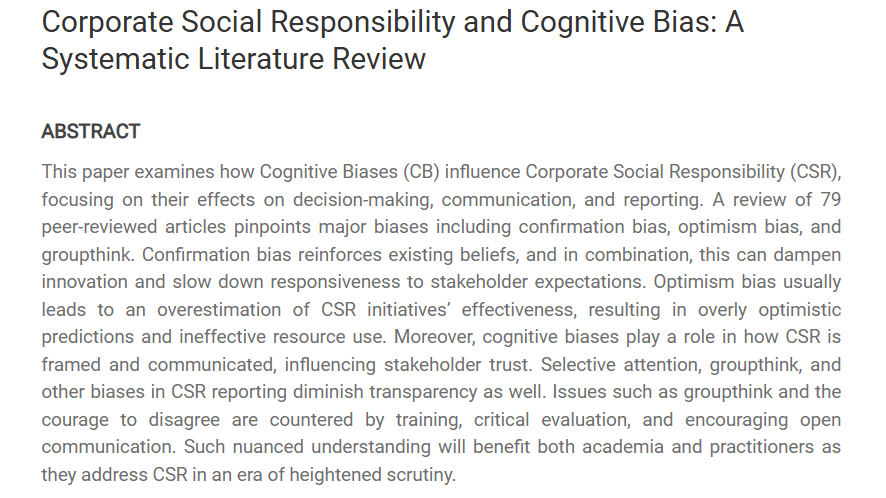
This paper explored how Cognitive Biases (CB) influence Corporate Social Responsibility (CSR) via review of 79 studies.
Have skipped a lot.
Findings:
· CB “have a significant impact on three key areas of CSR: decision-making, communication and perception, and reporting and evaluation”
· In decision-making, confirmation bias and optimism are important where decision makers “seek information that aligns with their existing beliefs, which can hinder innovation”
· “optimistic bias causes organizations to overestimate the success of their CSR initiatives, creating unrealistic expectations and insufficient contingency plans”, and a misallocation of resources
· For comms, “CB affects how CSR initiatives are communicated to stakeholders”, like the availability heuristic where “stakeholders focus mainly on easily remembered CSR activities, forgetting those that offer long-term benefits”
· Organisations “often overestimate how well stakeholders understand their CSR messages, leading to a false sense of transparency and potential misunderstandings”
· For reporting and eval, “biases such as selective attention and groupthink often influence practices” where “companies can focus on positive outcomes while ignoring failures, which ultimately reduces transparency and can lead to accusations of greenwashing”
· “how groupthink can hinder critical evaluation in corporate boards, leading to strategies that do not effectively tackle the complex challenges related to CSR”

More specific findings:
· Confirmation bias occurs when decision-makers “assign a preference to information that they consider highly according to their beliefs. This not only obscures innovation processes but also causes old and obsolete systems to persist”
· E.g. traditional CSR initiatives are believed to effectively enhance reputation, thereby “may overlook new evidence indicating that more innovative strategies could have a greater impact”
· Optimism bias where “organizations often misjudge the effectiveness of their CSR strategies due to optimism bias. Overconfident executives tend to display a heightened sense of optimism, believing that favorable outcomes are more likely than unfavorable ones”
· “overconfident CSR projects are the source of underinvestment and overbuilding of business facilities that result in the waste of the resources needed for genuine impact”
· Anchoring bias refers to “the propensity to refer to basic information during decision making. This process can hinder the ability to adapt and have optimal results”
· E.g. “dependence on historical benchmarks can obstruct organizations from seizing new opportunities for innovation in CSR. By sticking to old models, companies risk becoming stagnant and unable to adapt to the changing landscape”
· Framing effects have the “characteristic of influencing the level of perception of stakeholders. The presentation of CSR initiatives can have a huge impact on public support”
· Illusion of Transparency where “Organizations often misjudge how well stakeholders grasp their CSR messages”
· E.g. “stakeholders’ skepticism increases whenever they perceive unclear communication in CSR”

· For biases influencing CSR reporting and eval, selective attention is important where “companies often highlight positive results without considering challenges, which leads to an unrealistic picture of CSR performance”
· E.g. “such practices can undermine stakeholder trust and lead to accusations of greenwashing, as organizations strive to meet their stakeholders’ expectations of authenticity and transparency”
· Groupthink is also important, where “boards of directors which can negatively influence the critical evaluation of CSR strategies”
· E.g. “groupthink often leads to poor decisions by discouraging divergent opinions”
· The “concept of morality poses a significant challenge; this bias allows companies to justify unethical practices after achieving positive CSR results”
· E.g. “previous actions can create a moral and psychological justification, which allows individuals or organizations to adopt less ethical behavior without guilt. Potentially damaging to public trust when discrepancies arise between stated CSR values and current practices”
For moving forward, they argue:
· The need for transparency, critical evaluation and ethical integrity into effective CSR reporting & eval
· Need for strong and independent governance structures and control systems
· Third-party stakeholder engagement forums to “test the clarity and resonance of CSR messaging”
· Multi-level feedback loops and structured stakeholder surveys to “uncover discrepancies between managerial intent and external perception”
· “CSR communication protocols should incorporate checklists or structured message frameworks to ensure balanced reporting and prevent the selective presentation of only favorable outcomes (availability heuristic)”
· “Periodic communication audits can reinforce accountability and reduce reputational risks associated with misleading CSR narratives”

Shout me a coffee (one-off or monthly recurring)
Study link: https://doi.org/10.20900/jsr20250043
Safe AS LinkedIn group: https://www.linkedin.com/groups/14717868/

 SafetyInsights.org