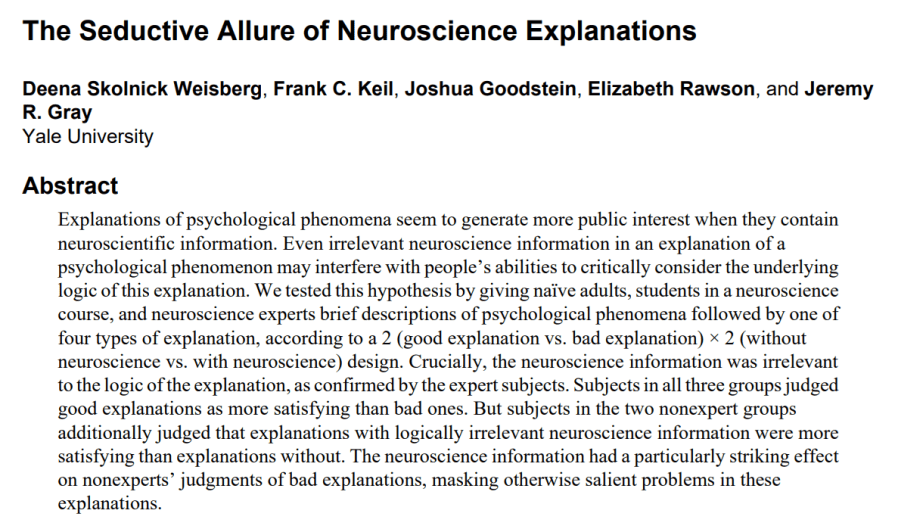
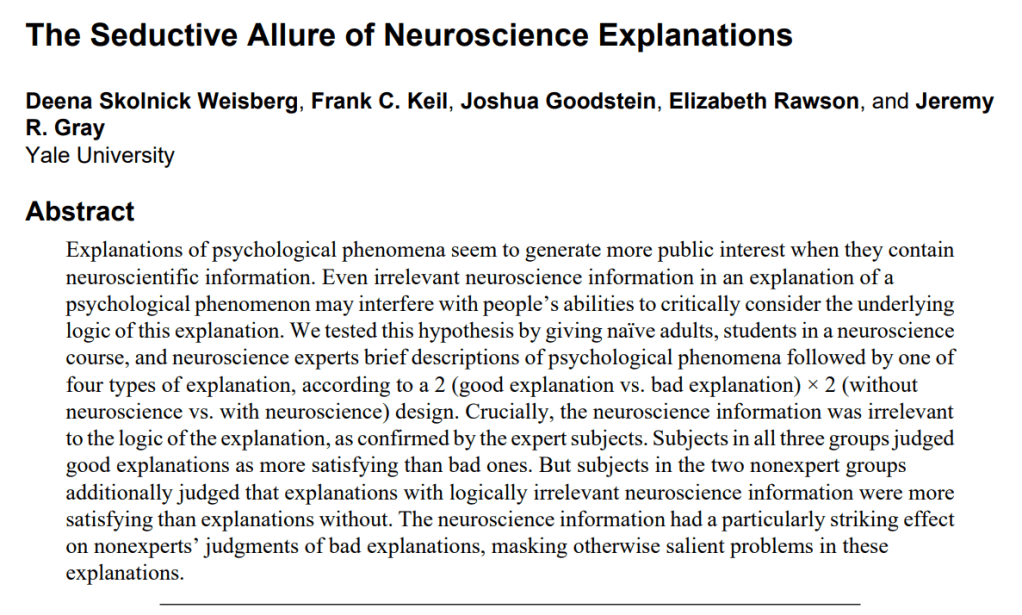
This was an interesting little study. It looked at the phenomenon of how psychological explanations seem to generate more public interest when they contain neuroscientific information. This includes even irrelevant info in an explanation may interfere with people’s abilities to comprehend the underlying logics of the information.
The authors proposed that neuroscience information in explanations may interfere with people’s ability to judge the quality of the explanations, where the presence of neuroscience information “may be seen as a strong marker of a good explanation, regardless of the actual status of that information within the explanation”, leading to people believing that they’ve seen a sound scientific argument when they haven’t and that neuroscience info was irrelevant to the explanation.
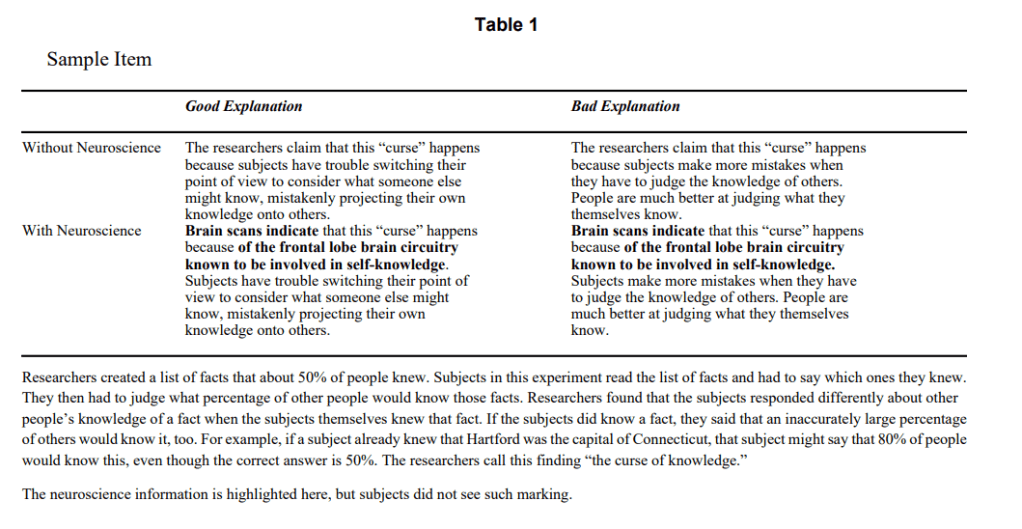
This study tested the hypothesis that neuroscience information can interfere with the interpretation of explanations. They had naïve adults, students in a neuroscience course, and neuroscience experts read brief psychology phenomena explanations, with a good and bad condition, and with neuroscience and without neuroscience information. The experiments explored just how adding “scientific-sounding” but empirically and conceptually uninformative neuroscience info impacts the interpretation of the explanations.
I’ve long had concerns about how neuroscience findings are positioned in arguments and so I found this quite cool.
Note: I haven’t fully summarised this study.
Findings:
The study found that, as expected, subjects in all three groups (i.e. naïve adults, students, experts) found ‘good’ explanations as more satisfying than the bad ones.
More interestingly, the subjects in the two nonexpert groups judged the explanations with “logically irrelevant neuroscience information [as] more satisfying than explanations without” (p470). Furthermore, as quoted in the paper the “neuroscience information had a particularly striking effect on nonexperts’ judgments of bad explanations, masking otherwise salient problems in these explanation” (p470).
The findings suggest that people systematically misunderstand the role that neuroscience should and should not play in explaining psychological explanations, where “logically irrelevant neuroscience information can be seductive”, having a greater impact on participants’ judgements than it should.
Whereas novices and neuroscience students rated bad explanations with neuroscience info as more satisfying, the experts didn’t. In contrast, experts rated good explanations *without* neuroscience info as more satisfying than good explanations with that info.
The authors then spend time exploring why nonexperts may be fooled, which I’ve not summarised.
Authors: Deena Skolnick Weisberg, Frank C. Keil, Joshua Goodstein, Elizabeth Rawson, Jeremy R. Gray, 2008, Journal of Cognitive Neuroscience.
Study link: https://doi.org/10.1162/jocn.2008.20040
Link to the LinkedIn article: https://www.linkedin.com/pulse/seductive-allure-neuroscience-explanations-ben-hutchinson

 SafetyInsights.org