“Calm down, you’re being emotional”.
Maybe I’m exaggerating this, but it seems like ‘being emotional’ is sometimes used more like a slur or weakness to avoid, rather than an observation of reality.
I’ve recorded a couple of pods which challenge this idea:
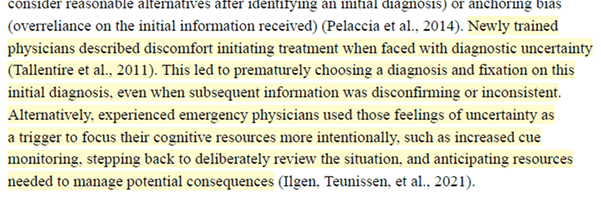
1. Image 1 highlights how being connected to feelings of uncertainty, how we feel about the issue, can help sensitise experienced emergency physicians to trigger more intentional focus on reviewing the situation
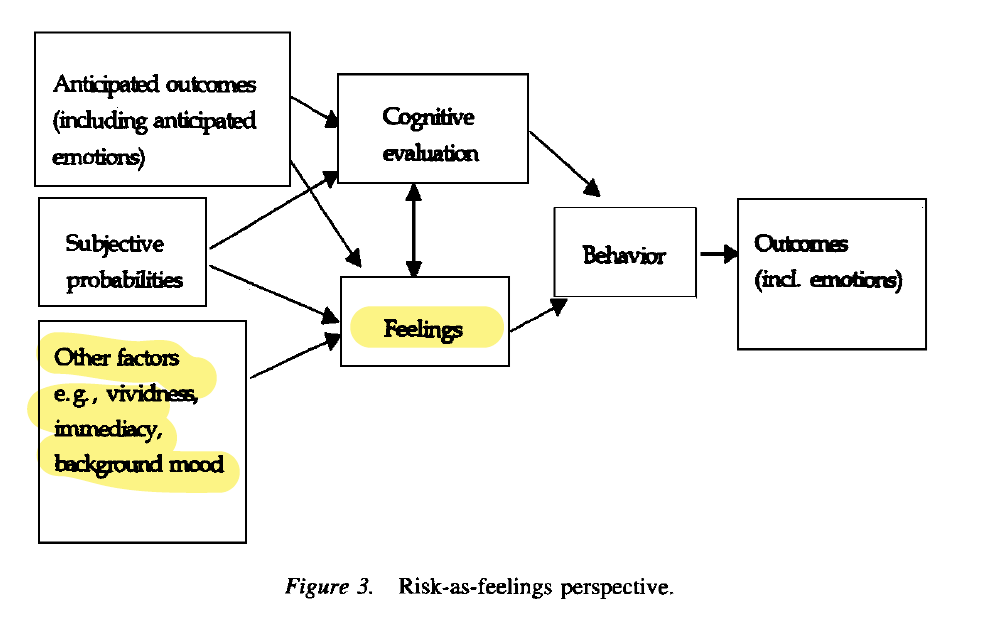
2. Image 2 highlights an empirically supported position that rather than risk judgements being rational evaluations of probabilities, they’re preceded by and informed by feelings
a. That is, what we ‘think’ about a risk (our cognitive evaluation) is informed by how we ‘feel’ about it
b. Hence, feelings are intimately intertwined within risk judgements – even apparently ‘objective’ evaluations
Besides the obvious value of feelings (love, affection, family etc.), it’s a feature (not a bug) and essential to many heuristics our brain employs to make rapid sense of the world in a satisfactory, rather than optimal, way
(Though, notably, some research, e.g. see Gigerenzer, has shown that heuristics can outperform rational and analytical methods.)
‘Risk as feelings’ podcast will be released on Thursday (AEST).
Image 1 source: Reale, C., Salwei, M. E., Militello, L. G., Weinger, M. B., Burden, A., Sushereba, C., … & Anders, S. (2023). Decision-making during high-risk events: a systematic literature review. Journal of Cognitive Engineering and Decision Making, 17(2), 188-212.
Image 2 source: Loewenstein, G. F., Weber, E. U., Hsee, C. K., & Welch, N. (2001). Risk as feelings. Psychological bulletin, 127(2), 267.


 SafetyInsights.org