This paper discusses some of the good, bad and ugly of GenAI use in construction.
GenAI “poised to fundamentally transform the Construction and Built Environment (CBE) industry” but also is a “dual-edged sword, offering immense benefits while simultaneously posing considerable difficulties and potential pitfalls”
Not a summary – just a few extracts:
The Good:
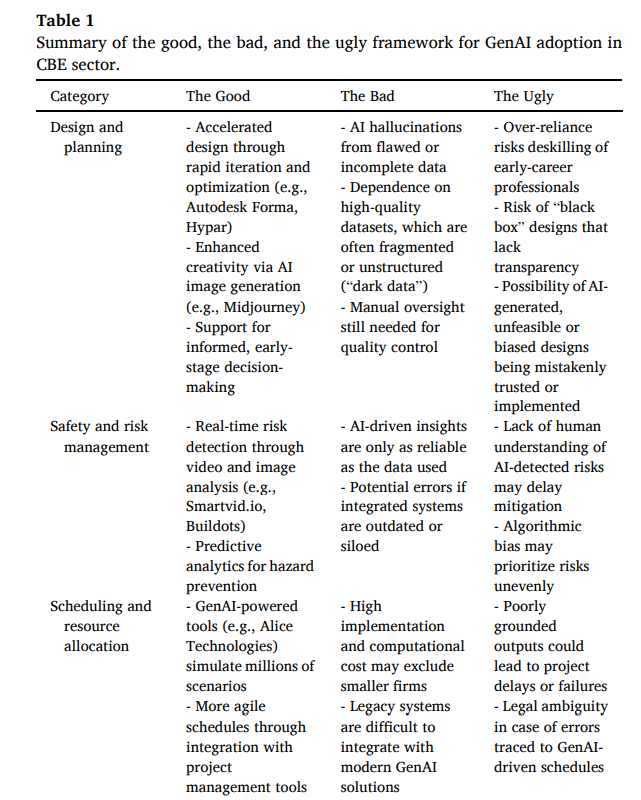
· GenAI has “remarkable ability to enhance efficiency, accuracy, and foster unprecedented innovation”
· This includes accelerated design and planning, enhancing risk management and safety, optimised scheduling and resource allocation, improved cost estimation and more
The Bad:
· “data dependency and quality” leading to “inaccurate outputs” and “AI hallucinations'” from “fragmented, inconsistent, and unstructured ‘dark data”
· “high computational demands and associated costs” that can be “prohibitive for smaller firms”
· “integration with legacy systems” which is “complex, time-consuming, and highly disruptive”
· “significant skill gaps and workforce adaptation challenges” requiring “comprehensive training and upskilling programs”
· “lack of transparency and explainability” leading to “erode trust among professionals”
The “Ugly” with some pitfalls:
· “over-reliance and deskilling” where “excessive dependence on GenAI… can lead to a degradation of critical thinking, problem-solving skills, and practical experience”
· “algorithmic bias and unfair outcomes” if training data reflects historical biases, potentially causing “unfair or discriminatory outcomes”
· “Privacy and cybersecurity risks are also significantly amplified” due to processing “vast amounts of sensitive project data”
· “The complexity of accountability and liability” means “determining who is ultimately responsible can be incredibly complex and legally ambiguous” for AI-generated errors or failures
· “workforce displacement and broader social impact” as GenAI will “automate many routine and repetitive tasks”
· “exacerbation of inequality” as high costs could “widen the gap between large… and smaller… companies”
· “the phenomenon of ‘AI hallucinations’ and the potential for misinformation is a critical ‘ugly’ aspect”, as LLMs can “generate plausible-sounding but entirely false information or designs”
In all, they argue that the transformative value of GenAI hinges on a “balanced and ethical implementation strategy”
and
“This strategy must be grounded in robust human oversight, continuous skill development, stringent data governance, and thoughtful policymaking to ensure that GenAI’s evolution is both beneficial and responsible for the future of the built environment”.
Ref: Van Tam, N. (2025). How generative AI reshapes construction and built environment: The good, the bad, and the ugly. Building and Environment, 113526.

Shout me a coffee (one-off or monthly recurring)
Study link: https://doi.org/10.1016/j.buildenv.2025.113526
Safe As LinkedIn group: https://www.linkedin.com/groups/14717868/

 SafetyInsights.org