A few extracts from Kühl’s interesting book called ‘Influencing Organizational Culture’.
It takes more of a deep, analytical and critical lens to ‘conventional’ cultural approaches.
Extracts:
· Kühl proposes that “to better understand the culture of an organization, we have to systematically distinguish between the three sides of an organization”
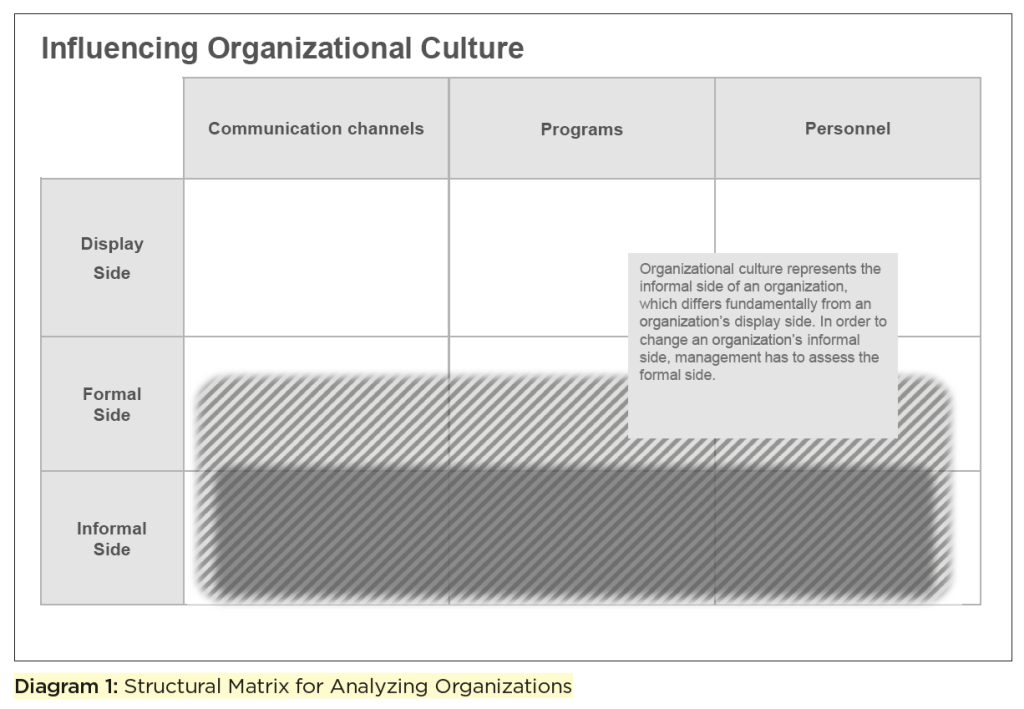
· The formal side covers the “official body of rules to which members have to feel bound”; they contain the membership conditions that people fulfill if they want to remain a member – or risk being shunned
· Informal side (said to be the ‘organisational cultural’ side): consisting of “long-established practices, of neat tricks to make work easier, and of regular deviations from formal rules”
· The display side, which is the façade of the organisation. It is “meant to present something by means of its embellishments, ornamentation, or perhaps its evenness”
· “Organizations present the most attractive facade possible to the outside world so that they can attract customer favor, influence the media to attain the best possible coverage, or to receive legitimation by politics”
· Using an “unavoidably” simple metaphor for these sides of an organisation related to the human body, the formal structure is the skeleton, nervous system the informal, and skin is the display side
· The skeleton doesn’t display itself immediately but “can be rendered easily visible with appropriate aids”
· “The nervous system, on the other hand, is difficult to recognize, even if it is crucial for the existence of the human body”
· “The skin is what you immediately recognize when you look at a body, which is why people dress it up with make-up or tattoos”
· “Only if you systematically keep an eye on the three sides of the organization can you avoid two fundamental mistakes that are frequently made in the discussion about organizational cultures”
· “The first mistake is that the informal (organizational cultural) side of the organization is not related systematically enough to the formal side”
· And “Even if informal programs, communication channels and decisions on personnel are identified in detail within the framework of a cultural analysis, they are not always related to formal programs”
· “The second mistake is that in the discussion on organizational cultures there is no fundamental distinction between the informal (organizational cultural) side and the display side of the organization”
· “What is overlooked, however, is that the function of the display side, which is so important for the production of legitimacy, is completely different from that of the informal side, which is more concerned with the very important formation of organizational-cultural expectations of behavior adapted to everyday problem”

Sounds like a lot like Rae and Provan’s delineation with the types of safety work and how they interact.
Thanks Martijn Flinterman for highlighting this.

Shout me a coffee (one-off or monthly recurring)
Book: https://organizationaldialoguepress.com/press/down/2018_Influencing-Organizational-Culture.pdf
Safe As LinkedIn group: https://www.linkedin.com/groups/14717868/

 SafetyInsights.org