
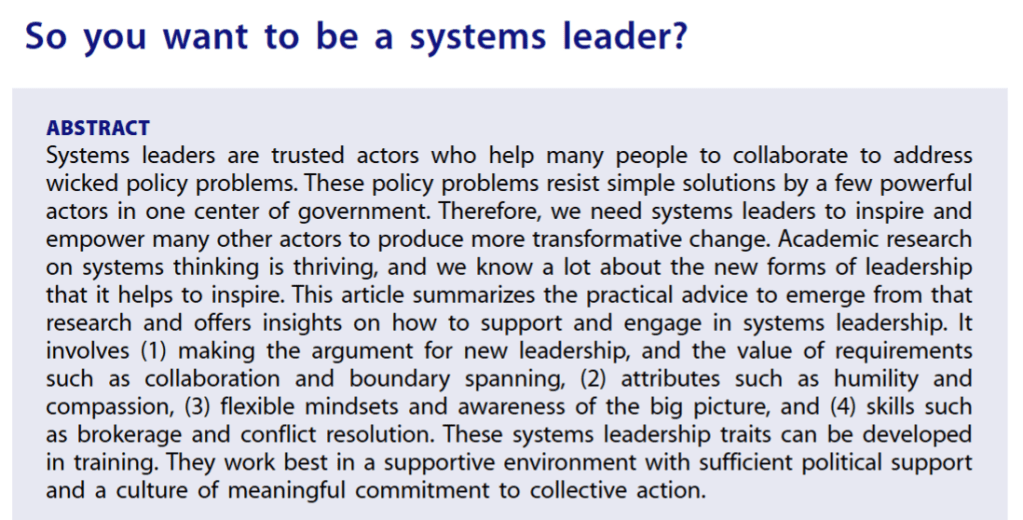
This article discusses systems leaders (SL).
· Systems leaders are “trusted actors who help many people to collaborate to address wicked policy problems”
· They’re people “who catalyzes collective leadership” for “deep changes necessary to accelerate progress against society’s most intractable problems”
· This is “necessary, to address wicked problems that transcend traditional boundaries” where “no one person or organisation can find the solution on their own”
· Systems leadership involves: “(1) making the argument for new leadership, and the value of requirements such as collaboration and boundary spanning, (2) attributes such as humility and compassion, (3) flexible mindsets and awareness of the big picture, and (4) skills such as brokerage and conflict resolution”
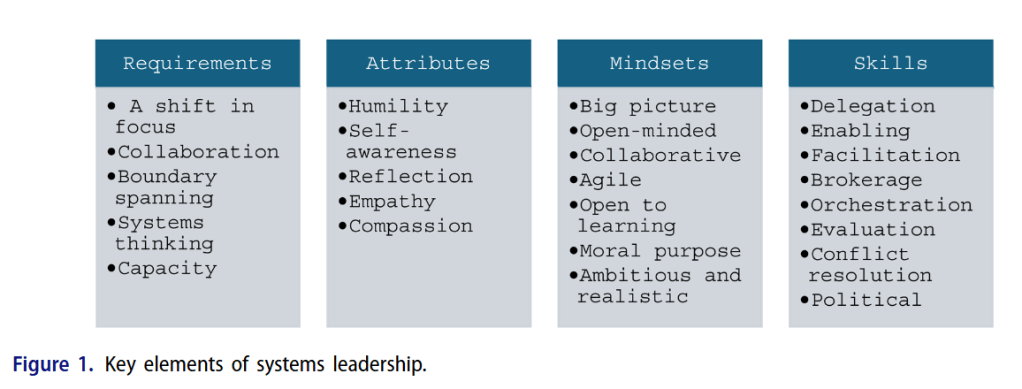
· It necessitates collaboration to “augment or replace hierarchy”
· SL requires boundary spanning to “address problems that transcend traditional sectoral or jurisdictional purviews”
· SL draws on systems thinking to “to understand the underlying causes of wicked problems and unpredictable dynamics of systems”
· Key attributes include “Humility” to “focus less on yourself, more on the perspectives and values of others”
· SL draws on “Self-awareness and reflection” to “think continuously about this process and be open to learning”, and “Empathy and compassion … to seek to understand what others are going through and can offer”
· These qualities are said to contrast with traditional “charisma, self-confidence, aloofness, and credit-claiming”

· They list mindsets to encourage, which includes seeing the big picture to understand problems from multiple perspectives
· “Open-minded and collaborative” to foster innovation
· “Agile and open to learning” in contexts of “high uncertainty and often unpredictable outcomes”
· Moral purpose directed at “democratic and participatory ways of working”
· For skills, they list delegation to “give many actors the space to be creative and collaborative”
· Enabling and facilitation to produce a “shared sense of commitment”
· Brokerage and orchestration which connects actors and prompts “productive tension and innovation”
· Making the case for change to provide an evidence base and “overcome skepticism”
· Building a supportive architecture can enable “new incentives backed by the authority to reward new ways of working”
· The supportive environment helps shift from a risk-averse and blaming culture toward a “culture of learning, where risk-taking (within safe boundaries) is encouraged”
· They list the ways to put it together – see the final image

Ref: Cairney, P., & Toomey, C. (2025). So you want to be a systems leader?. Policy Design and Practice, 1-15.

Shout me a coffee (one-off or monthly recurring)
Study link: https://doi.org/10.1080/25741292.2025.2545667
Safe As LinkedIn group: https://www.linkedin.com/groups/14717868/

 SafetyInsights.org