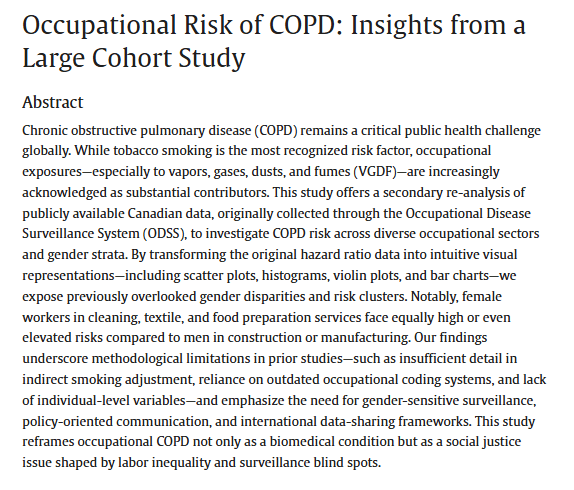
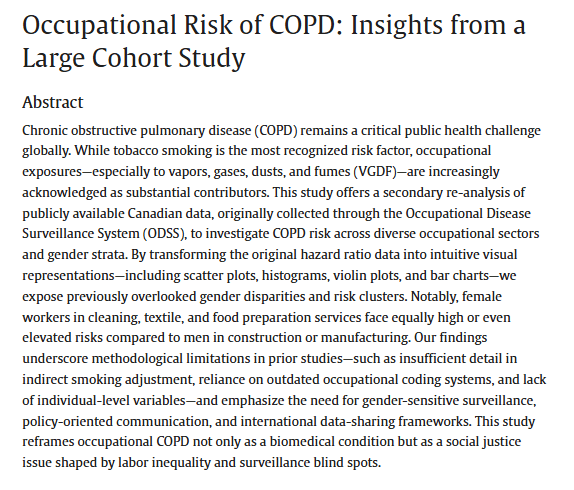
Female workers in cleaning, textile and food prep “face equally high or even elevated risks compared to men in construction or manufacturing” in COPD, according to this study.
This interesting study re-evaluated a large Canadian dataset using 1.5 million workers across multiple industries and 44k COPD cases.
Background:
· “Chronic obstructive pulmonary disease (COPD) remains a critical public health challenge globally”
· “While tobacco smoking is the most recognized risk factor, occupational exposures—especially to vapors, gases, dusts, and fumes (VGDF)—are increasingly acknowledged as substantial contributors”
· COPD has been “increasingly recognized that occupational exposures—especially to vapors, gases, dusts, and fumes (VGDF)—constitute a significant yet underappreciated etiological pathway for disease development”
Results:
· “Notably, female workers in cleaning, textile, and food preparation services face equally high or even elevated risks compared to men in construction or manufacturing”
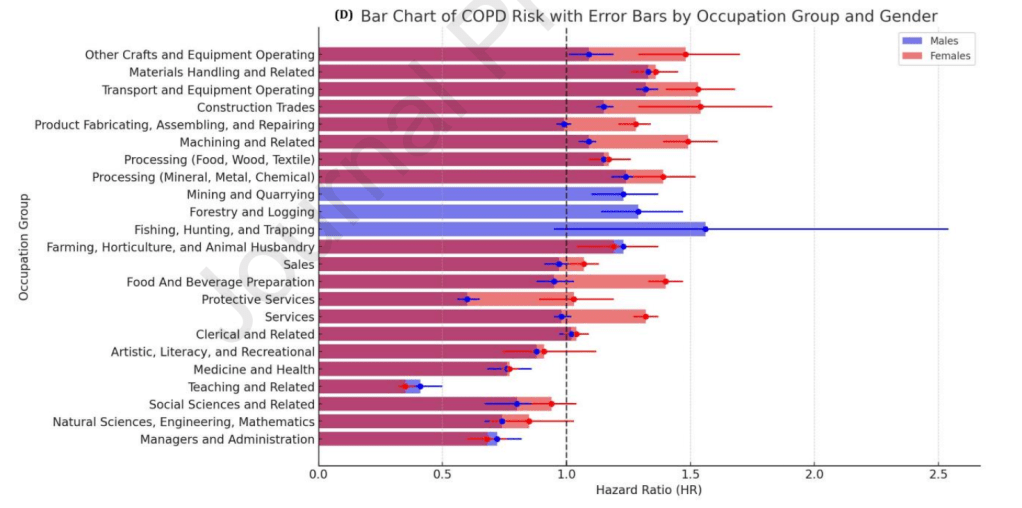
· “occupations such as construction (HRmale: 1.15, HRfemale: 1.54), transportation (HRmale: 1.32, HRfemale: 1.53), and materials handling (HRmale: 1.33, HRfemale: 1.36) cluster in the upper right quadrant of the scatter plot, indicating elevated HRs for both men and women”
· “high-risk occupations include mining (HRmale: 1.23) and processing (HRmale: 1.24, HRfemale: 1.39), consistent with known exposures to mineral dust, diesel exhaust, and chemical fumes”
· “In contrast, managerial and administrative roles exhibit reduced risks (HRmale: 0.72, HRfemale: 0.68), serving as a reference for low-exposure occupational environments”
· “the violin plot illustrates that while male workers experience a broader spread of HRs across occupations, certain female-dominated sectors exhibit concentrated high risks”
· “women in food and beverage preparation and cleaning services both report HRs of 1.40, while female workers in textile processing reach HR 1.14”
· “These results suggest that women in low-wage, low-status occupations may experience high exposure to respiratory hazards, often without sufficient protective equipment or regulatory oversight”
· “This is consistent with ILO reports indicating that over 80% of domestic workers globally lack occupational health protections”
In all, they argue these findings:
· “reveals a troubling pattern of occupational health invisibility that disproportionately affects women workers”, where the “traditional focus on male-dominated industrial sectors has created systematic blind spots in occupational health surveillance”
· And, “occupational COPD should not be understood merely as an isolated epidemiological phenomenon, but rather as a complex social and gendered health issue “shaped by labor inequality and surveillance blind spots”.
Ref: Yu, H., & Yu, Z. (2025). Occupational Risk of COPD: Insights from a Large Cohort Study. Safety and Health at Work.

Shout me a coffee (one-off or monthly recurring)
Study: https://doi.org/10.1016/j.shaw.2025.08.003
My site with more reviews: SafetyInsights.org
Shout me a coffee: https://buymeacoffee.com/benhutchinson
Safe As LinkedIn group: https://www.linkedin.com/groups/14717868/

 SafetyInsights.org