Safe As week in review:
28 Agentive language in investigations:
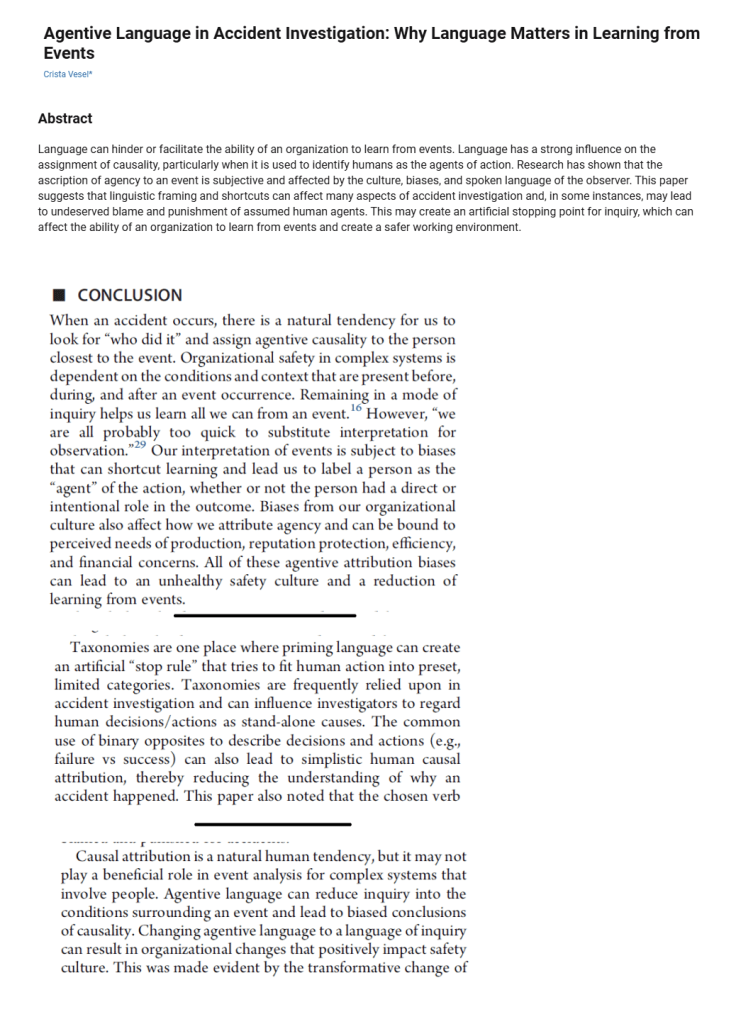
This ep discusses Vesel’s article, which unpacks the role of language in investigations.
· People naturally want to know who or what was responsible for an action and particularly something undesirable. The assignment of action is called agency, where an agent is a person or thing that takes an active role or produces a specified effect.
· Investigators may search for human failure and place significant weight on human agency
· Blame can be further influenced by the fundamental attribution error, where dispositional/personality-based qualities of people are prioritised over other factors, e.g. cultural, environmental, social
· A defensive attribution bias can also become “a protection mechanism for investigators and organizational leaders, separating them from the presumed cause and theoretically restoring safety to the system”
· Systemic models of performance, instead, tend to treat these elements of agency and performance as the beginning of the inquiry, not the end
· And to change culture, “you have to change the assumptions that drive the culture.16 Language can be a major driver of this change by proactively replacing words that lead to agentive blame with descriptions that lead to a more robust and inclusive analysis of events”
Spotify: https://spotifycreators-web.app.link/e/UjLMnwi6qWb
29 Restorative Just Culture Checklist:
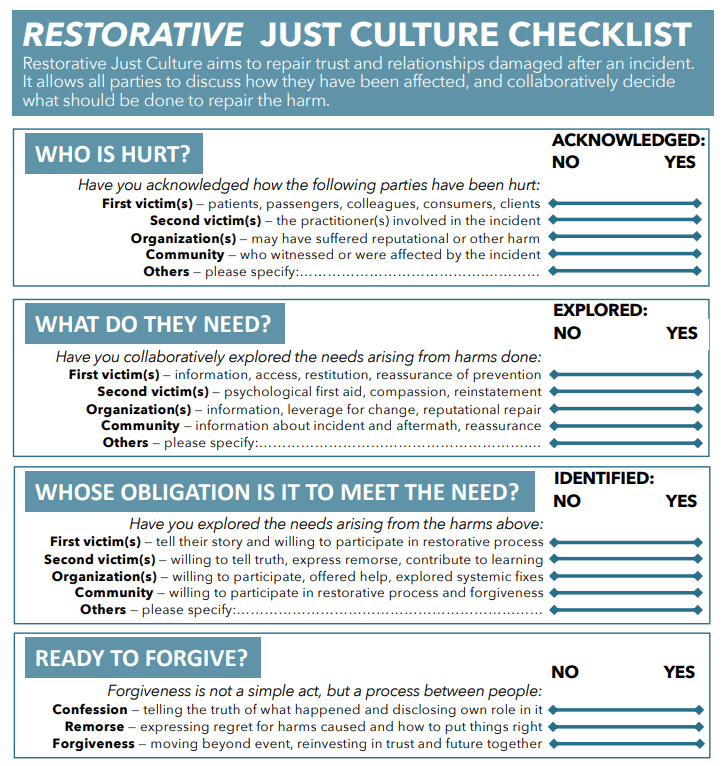
This pod covered Sid Dekker’s checklist from Safety Differently . com
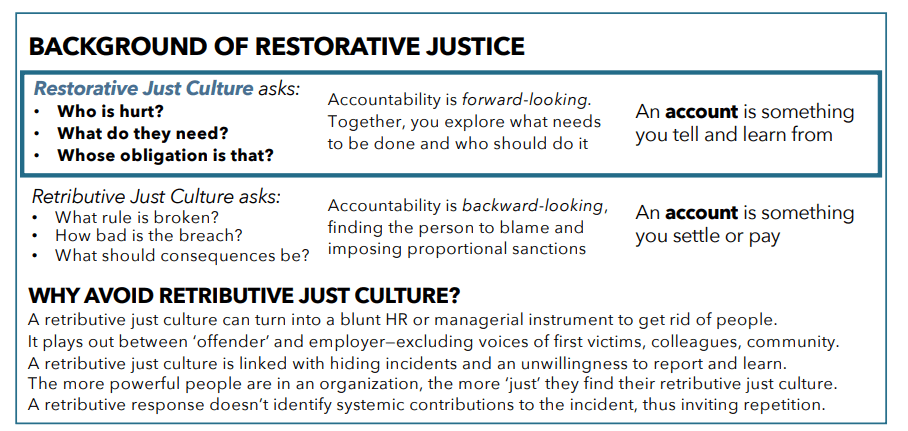
A restorative approach asks:
· Who is hurt?
· What do they need?
· Whose obligation is it to meet the need?
· It’s argued that “Accountability is forward-looking. Together, you explore what needs to be done and who should do it”
Spotify: https://spotifycreators-web.app.link/e/3LWYwvi6qWb
30 A better way to think about procedures:
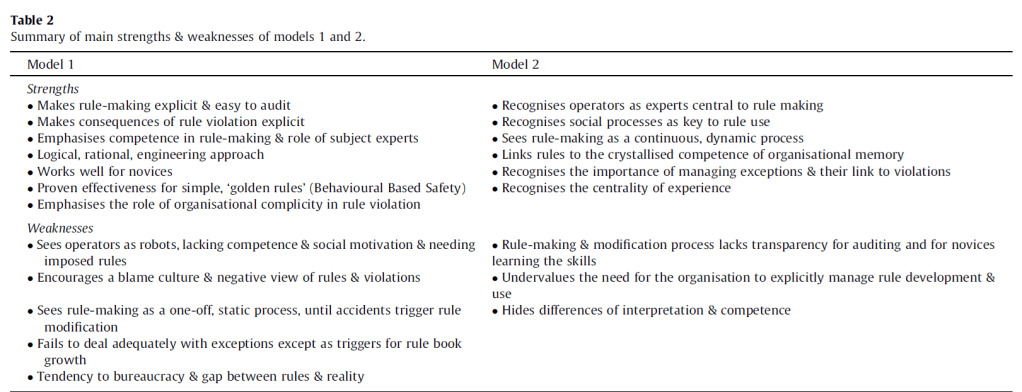
This pod covered the model 1 / model 2 perspective on procedures.
model 1: sees rules as an embodiment of the better way to work, designed by experts in advance to cover requirements & where things are seen to be safe providing people just follow the rules.
It’s said that from this perspective “Once devised, they are ‘carved in stone’, communicated to, and imposed on, the operators or workforce by management … to be enforced by suitable means to overcome the fallible human tendency to make errors and deviate from the rules” (Hale & Borys, 2013).
Model 2: focuses on rules as tools that people use for support but relying more on their experience – accepting that rules can’t cover all contingencies & people need to adapt to successfully & safely complete work.
E.g. As suggested by Carim et al. (2016), rules can rather act as “resources for action”, highlighting a dynamic nature of flexible interpretation and adaptation of rules.
Importantly, one model isn’t implicitly good or bad, nor should we advocate to eliminate model 1 (or eliminate procedural systems, which would likely not be a good idea). Both have their place.
Spotify: https://spotifycreators-web.app.link/e/DPIsGui6qWb
Refs:
Image 1: Vesel, C. (2020). Agentive language in accident investigation: Why language matters in learning from events. ACS Chemical Health & Safety, 27(1), 34-39.
Images 2 & 3: Dekker, S. Restorative Just Culture Checklist. From SafetyDifferently . com
Image 3: Hendricks, J. W., & Peres, S. C. (2021). Safety science, 134, 105016


 SafetyInsights.org