I found this an interesting juxtaposition of conventional and progressive views of human performance from the DOE Human Performance Improvement Handbook 2009, vol 1.
Not a criticism or commentary – just found it interesting. I’m probably making too much of it. But, whatever.
Extracts:
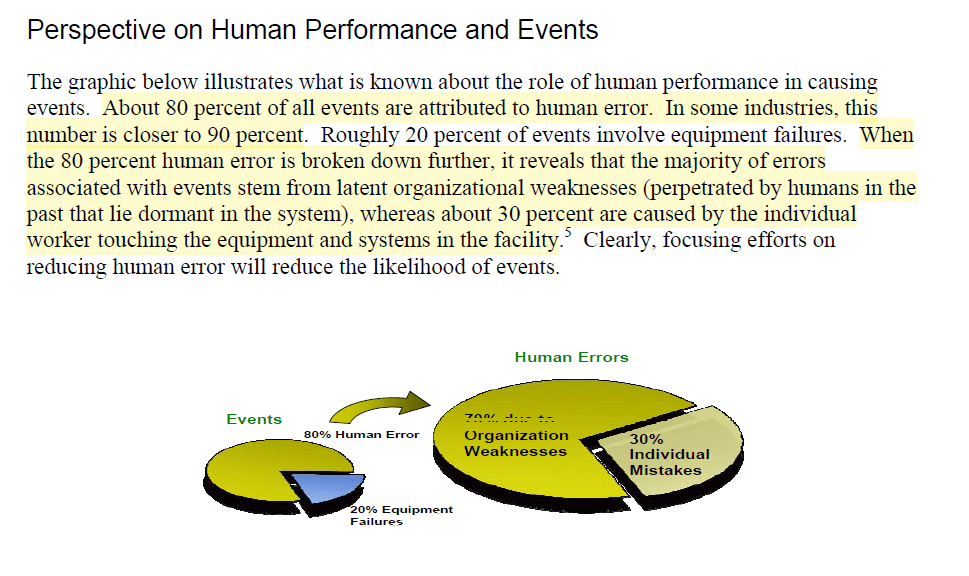
· They refer to the oft-quoted statement that “About 80 percent of all events are attributed to human error. In some industries, this number is closer to 90 percent”
· Though, importantly, they say that “When the 80 percent human error is broken down further, it reveals that the majority of errors associated with events stem from latent organizational weaknesses (perpetrated by humans in the past that lie dormant in the system)”
· And where the remaining “about 30 percent are caused by the individual worker touching the equipment and systems in the facility”
· But then use words like “perpetrated”, which…is jarring to see when talking about progressive human performance (though only seems to have been used like 2 or 3 times in the report)
· “a Nuclear Regulatory Commission review of events in which fuel was damaged while in the reactor showed that human error was a common factor in 21 of 26 (81 percent) events”
· They promote the importance of upstream factors, and then provide this quote, which I’m not sure is being criticised or not, “The report disclosed that “the risk is in the people—the way they are trained, their level of professionalism and performance, and the way they are managed”
· Next they talk about human performance isn’t a worker-focused phenomenon, as this belief “promotes the notion that failures are introduced to the system only through the inherent unreliability of people—Once we can rid ourselves of a few bad performers, everything will be fine. There is nothing wrong with the system”
· But this is a myth because “weaknesses in organizational processes and cultural values are involved in the majority of facility events. Accidents result from a combination of factors, many of which are beyond the control of the worker. Therefore, the organizational context of human performance is an important consideration”
· Further, a recent study “completed for the Nuclear Regulatory Commission (NRC) by the Idaho National Engineering and Environmental Laboratory (INEEL)8 indicates that human error continues to be a causal factor in 79 percent of industry licensee events”
· And of those events, there were “four latent failures (undetected conditions that did not achieve the desired end(s) for every active failure”
· “More significantly, design and design change problems were a factor in 81 percent of the events involving human error”

Shout me a coffee (one-off or monthly recurring)
Report: https://www.standards.doe.gov/standards-documents/1000/1028-BHdbk-2009-v1/@@images/file
Safe As LinkedIn group: https://www.linkedin.com/groups/14717868/

 SafetyInsights.org