Was your last incident a one-off occurrence or systemic failure?
Two extracts discussing this theme – first from Greg Smith (Proving Safety), and then Desai Link (‘Beyond the Incident’), who expanded the discussion on Greg’s question.
Images from Desai’s book.
Greg Argues:
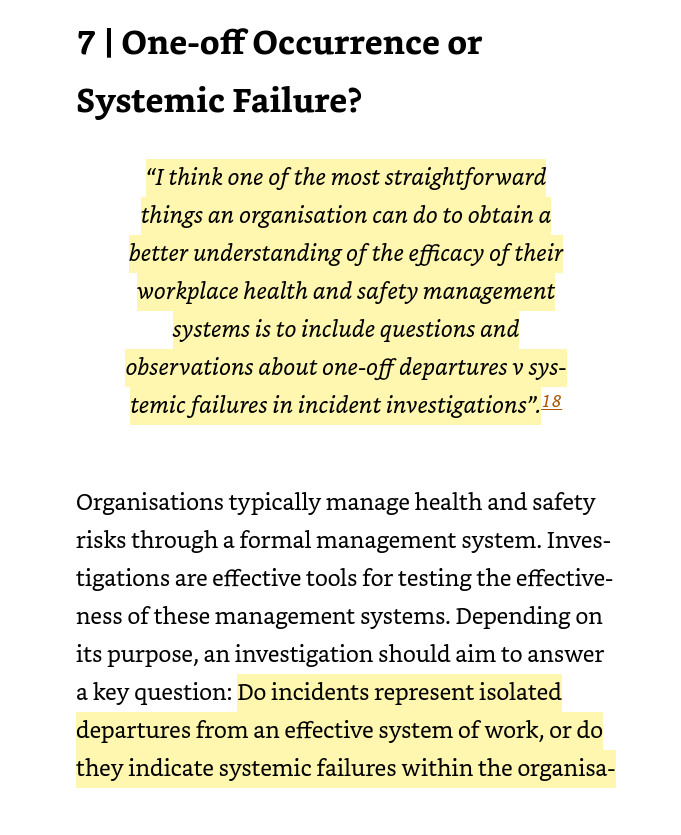
· An important aspect of assurance is “to continually question whether issues that we see in workplace health and safety management are one-off departures from an otherwise effective system, or whether they are, or are indicative of, potential systemic failure”
· “It is one thing to identify that a worker did not comply with the safety procedure, but it is another thing altogether to identify that half of the workforce did not know about the correct method to perform a task”
· Or “include a reference “in every incident investigation asking whether the incident was a one-off departure from the organisation’s expectations, or whether there is any evidence that the incident, or elements of it, might represent a systemic failure”
Desai expands:
· Examining the organisation’s safety systems should involve asking “What does it say should have happened? Is this an accurate representation of how things should happen? Was this followed in practice?”
· “were weekly inspections required to be performed? What does the risk assessment say? Was this actually done?”
· “What do the witnesses say about how the work is actually performed, the conditions they face regularly .. Their accounts can provide a clear picture of whether the incident was an anomaly or the result of ongoing systemic issues”
· “The key is to compare what should have happened according to the management system, what was happening from day to day under normal conditions, and what occurred at the time of the incident”
· “This comparison also reflects principles found in learning teams and systems-based reviews, where the gap between work-as-imagined and work-as-done is explored to understand adaptations, constraints, and systemic conditions”
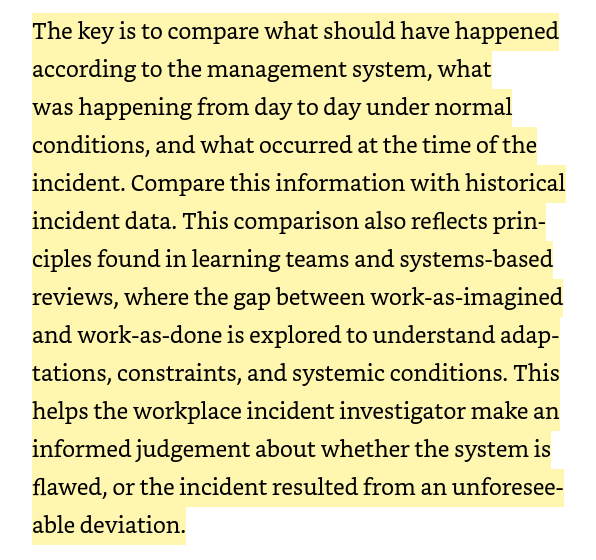
· Further, these questions help inform whether “the system is flawed, or the incident resulted from an unforeseeable deviation”
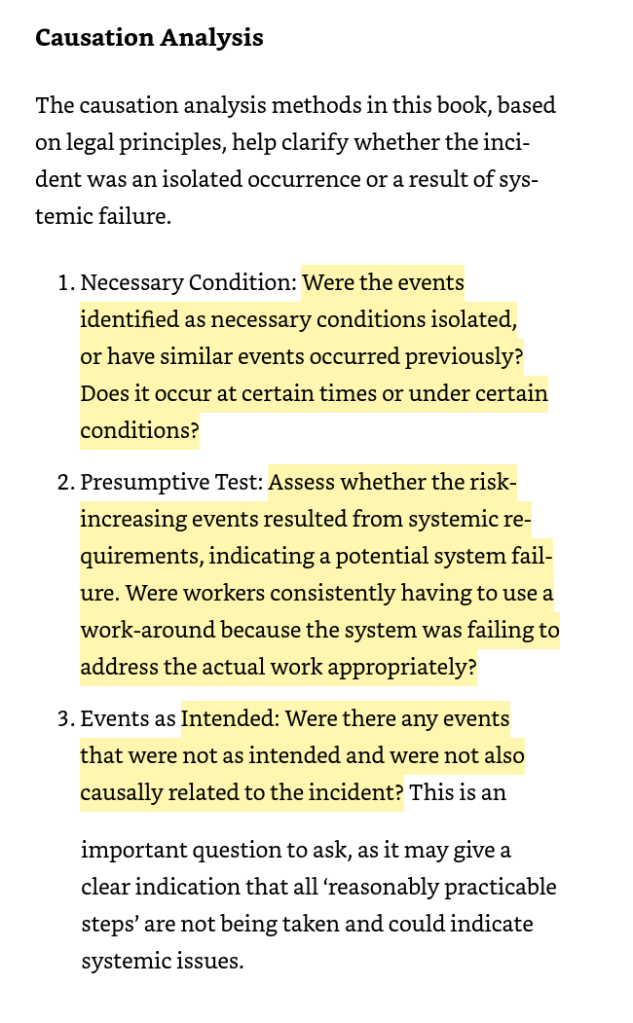
· When examining whether the incident was a one off or systemic issue, consider necessary conditions: “Were the events identified as necessary conditions isolated, or have similar events occurred previously? Does it occur at certain times or under certain conditions?”
· The presumptive test: “Assess whether the risk-increasing events resulted from systemic requirements, indicating a potential system failure. Were workers consistently having to use a work-around because the system was failing to address the actual work appropriately? “
· The events as intended: “Were there any events that were not as intended and were not also causally related to the incident?”
Refs:
1. Greg Smith – Proving Safety
2. Desai Link – Beyond the Incident: Practical Tools, Legal Causation and Applied Workplace Investigation Practice


 SafetyInsights.org