Principles for managing barriers in the petroleum industry – the Norwegian approach.
Here’s some extract from this 40 page guide:
· Barriers are “measures intended to detect failure, hazard and accident situations at an early stage, reduce their potential for propagating and limit harm and disruption”
· “No matter how safely and robustly we design and operate petroleum activities, failure, hazard and accident situations may still arise. This is when we need barriers to help protect against accidents”
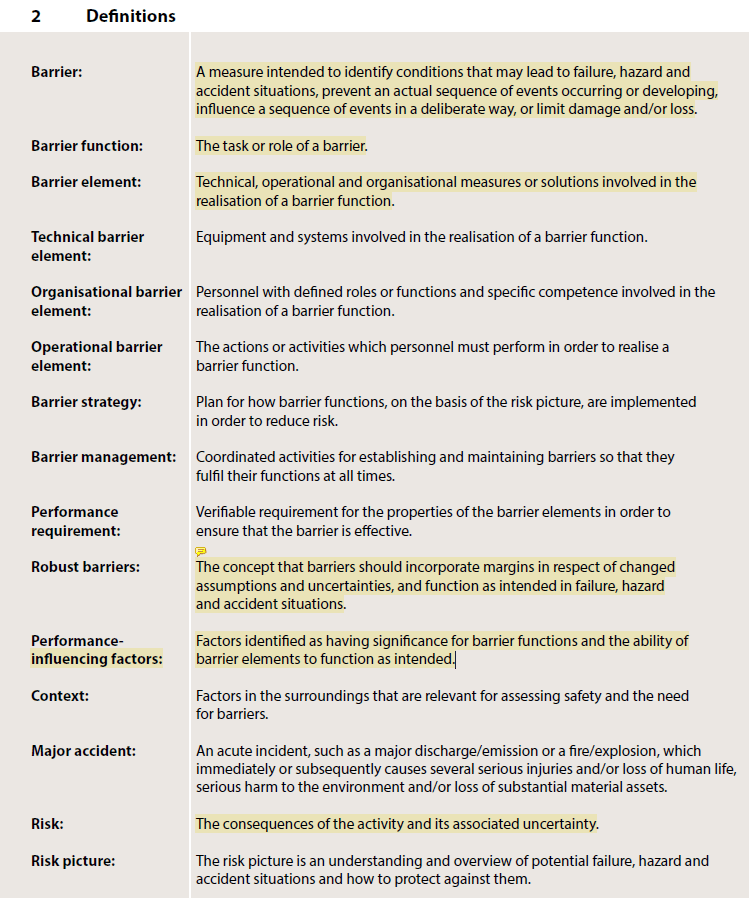
· A technical barrier element is “Equipment and systems involved in the realisation of a barrier function”
· For a barrier to fulfill its function, the technical/non-tech elements must meet: functionality, integrity and robustness
· Functionality is the “influence they have on the chain of events (assuming their presence)”
· Integrity is the barrier element’s “ability and potential to be in place and intact at all times”
· Robustness is the ability “to withstand situations that are somewhat different from the intended circumstances and that they ‘survive’ a failure, hazard and accident situation”
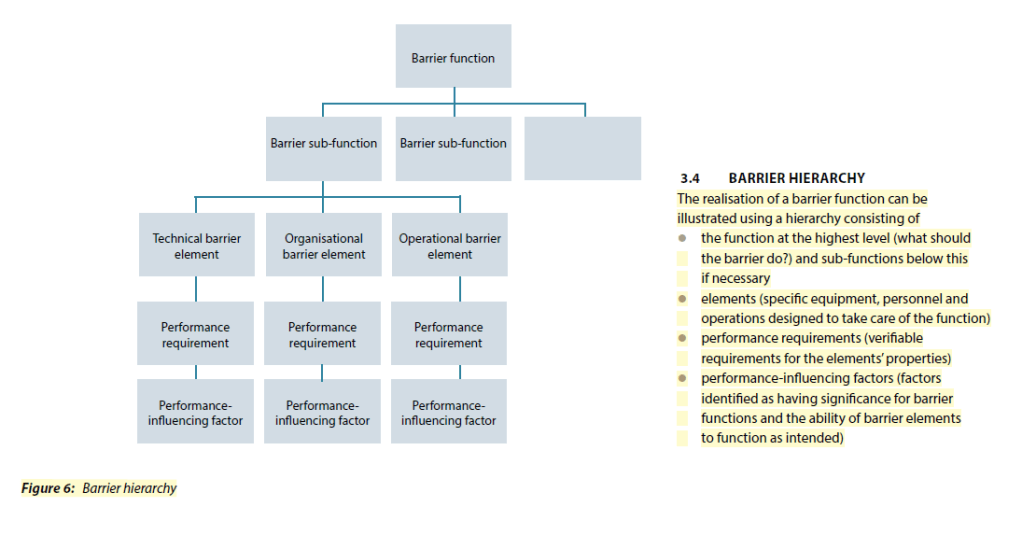
· Specific and verifiable performance requirements must be set for technical barrier elements, ensuring they function as intended for the ‘specific risk picture’”
· There’s also performance-influencing factors to consider, being “factors identified as having significance for barrier functions and the ability of barrier elements to function as intended”
· “As a fundamental principle, priority should be given to likelihood-reducing measures over consequence-reducing measures, but there is often a need for both types of measures”
· Barriers can be categorised as passive or active (and more)
· Passive barriers are present without needing activation or intervention, like a bund or firewall
· Active barriers require activation or intervention and, normally, passive barriers are preferred over active
· “Active barriers that are activated automatically are normally preferable to active barriers that require intervention” and “technical barrier elements are often preferred to elements that require human intervention”
· Strengths of technical systems are that “they are ‘always’ in place and ready to perform their tasks”
· They also perform well when “many signals have to be processed quickly and fixed actions performed in sequence or simultaneously”
· But they have weaknesses “in terms of flexibility and their ability to handle unforeseen situations or combinations of situations” and falling short during “non-predefined situations”
· People, in contrast, have greater flexibility, “the ability to see new patterns, and assess complex and unforeseen situations (“black swan events”)”
· But, human performance has limits where they “may misunderstand complex situations, make errors, not be situationally aware and act slowly”
· Hence, “it is often beneficial to distribute tasks between technical systems and people, where each have their own strengths and weaknesses”
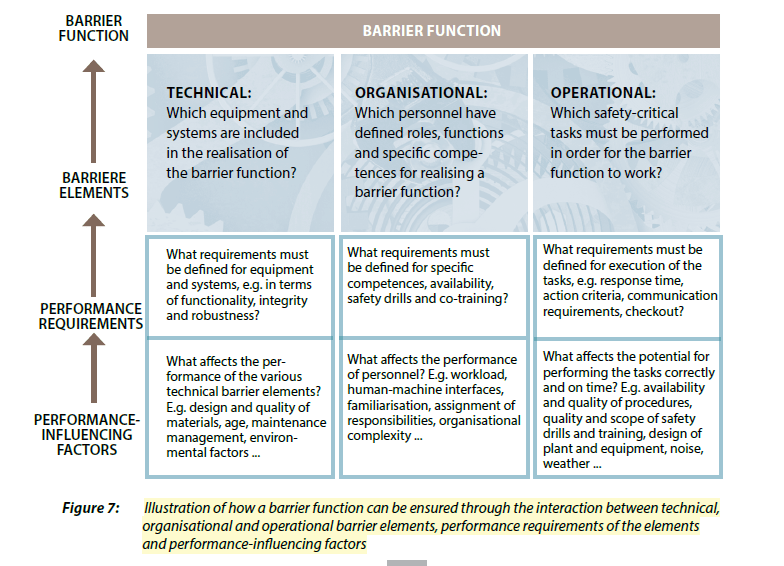
· Moreover, effective barrier functions are often provided through the interaction of tech, operational and org elements, captured in the following principle: “Who does what with which equipment in failure, hazard and accident situations?”
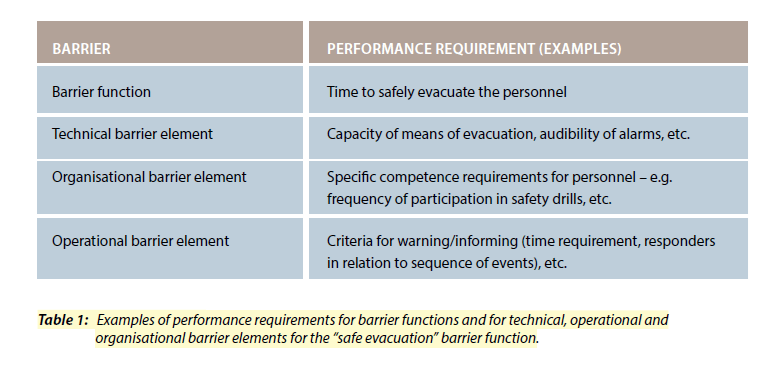
· “Barrier elements should be restricted to those elements that have a specific role in ensuring the barrier function. For example, a procedure may be a useful aid to describe what is needed to safeguard a barrier function. However, in itself the procedure cannot be considered to be a barrier element”
· “The same is true of safe job analyses, which are useful tools for identifying risk in operations and establishing temporary barriers which must be in place before performing an operation ..A safe job analysis is not in itself a barrier element”
· “Not all performance-influencing factors are equally important. In barrier management, it may be appropriate to restrict oneself to performance-influencing factors that have a significant effect on the barrier elements’ ability to function”
· “Common sense must also be used in addition to risk analyses”
· And, we shouldn’t restrict risk reduction purely to measures which can be quantified, e.g. “preventing hot surfaces on equipment which could be exposed to diesel oil leaks” will be a sensible measure in most cases, even if its effect cannot be quantified in a QRA”
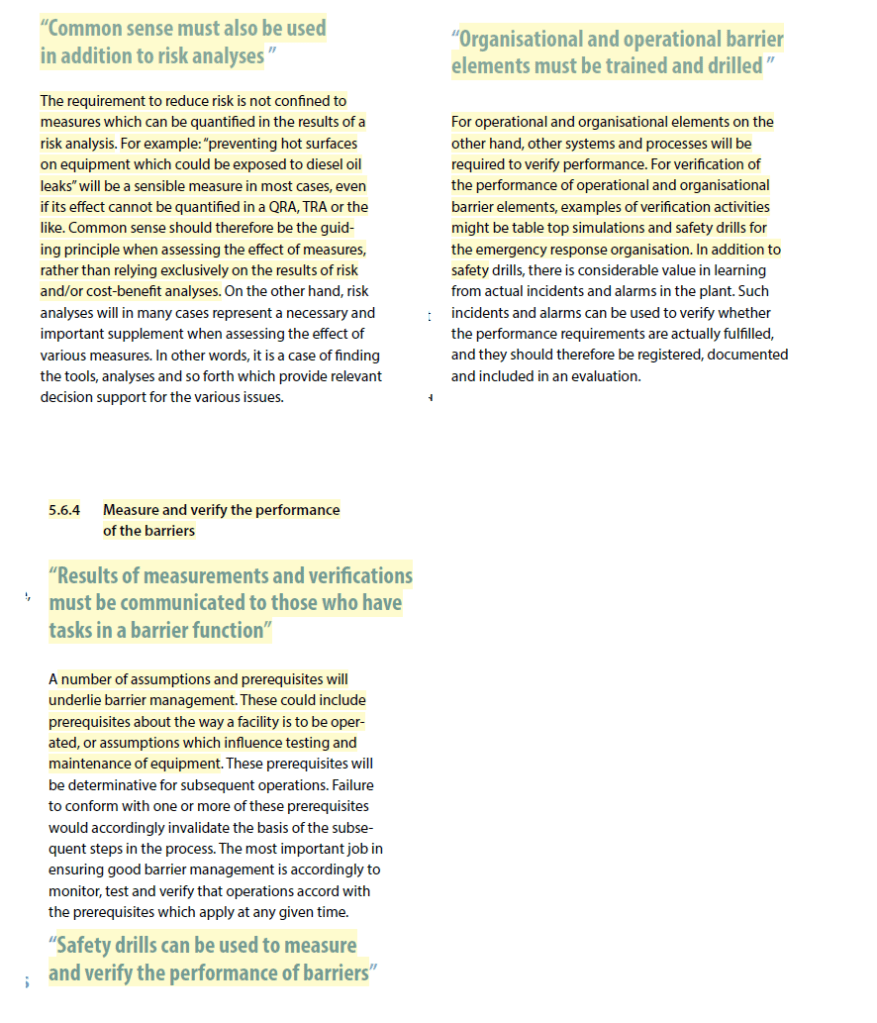
· “Common sense should therefore be the guiding principle when assessing the effect of measures, rather than relying exclusively on the results of risk … analyses”
· Operational and org elements may need additional processes to verify performance, like “table top simulations and safety drills for the emergency response organisation. In addition to safety drills, there is considerable value in learning from actual incidents”
· “Organisational and operational barrier elements must be trained and drilled”
Ref: Petroleum Safety Authority Norway (2017)

Safe As LinkedIn group: https://www.linkedin.com/groups/14717868/

 SafetyInsights.org