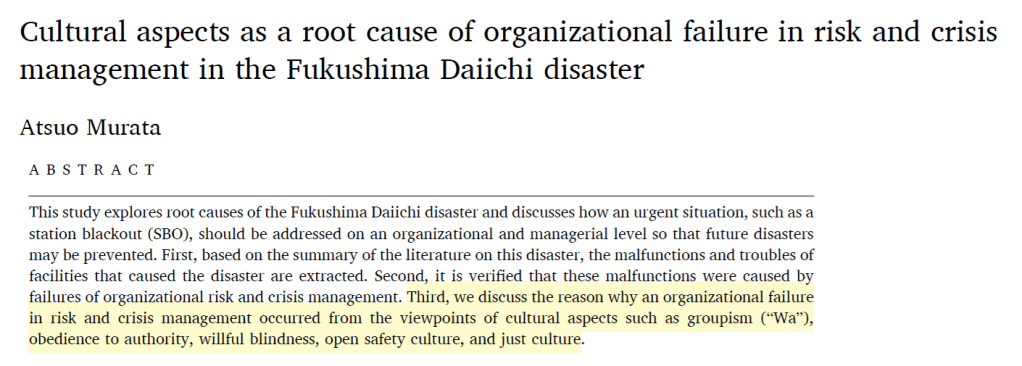
This article explored some cultural aspects underpinning the Fukushima disaster.
Extracts:
· Org failure types contributing to the disaster included “inadequate risk assessments and lack of safeguards against known threats”, “inadequate levels of knowledge and equipment inspection related to severe accidents”, “inadequate emergency response training and preparedness” & “inadequate regulatory oversight by regulators and the government”
· Cultural factors included Groupism (“Wa”), where “The tendency to avoid open discussion in Japan may be evidenced by Japanese people’s emphasis on ‘Wa’ (harmony)”
· “Strong groupism (“Wa”) must have induced obedience to authority and willful blindness… and prevented the penetration of open and just culture”
· Obedience to authority displays as “strong obedience to people in high positional rank”
· The IAEA recommendation to grant full authority to the emergency director was “ignored owing to the cultural practice of placing importance on the ranking (authority) of the organization or the government”
· There was also a wilful blindess, which makes organisations “falsely feel that this is innocuous and efficient”, causing them to “ignore[e] on purpose” significant risks
· A culture of silence and/or an immaturity open culture were said to lead to an environment where “people are afraid of being blamed for raising safety-related issues without obeying to the decision of nuclear community”
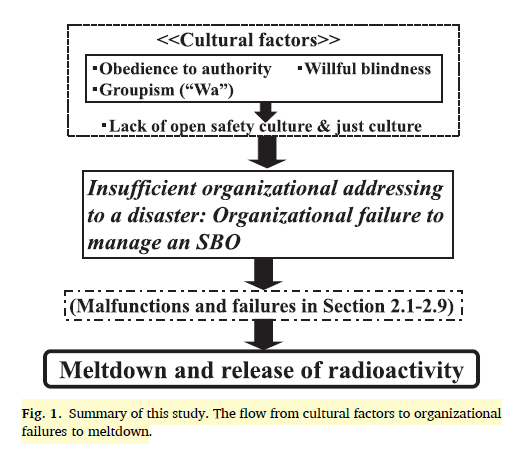
· “Placing blame for failures under the influences of culture of silence or groupism (“Wa”) never promotes the opportunity to speak up”
· The formation of their own nuclear community where “open discussion is not permitted”, this community, consisting of TEPCO, regulators and government”, suffered from “cozy collusion”, where “open discussion promoted by speaking up was impossible”
· TEPCO and regulators were said to have organisationally failed, by frequently making “inappropriate decisions to put organizational interests ahead of safety”
· “It seems plausible to regard that such Japanese cultures as groupism, obedience to authority (power distance), or willful blindness caused immaturity of open and just culture that prevented learning from failures, and eventually ingrained deeply behind the organizational failures to appropriately prepare for … crises”
· “Under such a groupism (“Wa”)-based culture where people are afraid of being blamed for not obedient to the authority, and willful blindness becomes more dominant, workers obey blindly to authority without open discussion, and learning from failures is never promoted”
· The National Diet of Japan (2012) points out that “experiences of the Three Mile Island or Chernobyl nuclear power plant disaster were not fully exploited in Japan … However, Japanese people do not openly and conspicuously criticize or actively learn from the failures of others”
Ref: Murata, A. (2021). Safety Science, 135, 105091

Study link: https://doi.org/10.1016/j.ssci.2020.105091
Safe As LinkedIn group: https://www.linkedin.com/groups/14717868/

 SafetyInsights.org