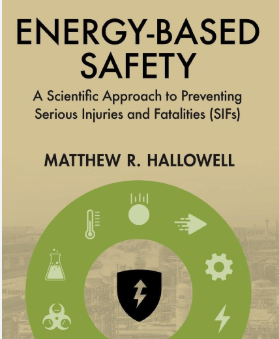
More extracts from Matt Hallowell’s energy based safety:
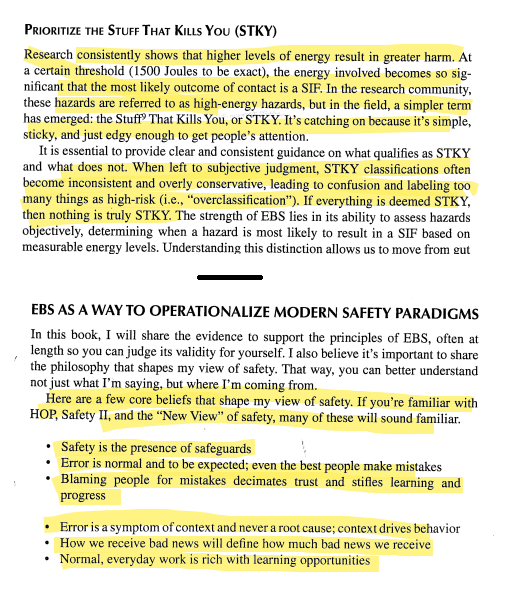
· “Research consistently shows that higher levels of energy result in greater harm. At a certain threshold (1500 Joules to be exact), the energy involved becomes so significant that the most likely outcome of contact is a SIF”
· “Every [physical] injury results from a transfer of energy to the human body; identifying and managing these transfers is at the heart of safety”
· These SIF potential hazards have been called the “Stuff That Kills You, or STKY”
· When qualifying STKY, “When left to subjective judgment, STKY classifications often become inconsistent and overly conservative, leading to confusion and labeling too many things as high-risk (i.e.,”overclassification”)”
· Hence “If everything is deemed STKY, then nothing is truly STKY”
· Matt outlines some core beliefs that’s shaped his views, including: safety is the presence of safeguards [** though in barrier thinking, safeguards are the lesser-dependable controls]. Error is normal and to be expected, blaming people for mistakes “decimates trust and stifles learning”, error is a symptom of context “and never a root cause”
· “To be adequate, controls must be targeted and intentional, strong enough to mitigate energy, and forgiving enough to account for human error”
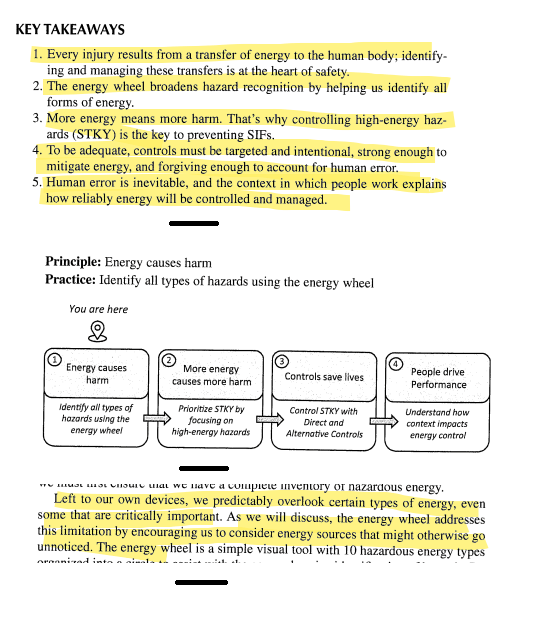
Regarding energy:
· “Left to our own devices, we predictably overlook certain types of energy, even some that are critically important”
· “We have come a long way in safety, but not far enough. We still rely mainly on instinct when recognizing hazards”
· “We identify, discuss, and record whatever hazards come to mind first, while systematically (and unknowingly) missing the rest”
· “If you want evidence of this trend, grab a pile of pre-job briefing forms. You will find that the hazards recorded are mostly the same: slips and trips, pinch points, dropped objects, and other common terms that reflect a repetitive, surface-level discussion”
· “Even among high-performing organizations, we have found that hazard recognition performance is far lower than imagined”
Finally, Matt argues:
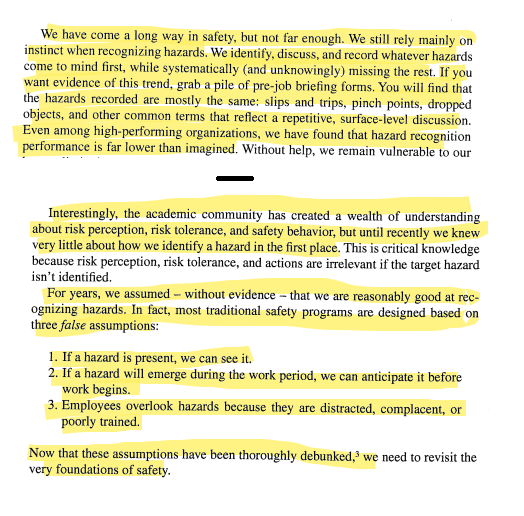
“For years, we assumed – without evidence – that we are reasonably good at recognizing hazards. In fact, most traditional safety programs are designed based on three false assumptions”
The false assumptions being:
· “If a hazard is present, we can see it”
· If a hazard will emerge during the work period, we can anticipate it before work begins”
· Employees overlook hazards because they are distracted, complacent, or poorly trained”
· “Now that these assumptions have been thoroughly debunked, we need to revisit the very foundations of safety”


 SafetyInsights.org