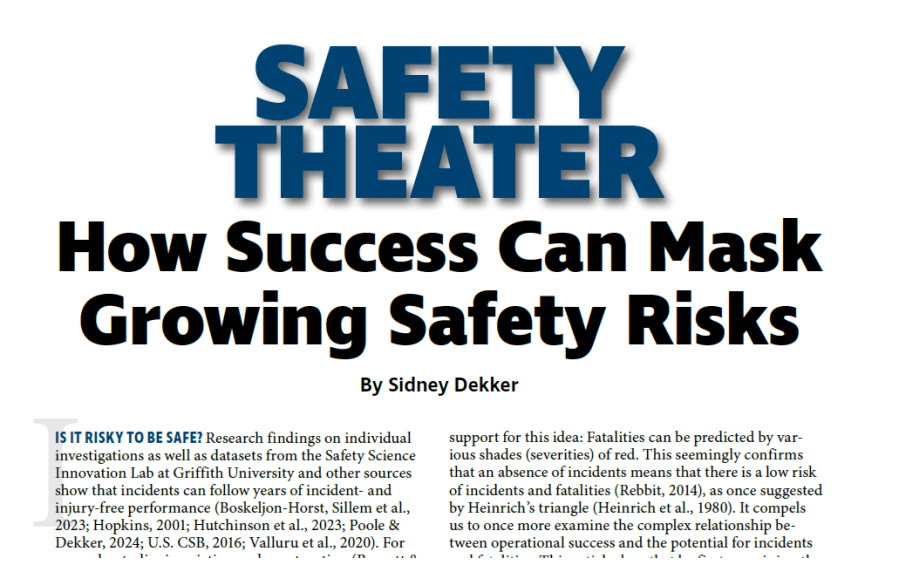
Extracts from Sid Dekker’s recent article on ‘Safety Theatre’
· “Is it risky to be safe? … [evidence shows] that fatalities can hide in the green: the fewer incidents or injuries, or the “greener” the audit or safety culture survey, the higher the organization’s fatal incident risk”
· “In contrast, conventional safety approaches rely on the absence of incidents as a signal of effective safety management”
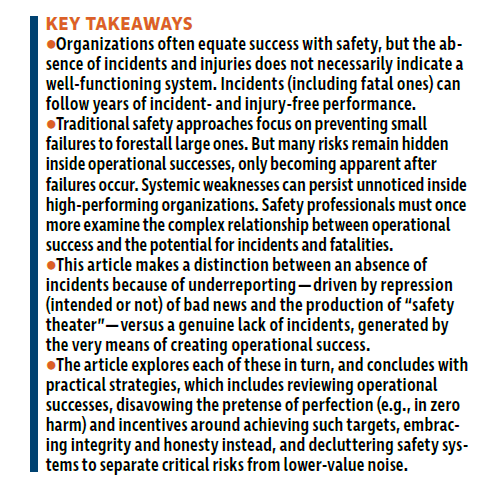
· There are examples of major incidents “that emanated from the “green” after long periods of apparently safe work without incident”
· Problematically with the evidence base, “individual case studies cannot adjudicate whether successful, failure-free performance contains the potential for incidents, or whether this potential hides in a persistent throb of smaller failures”
· “Safety theater” refers to the performance of work when subject to some form of surveillance (e.g., inspection, management visit, supervisor observation) in such a way as to demonstrate compliance”
· “During the performance of safety theater, informal ways of working slide out of view … It presents an image of work as imagined only to revert to work as done when left alone to continue work”
· “The misreading of what produces safety (strict compliance with safety rules) is really a misapprehension of everyday work, of what it takes to get the job done amidst goal conflicts, changing circumstances and limited resources”
· “Safety theater can occur when an organization lacks appetite for bad news”
· “The fundamental regulator paradox explains how a zero-harm program prevents an organization from seeing and managing its real safety risks …When the data is reduced to zero, safety professionals have no reliable signals to guide system management, leaving them with no meaningful information”
· “risks of zero reporting increase when management implements incentive systems that reward low or no incidents, or when companies must show an absence or a low number of incidents to secure contracts”
· “The easiest way to achieve zero is to keep quiet, hide bad news and keep playing safety theatre”
· “If an organization excels at producing something cheaply and efficiently, incidents often emerge through the same processes that made it successful”
· “success can be dangerously seductive. Visible success leads to more success, but invisible small compromises can build up, which can increase the chances of an incident. This pattern is known as the “drift into failure”
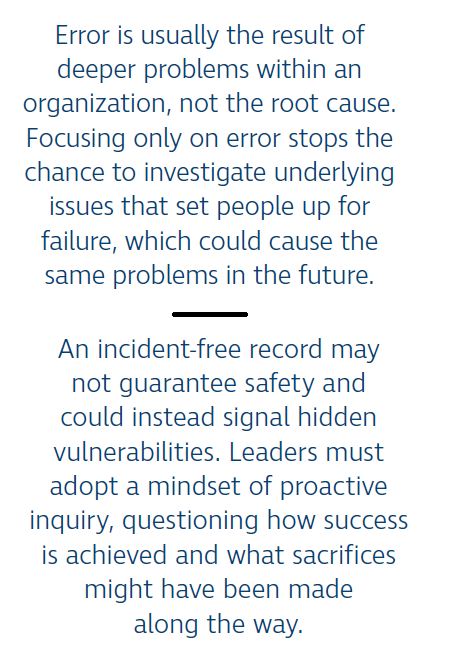
· “Error is usually the result of deeper problems within an organization …Focusing only on error stops the chance to investigate underlying issues that set people up for failure”
· “Develop safety metrics that reward transparency and move away from metrics based on the absence of bad news”
· “Shifting away from lagging indicators such as injury rates has often been recommended. Instead, organizations are encouraged to use measures of their safety capacities, such as their capacity to adequately understand, learn, respond to and provide the right resources for safe operations”
· “To break through risk secrecy when an organization is successful, organizations can … Acknowledge that high performance often masks risks”
· “Use structured post-success reviews (e.g., learning reviews, learning teams) to identify whether (or which) safety trade-offs were made to achieve operational and financial goals”
· “Engage those who know the organization but can see it with fresh eyes, and even switch roles with them”
· “Declutter safety systems … Many sources point to a rich oversupply of safety policies, rules and procedures, many of which cannot even be traced back to (or blamed on) regulations in most professional fields”
· “The problem with safety clutter is that when everything is treated as important, critical risks can be overlooked”
Ref: Dekker, S. (2025). PSJ PROFESSIONAL SAFETY OCTOBER 2025


 SafetyInsights.org