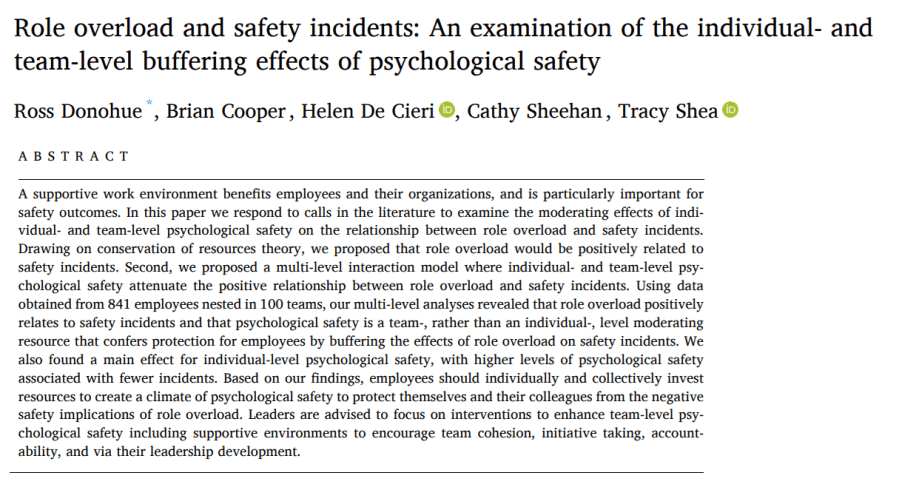
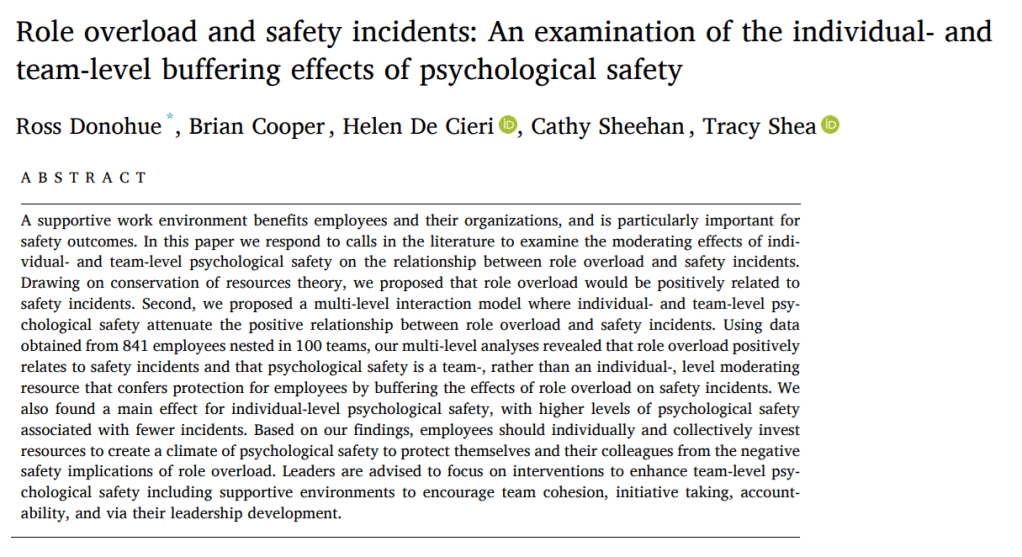
This study evaluated the how psychological safety can buffer the effects of role overload on safety incidents.
Data was from 841 employees across 100 teams in a large Australian health service.
Extracts:
· The analysis revealed that “role overload positively relates to safety incidents”
· Role overload is defined as quantitative role overload, occuring “when an individual perceives that the volume and pace of work they are required to perform is excessive”
· This stressor therefore depletes energy resources, exposing employees to “to greater risk of experiencing a safety incident”, resulting from cognitive factors like “inattention, fatigue, and distraction”
· Safety incidents included a sum of “reported safety incidents,” “unreported safety incidents,” and “near misses”
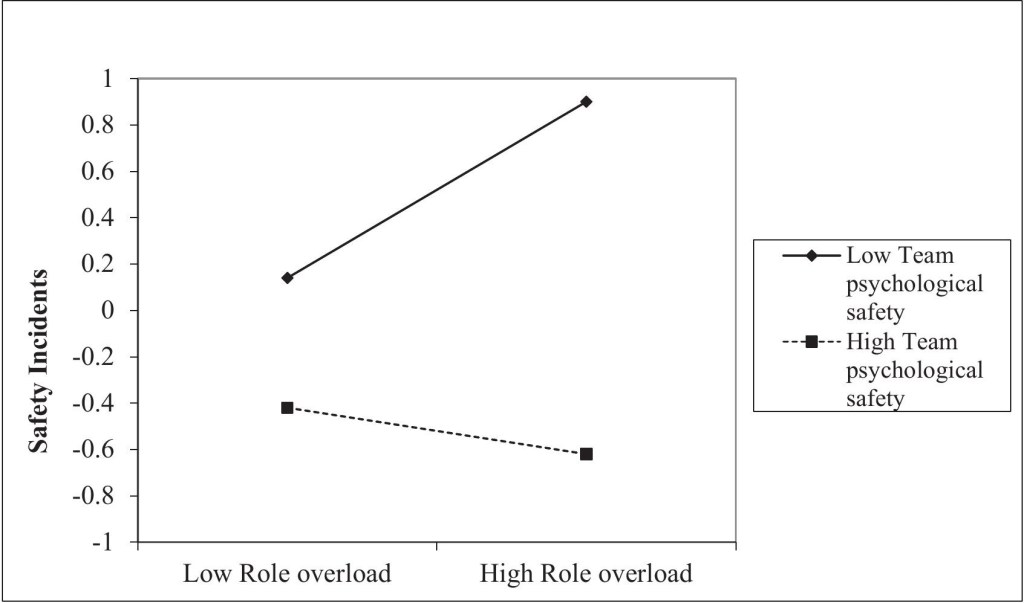
· For psychological safety’s effects, they say “psychological safety is a team-, rather than an individual-, level moderating resource that confers protection for employees by buffering the effects of role overload on safety incidents”
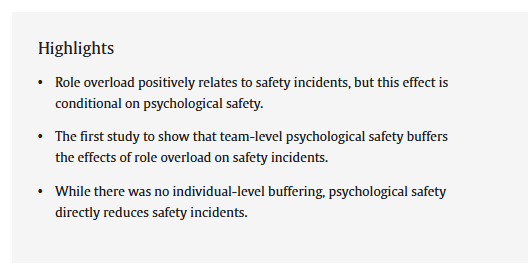
· The relationship between role overload and safety incidents was “weaker (de-intensified) with high… levels of team psychological safety and intensified when team psychological safety is low”
· In psychologically safer teams, the members “feel supported and can request help when under pressure” and can “look out for each other in terms of potential risks and provide assistance”
· Contrary to prediction, the study “did not find a statistically significant individual-level interaction” with individual psychological safety and role overload
· Further, while it didn’t act as a moderate, a significant effect was found with “higher levels of psychological safety associated with fewer incidents”
· They argue that the finding that only team-level PS moderated the relationship “challenges the homology assumption… that the effects of psychological safety are the same at different levels of analysis”
· “Employees should individually and collectively invest resources to create a climate of psychological safety”
· Leaders are “advised to focus on interventions to enhance team-level psychological safety”
· And PS interventions should include promoting “supportive environments to encourage team cohesion, initiative taking, accountability, and via their leadership development”
Ref: Donohue, R., Cooper, B., De Cieri, H., Sheehan, C., & Shea, T. (2026). Role overload and safety incidents: An examination of the individual-and team-level buffering effects of psychological safety. Safety Science, 193, 107008.


 SafetyInsights.org