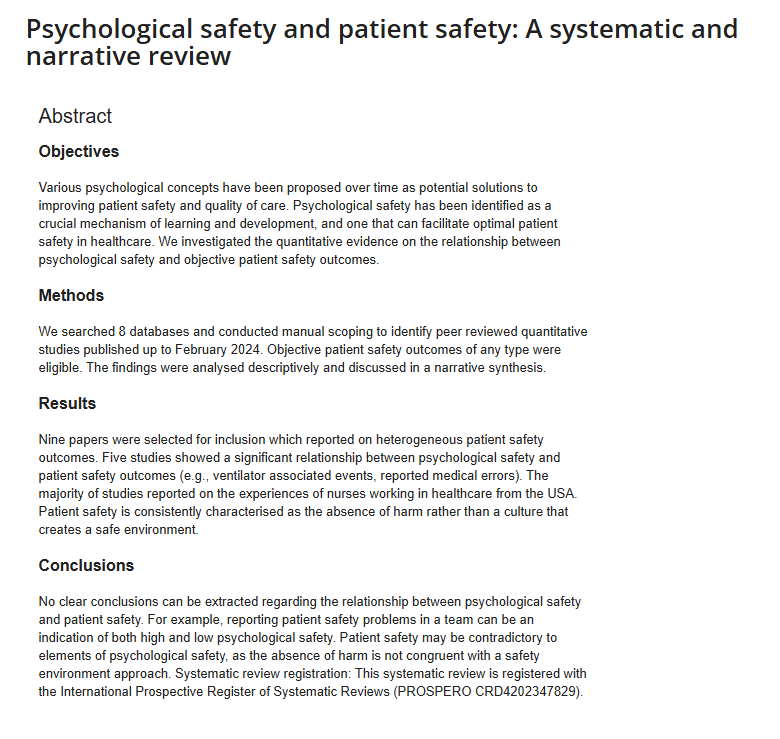
This explored the links between psychological safety and objective patient safety outcomes:
· “No clear conclusions can be extracted regarding the relationship between psychological safety and patient safety”
· “The evidence linking psychological and patient safety is equivocal”
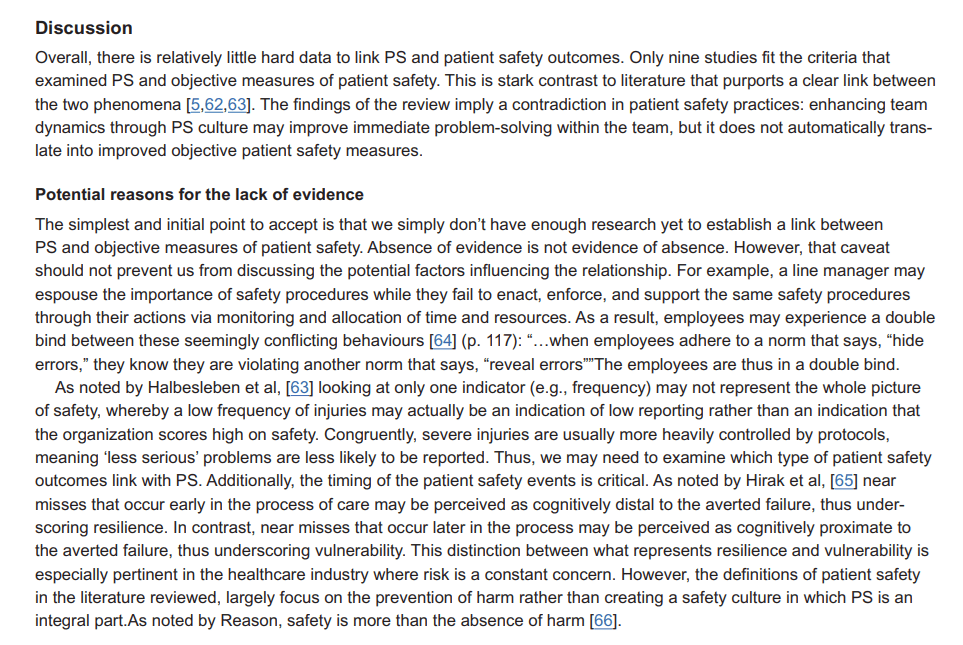
· “Overall, there is relatively little hard data to link PS and patient safety outcomes”
· “Only nine studies fit the criteria that examined PS and objective measures of patient safety”
· “Reporting patient safety problems in a team can be an indication of both high and low psychological safety”
· A “paradoxical phenomenon” occurs “whereby high PS teams appear to operate less safely due to their increased tendency to report more unsafe practices and the willingness to report incidents”
· “PS did not correspond to the use of the reporting system as professions with lower PS were more likely to use the reporting system compared to physicians who expressed the highest PS”
· “Of the nine studies, only five studies indicated a significant relationship between PS and patient safety”
· One study found that units with lower PS “reported a greater use of restraints with patients, but also found that units with higher PS utilized seclusion more”
· One study found “a negative association between PS and reported medical errors, suggesting that high-PS teams may have open dialogue among team members about errors to learn from mistakes and improve systems to reduce future errors”
· The influence of PS on reporting “is more pronounced in scenarios where near misses are perceived as more critical or dangerous”
· “Patient safety may be contradictory to elements of psychological safety, as the absence of harm is not congruent with a safety environment approach”
· The literature review suggests “that PS doesn’t work in the expected way in healthcare [6–8], where figuring out what can be talked about (and not talked about) trumps the generic idea of PS per se”
· “The most reliable evidence concerning the benefits of PS relate to creative/learning activities, however it can be detrimental concerning routine tasks”
· “The current literature focuses on what can be measured in terms of healthcare performance (harm) and not what is perceived (safety)”
Ref: Montgomery, A., Chalili, V., Lainidi, O., Mouratidis, C., Maliousis, I., Paitaridou, K., & Leary, A. (2025). Psychological safety and patient safety: A systematic and narrative review. PLoS One, 20(4), e0322215.

Shout me a coffee (one-off or monthly recurring)
Study link: https://doi.org/10.1371/journal.pone.0322215

 SafetyInsights.org