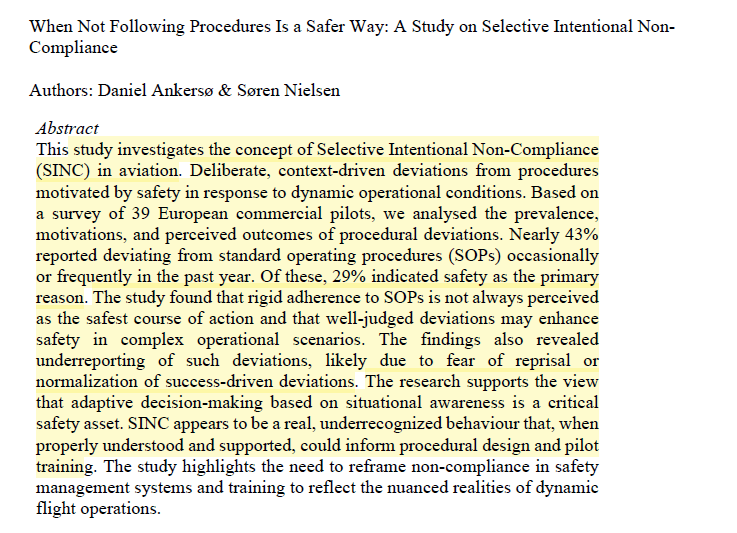
This Lund thesis from Daniel Ankersø & Søren Nielsen was cool – they interviewed 39 European commercial pilots exploring procedural departures.
Some extracts:
· They coin a new term – Selective Intentional Non-Compliance (SINC)
· SINC is “A purposeful and deliberate deviation from policies or procedures when a flight crew’s judgement is, that deviating from a procedure could improve flight safety”
· SINC leverages the idea that “procedures must be applied with judgment, flexibility, and practical sense and can be selectively strayed from when adherence to procedures would weaken flight safety, thus not be safest option”
· It’s selective as it’s non-habitual with “strong risk assessment and judgement” and “purposeful, deliberate, and grounded in situational understanding, not impulsiveness”
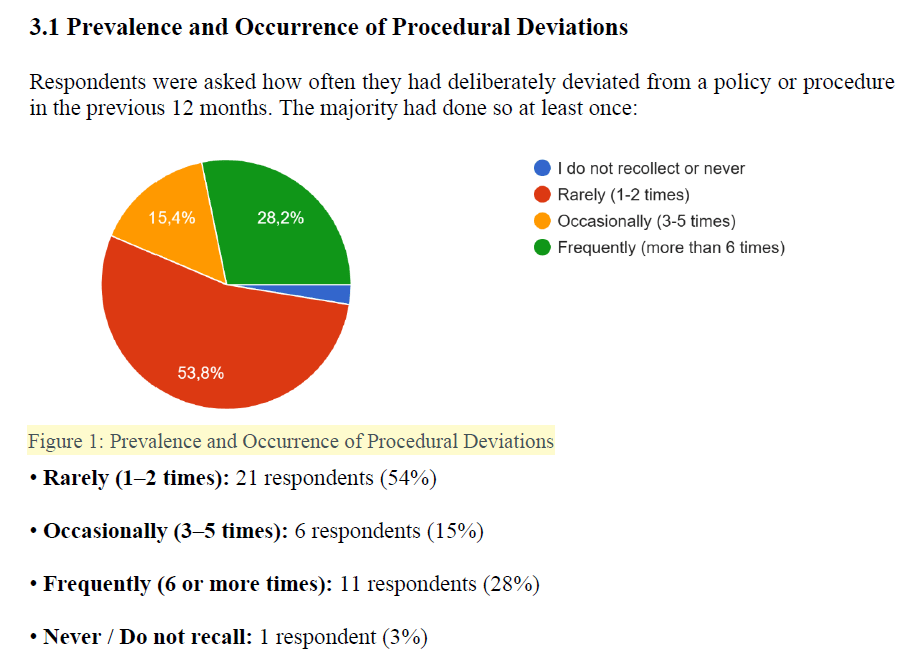
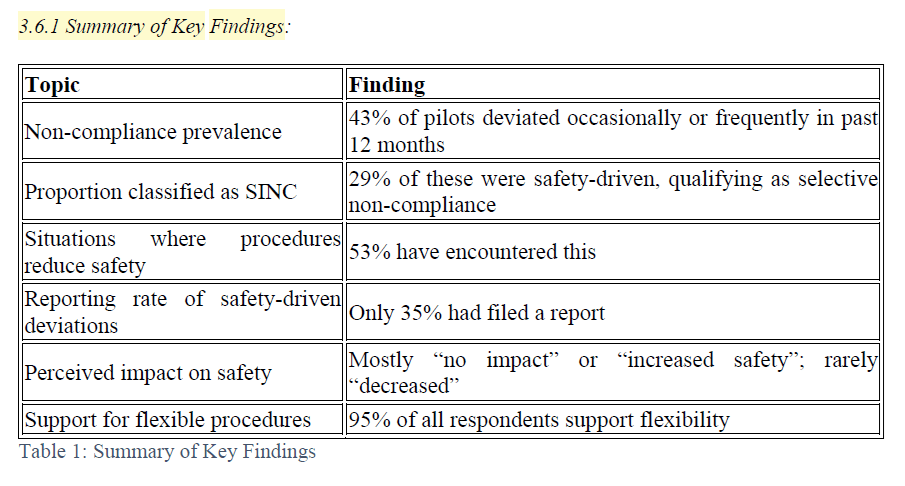
· They found 43% of respondents reported “reported occasional or frequent deviations from procedures, indicating that intentional non-compliance from procedure or policy noncompliance is a relatively frequent occurrence in flight operational contexts”
· Hence “intentional non-compliance is not a fringe behaviour but rather a normalized part of daily flight operations for nearly half the surveyed pilots”
· It “supports the idea that strict, unwavering adherence to SOPs is often unrealistic in the dynamic operational context of aviation”
· “real-world flight environments routinely present situations where SOPs may be impractical or inappropriate, requiring pilots to make contextual judgments”
· And “non-compliance is often a response to a complex situation where one needs to look beyond the current situation and plan, not carelessness”
· “These results counter the common narrative that non-compliance stems primarily from laziness or performance pressure”
· Pilots recognise the need to apply SINC, and hence depart from procedures to maintain safety margins and where “rigid application could introduce risk, not mitigate it”
· “As a result, procedures must be complemented with pilot judgment and adaptability”
· Significant incident underreporting was also observed by pilots and “particularly for non-compliance when it leads to no negative outcome (e.g., incident or accident)”
· “It appears that many flight crews underreport safety-driven deviations with positive outcome”
· All respondents provided agreement that “flight crews should have operational flexibility to deviate from procedures when it is perceived to enhance safety”
· And “checklists and SOPs should be designed with flexibility and adaptability in mind. Procedures should support good decision-making and not replace it”
· “The practical experience from the real world of aviation seems to confirm that contextual judgment is not only necessary but expected”
Ref: When Not Following Procedures Is a Safer Way. Daniel Vagner Ankersø & Søren Nielsen. Lund 2025

Shout me a coffee (one-off or monthly recurring)
Study link: https://lup.lub.lu.se/luur/download?func=downloadFile&recordOId=9213938&fileOId=9213939

 SafetyInsights.org