Coping with uncertainty: The interaction of psychological safety and authentic leadership in their effects on defensive decision making
This studied the relationship between defensive decision making and psychological safety and authentic leadership.
315 managers were involved in an experimental scenario.
Extracts:
· Defensive decision making occurs “when employees do not decide in the best interest of the organization but rather opt for a personally safer alternative”, e.g. ordering unnecessary medicine, tests or inspections, excessive designs
· They describe it via CYA (“cover your ass”), in case something goes wrong they’ve effectively covered themselves
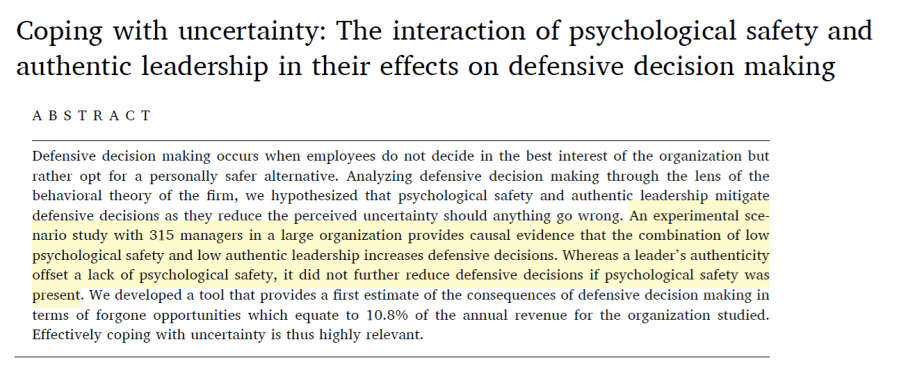
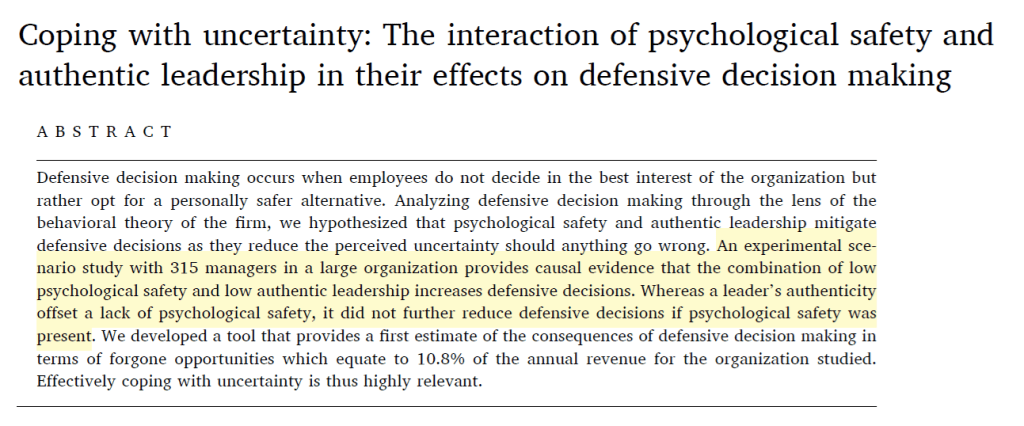
· They provide “causal evidence that the combination of low psychological safety and low authentic leadership increases defensive decisions”
· “Whereas a leader’s authenticity offset a lack of psychological safety, it did not further reduce defensive decisions if psychological safety was present”
· “When a team lacks psychological safety, authentic leadership plays a crucial role in mitigating defensive decisions” and specifically “a leader’s authenticity offset a lack of psychological safety”
· When psychological safety “was present, the occurrence of defensive decisions was unaffected by the authenticity of the leader’s behavior, indicating substitution of leadership”
· Hence authentic leadership didn’t “further reduce defensive decisions if psychological safety was present”
· Defensive decision making was equated to “10.8% of the annual revenue for the organization studied”
· “Our study indicates that decision makers working in a psychologically safe environment effectively deal with uncertainty regardless of the leader’s authenticity”
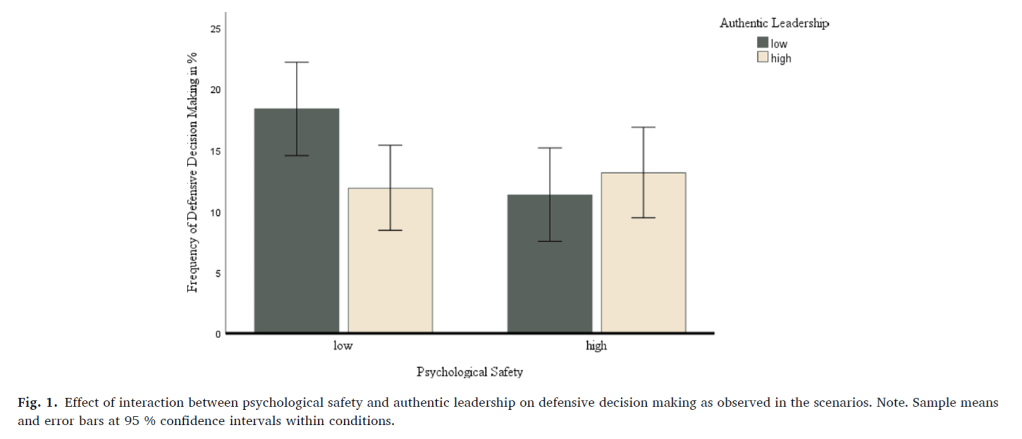
· And “either authentic leadership or psychological safety needs to be present to reduce defensive decision making, but not both”
· “While leaders play a key role in developing psychological safety … [other researchers] contended that other factors, such as organizational norms and work design characteristics (such as autonomy and role clarity) are also relevant for creating psychological safety”
· “Thus, to cultivate psychological safety sustainably, organizations need to adopt a broader perspective that goes beyond leader-centric measures”
· “Cover your ass” is a term used in the managerial world to describe a situation where decision makers opt for the personally safer option that protects themselves rather than pursue a more uncertain option that is in the organization’s best interest”
· “However, by fostering authentic leadership behavior and cultivating psychological safety, organizations can empower employees to resist attempts to avoid it and protect themselves in their decisions and to instead cope with uncertainty more effectively”
Ref: Artinger, F. M., Marx-Fleck, S., Junker, N. M., Gigerenzer, G., Artinger, S., & van Dick, R. (2025). Journal of Business Research, 190, 115240.

Shout me a coffee (one-off or monthly recurring)
Study link: https://doi.org/10.1016/j.jbusres.2025.115240

 SafetyInsights.org