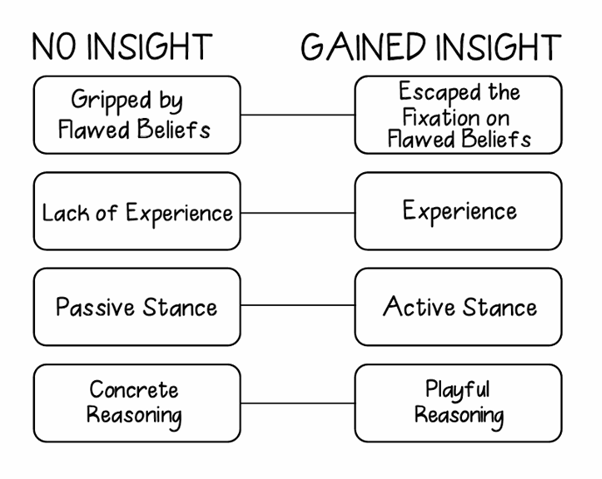
Extracts from Gary Klein’s ‘Seeing What Others Don’t’, about how insights and intuitions emerge, or don’t.
Based on cases examined by Klein:
· Insights failed to emerge when some “fixated on some erroneous ideas that blinded them to the discovery”
· “The strategy for the successful twins seemed to be to speculate and test, whereas the failure twins clung to the flawed belief and wouldn’t let go of it”
· “We’re likely to miss the insight if we rely on a flawed belief, either in a theory or in data, and we make it worse if we’re pigheaded and fixate on that belief”
· “The more central the belief is to our thinking, the harder it is to give up”
· “We are much more likely to explain away any anomalies rather than revise our beliefs in the face of them”
· “17 out of the 30 failure twins simply lacked the experience to see the implications and gain the insight”
· “Experience isn’t just about having the necessary knowledge. Experience is about how we use our knowledge to tune our attention”
· “Our background can sensitize us to cues or patterns that others might miss”
· “People with a generally prepared mind haven’t done specific homework to get ready for their insight. Rather, their efforts and their interests have prepared them to notice things others miss”
· “Many of the failure twins seemed passive. They took care of the necessary tasks but didn’t actively scan for new developments and opportunities”
· “The active stance twins were open to data and inquiry, collecting new data” whereas “The twins with the passive stance didn’t even inquire”
· “People differ in how well they tolerate contradictions and ambiguity, and this personality style likely affects their success at gaining insights”
· Concrete thinkers, “just want to work with the facts, not with flights of fancy”
· “This concrete reasoning style wouldn’t leave people very open to insights”
· “The playful reasoning style likes to juggle ideas and imagine hypothetical scenarios”
· “This personality trait is about having a playful mind and enjoying speculations about hypothetical situations”
· Hence, insights emerge where people entertain the improbable and imagine the impossible

Shout me a coffee (one-off or monthly recurring)
Ref: Klein, G. 2017, Seeing What Others Don’t.

 SafetyInsights.org