
More wisdom from Don Norman on human-centred design and his error credo (which in later work he extends to humanity-centred design):
· “Pinning the blame on the person may be a comfortable way to proceed, but why was the system ever designed so that a single act by a single person could cause calamity?”
· “Eliminate the term human error. Instead, talk about communication and interaction … When people collaborate with one another, the word error is never used to characterize another person’s utterance”
· “That’s because each person is trying to understand and respond to the other, and when something is not understood or seems inappropriate, it is questioned, clarified, and the collaboration continues”
· “Machines are not people. They can’t communicate and understand the same way we do. This means that their designers have a special obligation to ensure that the behavior of machines is understandable to the people who interact with them.”
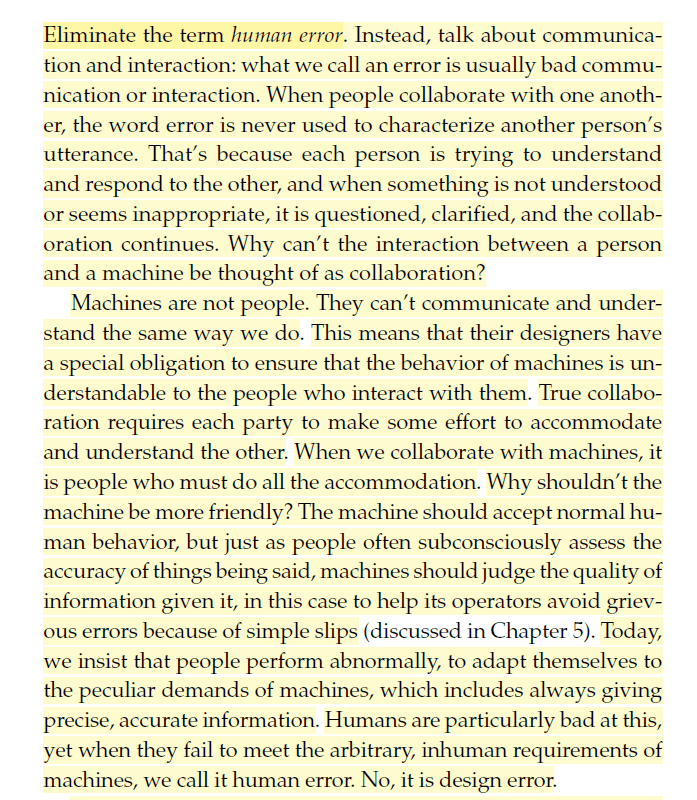
· “When we collaborate with machines, it is people who must do all the accommodation. Why shouldn’t the machine be more friendly? The machine should accept normal human behavior, but just as people often subconsciously assess the accuracy of things being said”
· “we insist that people perform abnormally, to adapt themselves to the peculiar demands of machines, which includes always giving precise, accurate information. Humans are particularly bad at this, yet when they fail to meet the arbitrary, inhuman requirements of machines, we call it human error”
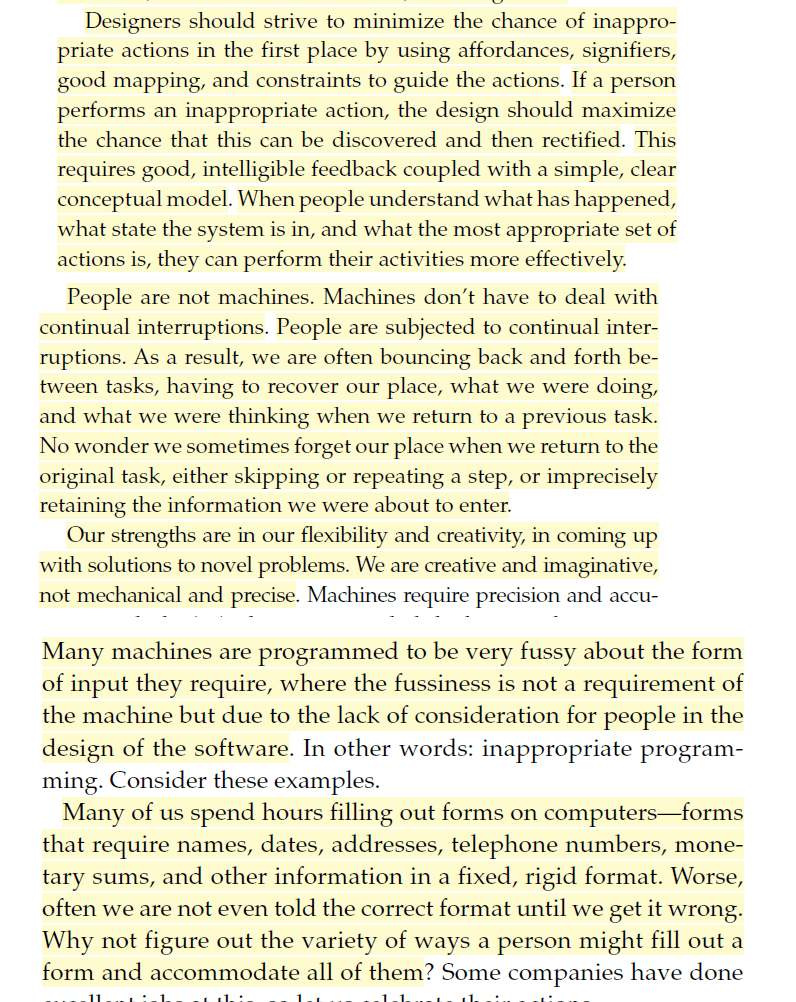
· “Designers should strive to minimize the chance of inappropriate actions in the first place by using affordances, signifiers, good mapping, and constraints to guide the actions”
· “People are not machines. Machines don’t have to deal with continual interruptions. People are subjected to continual interruptions. As a result, we are often bouncing back and forth between tasks, having to recover our place, what we were doing, and what we were thinking when we return to a previous task”
· “Our strengths are in our flexibility and creativity, in coming up with solutions to novel problems. We are creative and imaginative, not mechanical and precise”
· “Machines require precision and accuracy; people don’t. And we are particularly bad at providing precise and accurate inputs. So why are we always required to do so?”
· “Many machines are programmed to be very fussy about the form of input they require, where the fussiness is not a requirement of the machine but due to the lack of consideration for people in the design of the software”
Ref: Norman (2013). The Design of Everyday Things


 SafetyInsights.org