
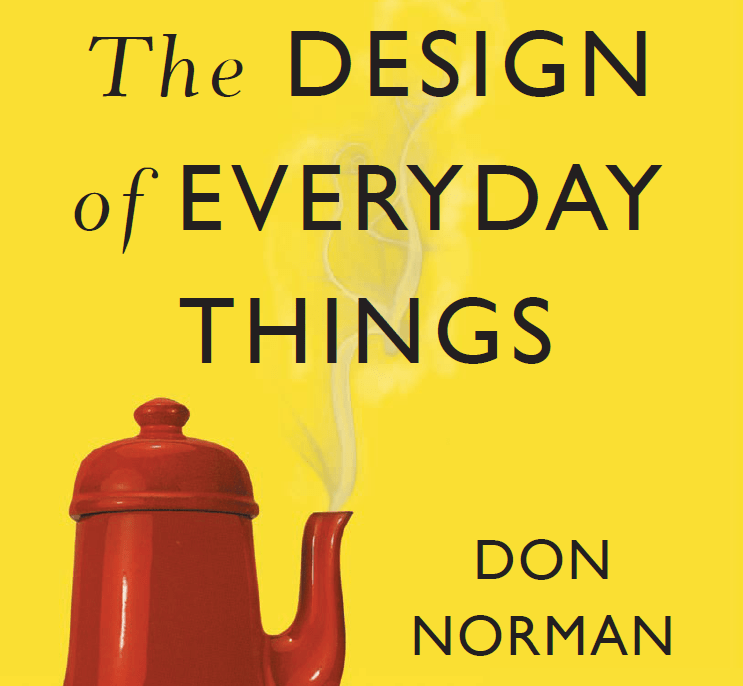
Here Don Norman discusses knowledge in the head vs knowledge in the world – from The Design of Everyday Things.
Extracts:
· “Every day we are confronted by numerous objects, devices, and services, each of which requires us to behave or act in some particular manner. Overall, we manage quite well”
· “Our knowledge is often quite incomplete, ambiguous, or even wrong, but that doesn’t matter: we still get through the day just fine. How do we manage? We combine knowledge in the head with knowledge in the world”
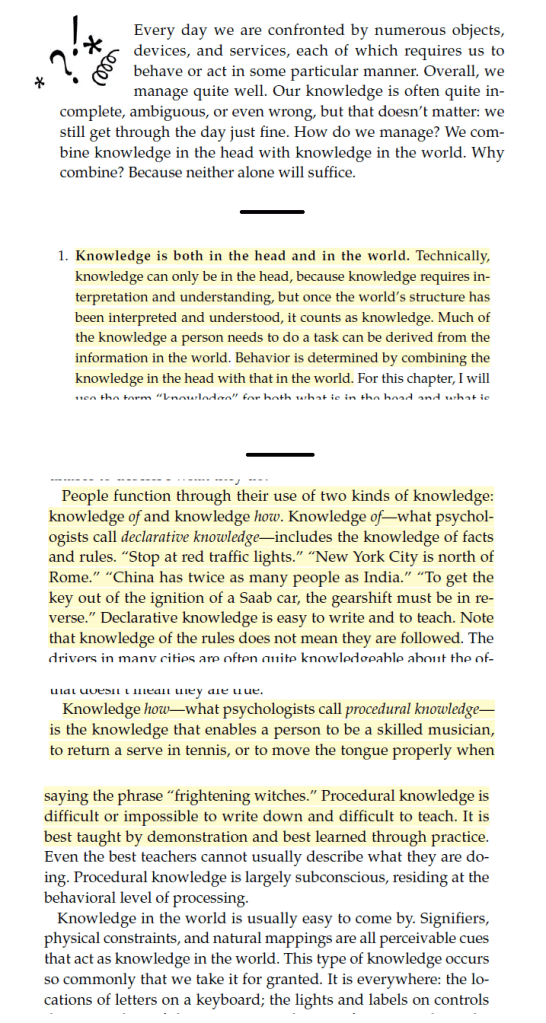
· “Knowledge is both in the head and in the world. Technically, knowledge can only be in the head, because knowledge requires interpretation and understanding, but once the world’s structure has been interpreted and understood, it counts as knowledge”
· “Much of the knowledge a person needs to do a task can be derived from the information in the world. Behavior is determined by combining the knowledge in the head with that in the world”
· “Whenever knowledge needed to do a task is readily available in the world, the need for us to learn it diminishes”
· “We only need to remember sufficient knowledge to let us get our tasks done. Because so much knowledge is available in the environment, it is surprising how little we need to learn”
· “This is one reason people can function well in their environment and still be unable to describe what they do” (e.g. like drawing how a bike works)
· “People function through their use of two kinds of knowledge: knowledge of and knowledge how. Knowledge of—what psychologists call declarative knowledge—includes the knowledge of facts and rules. “Stop at red traffic lights”
· “Declarative knowledge is easy to write and to teach. Note that knowledge of the rules does not mean they are followed”
· “Knowledge how—what psychologists call procedural knowledge— is the knowledge that enables a person to be a skilled musician, to return a serve in tennis”

· “Procedural knowledge is difficult or impossible to write down and difficult to teach. It is best taught by demonstration and best learned through practice”
· “Procedural knowledge is largely subconscious, residing at the behavioral level of processing”
· “Knowledge in the world is usually easy to come by. Signifiers, physical constraints, and natural mappings are all perceivable cues that act as knowledge in the world”
· “Knowledge in the world, external knowledge, is a valuable tool for remembering, but only if it is available at the right place, at the right time, in the appropriate situation. Otherwise, we must use knowledge in the head, in the mind”
· “Effective memory uses all the clues available: knowledge in the world and in the head, combining world and mind”
· “Knowledge in the world and knowledge in the head are both essential in our daily functioning .. [but can require] a tradeoff”
· Norman then goes to some length to discuss the nature of distributed cognition (but I’m out of space…)


 SafetyInsights.org