Extracts from the Callide investigation, involving a significant boiler pressure event. Thanks to @wade n for flagging this report.
Not going into the event details – so check out the report.
Extracts:
· “The incident reflects a systemic failure to manage both technical and organisational risks, highlighting the critical need for integrated system reviews, clearly defined performance standards, and disciplined oversight of process safety”
· “The incident was triggered by the concurrent failure of several independent controls”
· “Clinker falls were treated as routine operational events rather than serious process safety concerns. As a result, these events were not consistently reported, investigated, or escalated”
· “This normalisation eroded oversight, diminished risk visibility, and contributed to missed opportunities for control improvements”
· “The Burner Management System incorporates multiple layers of logic and sequencing. However, there is no unified view of how the system behaves under critical conditions”
· “Control logic diagrams are fragmented, and there is no accessible, documented end-to-end representation of system operation during a real-world event”
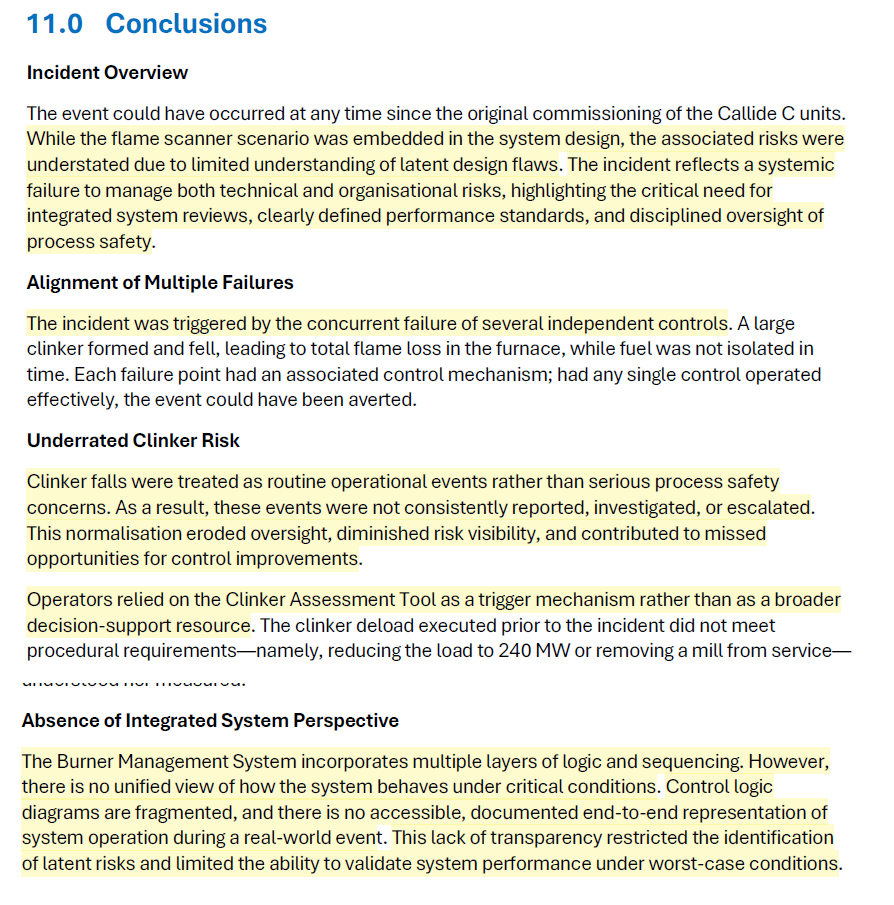
· “This lack of transparency restricted the identification of latent risks and limited the ability to validate system performance under worst-case conditions”
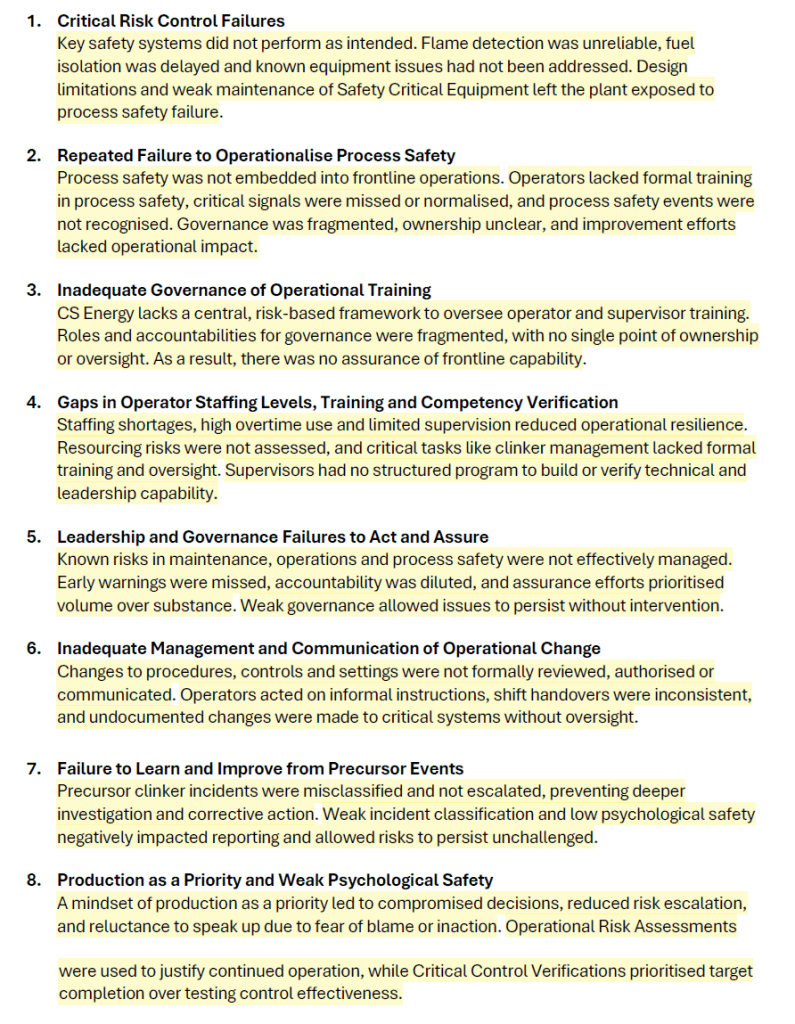
· “Key safety systems did not perform as intended”
· “Process safety was not embedded into frontline operations. Operators lacked formal training in process safety, critical signals were missed or normalised, and process safety events were not recognised”
· “Governance was fragmented, ownership unclear, and improvement efforts lacked operational impact”
· “Staffing shortages, high overtime use and limited supervision reduced operational resilience”
· “Resourcing risks were not assessed, and critical tasks like clinker management lacked formal training and oversight”
· “Supervisors had no structured program to build or verify technical and leadership capability”
· “Early warnings were missed, accountability was diluted, and assurance efforts prioritised volume over substance”
· “Weak governance allowed issues to persist without intervention”
· “A mindset of production as a priority led to compromised decisions, reduced risk escalation, and reluctance to speak up due to fear of blame or inaction”
· “Operational Risk Assessments were used to justify continued operation, while Critical Control Verifications prioritised target completion over testing control effectiveness”

Shout me a coffee (one-off or monthly recurring)
Report link: https://www.csenergy.com.au/ArticleDocuments/276/Callide%20Power%20Station%20Unit%20C3%20Incident%20Report.pdf.aspx

 SafetyInsights.org