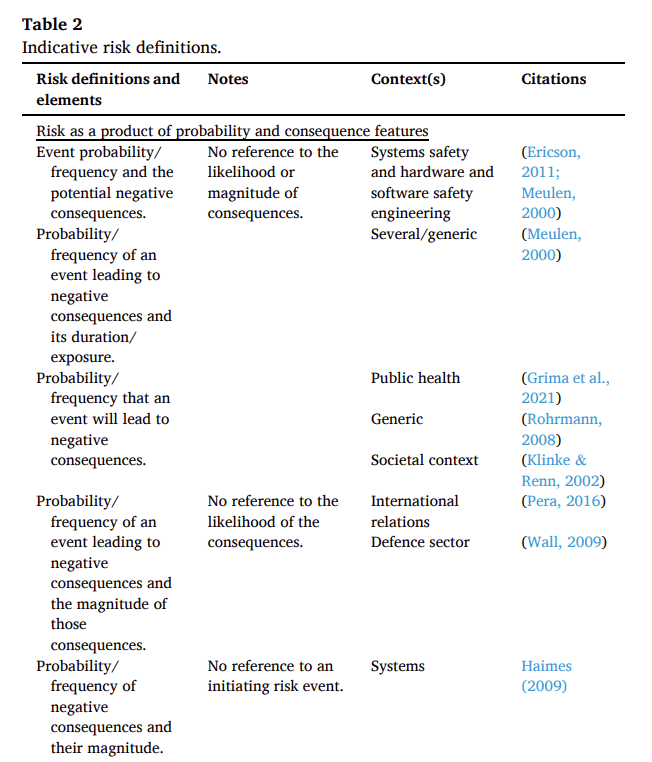
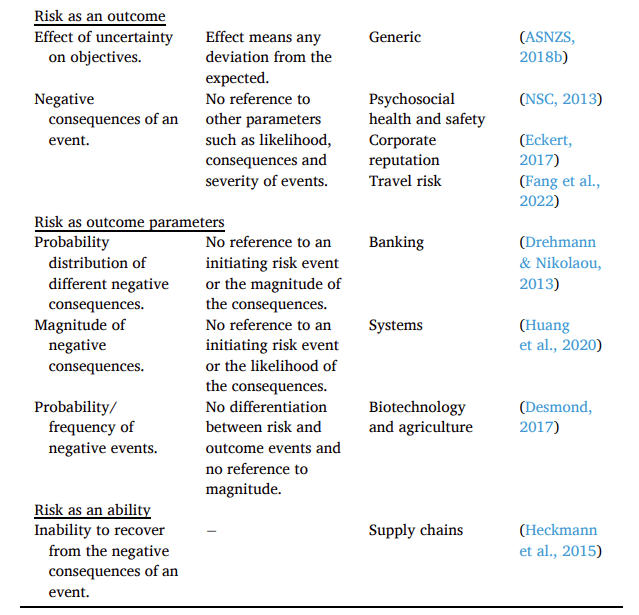
While on the topic of risk (see the post from yesterday – link below), the first two images have a group of definitions.
Images 2/3 below highlight one perspective from Prof Terje Aven.
And, without excluding other definitions, here they argue that risk can include: “identified events and consequences, assigned probabilities, uncertainty intervals, strength of knowledge judgements, as well as considerations about surprises (black swans)”.
In other works they also incorporate resilience, risk appetite, and more, into their definitions. They have argued that risk is often, but not always, a combination of objective, subjective, and intersubjective elements.
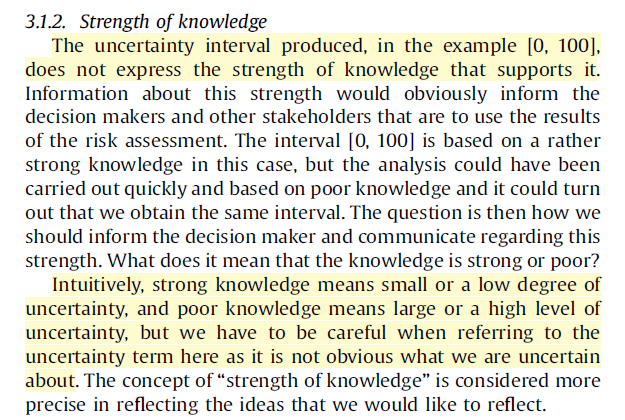
They provide a means of assessing the strength of knowledge that underpins the assumptions and data informing risk.
E.g. “Intuitively, strong knowledge means small or a low degree of uncertainty, and poor knowledge means large or a high level of uncertainty”.
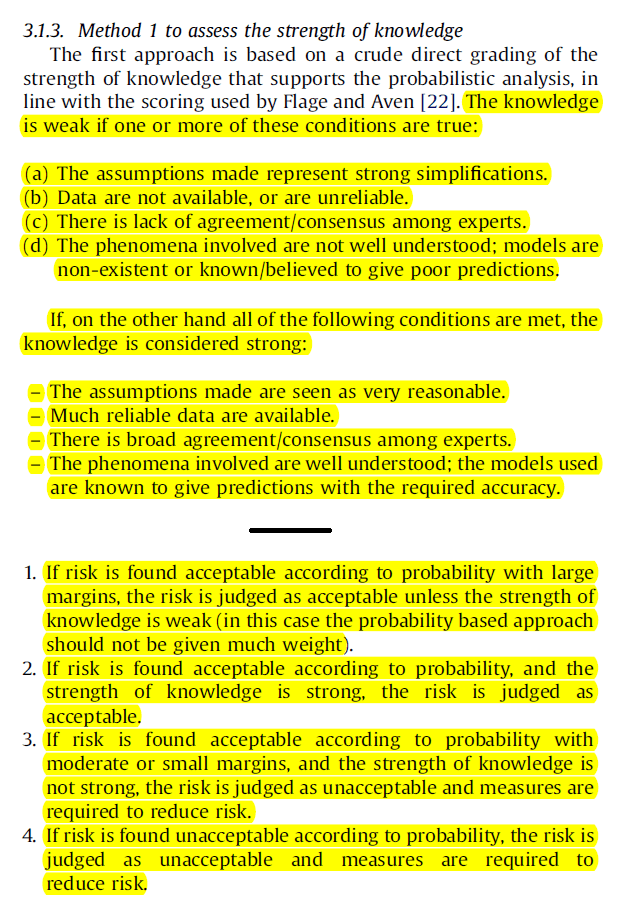
Weak knowledge can be represented by assumptions of strong simplifications, data isn’t available or is unreliable, a lack of agreement of consensus, and poorly understood phenomena.
In his podcast, they gave an example like this being a strongly justified belief: “we can conclude that it is safe to fly as the probability of undesirable consequences is low and the supporting knowledge strong”.
Yesterday’s article: https://safetyinsights.org/2025/12/01/risk-as-a-social-construction-and-notes-on-quantification-from-prof-terje-aven/
Refs:
Images 1-2: Karanikas, N., & Zerguine, H. (2025). Redefining health, risk, and safety for occupational settings: A mixed-methods study. Safety Science, 181, 106698.
Images 3-5: Aven, T. (2013). Practical implications of the new risk perspectives. Reliability Engineering & System Safety, 115, 136-145.
Prior post:


 SafetyInsights.org