This 2010 appeal involved the death of a backhoe operator, who was working near two sediment ponds.
He suffered a heart attack and subsequently fell into a pond and drowned.
Just a few extracts:
· The ponds had a ramp, where a chain was attached with a sign saying “Strictly No Admittance”; two other signs were near a railing near the pond reading “Danger Deep Water”
· The prosecution hinged specifically on the risk, rather than the death, noting “I am satisfied that the risk as alleged namely the risk that someone working in or near the sediment ponds could fall into it was a relevant risk”
· “That the risk was known was evidenced from some of the things that were in place – the no access area in front of the sediment ponds, the chain with a warning sign ‘Strictly No Admittance’ at the entrance to the ramp, the fence around the sediment pond, some of the signage”
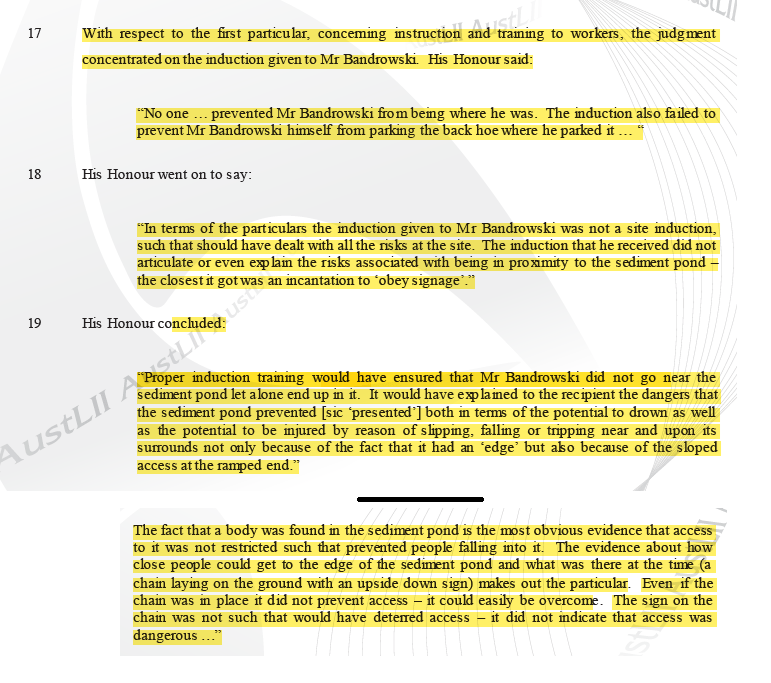
· “concerning instruction and training to workers, the judgment concentrated on the induction given to Mr Bandrowski. His Honour said: “No one … prevented Mr Bandrowski from being where he was. The induction also failed to prevent Mr Bandrowski himself from parking the back hoe where he parked it … “
· “the induction given to Mr Bandrowski was not a site induction, such that should have dealt with all the risks at the site. The induction that he received did not articulate or even explain the risks associated with being in proximity to the sediment pond – the closest it got was an incantation to ‘obey signage’.
· “Proper induction training would have ensured that Mr Bandrowski did not go near the sediment pond let alone end up in it. It would have explained to the recipient the dangers that the sediment pond prevented [sic ‘presented’] both in terms of the potential to drown as well as the potential to be injured … not only because of the fact that it had an ‘edge’ but also because of the sloped access at the ramped end”
· They also focused on the fact that there was little in the way to prevent people from accessing the pond – “The fact that a body was found in the sediment pond is the most obvious evidence that access to it was not restricted such that prevented people falling into it”
· “Even if the chain was in place it did not prevent access – it could easily be overcome. The sign on the chain was not such that would have deterred access – it did not indicate that access was dangerous …”
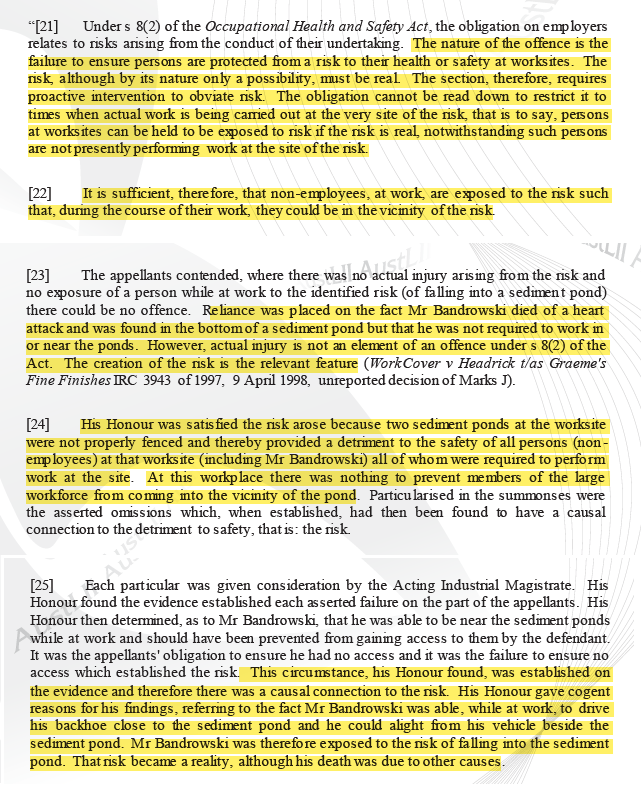
· “Under s 8(2) of the Occupational Health and Safety Act, the obligation on employers relates to risks arising from the conduct of their undertaking. The nature of the offence is the failure to ensure persons are protected from a risk to their health or safety at worksites”
· “The risk, although by its nature only a possibility, must be real. The section, therefore, requires proactive intervention to obviate risk”
· “The obligation cannot be read down to restrict it to times when actual work is being carried out at the very site of the risk, that is to say, persons at worksites can be held to be exposed to risk if the risk is real, notwithstanding such persons are not presently performing work at the site of the risk”
· “It is sufficient, therefore, that non-employees, at work, are exposed to the risk such that, during the course of their work, they could be in the vicinity of the risk”
· The appellants contested the link to the risk and exposure, since the deceased died of a heart attack and wasn’t supposed to be working near the ponds
· However, “actual injury is not an element of an offence under s 8(2) of the Act. The creation of the risk is the relevant feature”
- And “the risk arose because two sediment ponds at the worksite were not properly fenced and … there was nothing to prevent members of the large workforce from coming into the vicinity of the pond”
- And “the risk arose because two sediment ponds at the worksite were not properly fenced and … there was nothing to prevent members of the large workforce from coming into the vicinity of the pond”
- The worker was able, while at work, to “drive his backhoe close to the sediment pond and he could alight from his vehicle beside the sediment pond. Mr Bandrowski was therefore exposed to the risk of falling into the sediment pond. That risk became a reality, although his death was due to other causes”
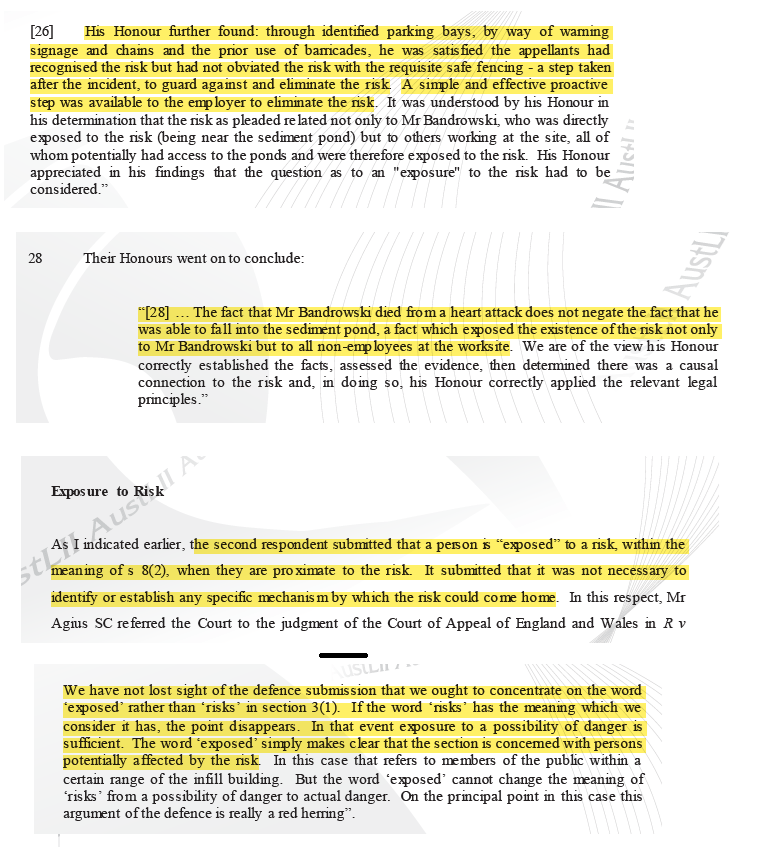
- “His Honour further found: through identified parking bays, by way of warning signage and chains and the prior use of barricades, he was satisfied the appellants had recognised the risk but had not obviated the risk with the requisite safe fencing – a step taken after the incident, to guard against and eliminate the risk”
- “A simple and effective proactive step was available to the employer to eliminate the risk”
- “The fact that Mr Bandrowski died from a heart attack does not negate the fact that he was able to fall into the sediment pond”
- And an “open body of water presented a risk to non-employees at work at the site of falling into the sediment ponds on the relevant date. The risk was real not remote, notwithstanding the fact that work was not normally performed by persons”
- They also unpacked ‘exposure to risk’ – which was argued to mean somebody being “proximate to the risk”. However, “It submitted that it was not necessary to identify or establish any specific mechanism by which the risk could come home”
- “We have not lost sight of the defence submission that we ought to concentrate on the word ‘exposed’ rather than ‘risks’”
- “If the word ‘risks’ has the meaning which we consider it has, the point disappears. In that event exposure to a possibility of danger is sufficient. The word ‘exposed’ simply makes clear that the section is concerned with persons potentially affected by the risk”
Ref: Thiess Pty Limited v Industrial Court of New South Wales [2010] NSWCA 252


 SafetyInsights.org
One thought on “2010 legal appeal/prosecution: unpacking exposure to risk, value of inductions, and other concepts”