

What factors facilitate or obstruct learning from incidents in construction?
This systematic literature review evaluated 30 papers from 12 countries.
* Parts 2 & 3 in comments *
Extracts:
· Overall, they identified four core learning topics: 1) learning input, 2) learning process, 3) learning participant, 4) learning context – see image 2 for context
· “learning context has the greatest impact on the formation of LFI [Learning From Incidents] … followed by learning participant … learning process … and learning input”
· “short of effectual LFI system is the most obstructive element, whereafter organizational bullying, and participants’ beliefs (e.g. unsafe behavior of workers causing most accidents)”
· That is, a belief that accidents mostly derive from individuals and behaviour was a dominant barrier to effective organisational learning
· For learning inputs – “undetected and unidentified reportable incidents (n = 11), lack of attention to minor precursor incidents (n = 6), underreporting of discovered incidents (n = 4), and ambiguous interpretation of causal relationship (n = 4) were identified as the influencing factors of the learning input dimension for LFI in construction industry”
· “managers and front-line staff have difficulty agreeing on what counts as an “incident”
· “Second, “what is worth reporting” depends largely on the definitional domain and boundary of reportable incidents depicted by the organizations”
· They note that learning is influenced with “whether the organizational culture values small incidents and attempted incidents as significant sources of learning”
· “most articles agree that managerial level in construction industry is reluctant to report near misses”
· For some, some incidents and near misses are regarded as “daily fluke events … as being naturally related to normal work … To overcome this idea, Baker et al. (2018) and Martins et al. (2022) proposed that organizations can learn more by combining daily operation and the project process, rather than assessing and investigating the serious consequence incidents”
· According to one source, “27% of 135 construction workers did not report their injuries. Underreporting is the key inhibitor of LFI, mainly due to employees’ fear of criticism”
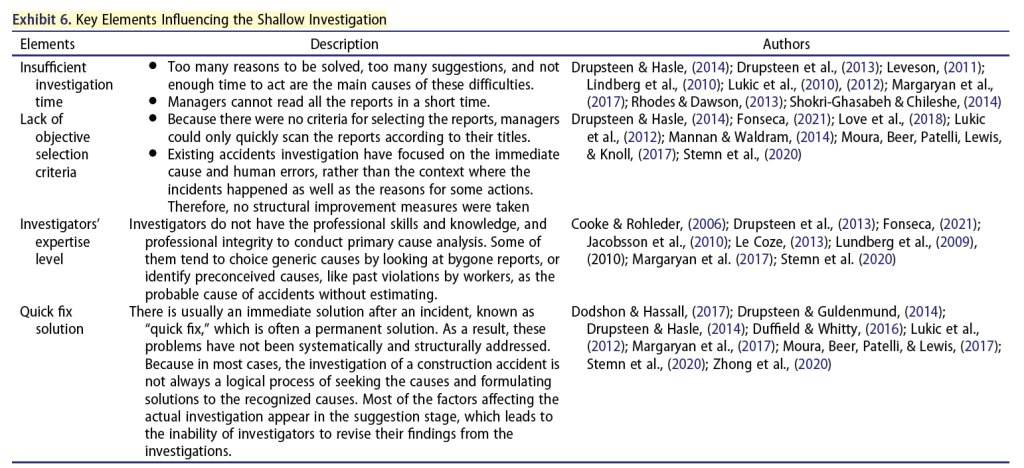
· Further, “some literature agrees that when the explanation of incident causality is ambiguous, the focus of investigation is placed on individuals rather than processes, because causal factors associated with individual behaviors are more readily and most normally recognized than organizational elements”
· “learning usually happens at a very local level, such as the particular location in the site where the accident happened. The learning content is finite documents, mainly through discussion within work shifts and notes in daily record. Thus, it makes LFI hard to happen at the organizational level”
· “Lukic et al. (2012) further indicated that oversimplification of learning points is also the main reason for the inadequate description of reported incidents, implying a ‘root cause lure.’ In most cases, information about incidents was available from a single source (e.g., intranet or e-mail), and the accident investigation report did not report what management had done to prevent a recurrence”
· “financial and political pressures are primary causes of LFI barriers (Leveson, 2011). LFI should describe changes in systems and human behaviors over time through process control from a long-term perspective, rather than focusing the problems on considering individual incidents and human behaviors”
· “18 articles indicated that participants have a deep-rooted belief that accidents are widely attributed to operational errors (Leveson, 2011). Geller (2014) labeled people with such thoughts as safety bullying, and he showed that such beliefs shift the focus of organizational culture and management system problems to individuals”
· “Organizational bullying (n = 19), Lack of trust, communication, and knowledge sharing (n = 15), formal/informal learning structure (13) and Managers’ attitude (n = 11) were identified as the key influencing factors of the learning context dimension for LFI in construction industry”
· “Organizational bullying (n = 19). Investigating incidents to find a unique root cause, abuse of feedback, setting incorrect goals, abuse of discipline, abuse of incentives, uneducated training, golden rules, etc., are bullying behaviors”
· “LFI is normally achieved through formal reporting, meetings, and statements to managerial level (Shedden & Ahmad, 2010). In comparison, informality of learning happens during the implementation of the project, where LFI is not necessarily a clear goal”
· “more employees recognize that they are learning in a formal setting rather than an informal one. However, there is no formal mechanism to produce data and learn from daily work”

Shout me a coffee (one-off or monthly recurring)
Study link: https://doi.org/10.1080/10429247.2025.2485683

 SafetyInsights.org