This prosecution resulted from multiple workers falling to the ground with an ice compressor, as the roof space flooring gave way.
It discussed moral culpability and duties between a client and their influence or control over works and contractors versus the contractors.
Read the case for details on the incident.
Extracts:
· “Safe Work Method Statement did not refer to task of decommissioning and removing an item of plant — procedure adopted for lifting and moving compressor was informal and ad hoc”
· “one-off” failure, not systems failure”
· There was “no discussion about how much weight the [flooring] panels could withstand and no system of falls arrest in place. Further, there was no edge protection such as handrails or other barriers to prevent a worker falling over the edges of the roof space”
· The PCBUs “failed to ensure that the work in the cool room roof was carried out from a surface that was structurally capable of supporting all persons and objects that were placed on it”
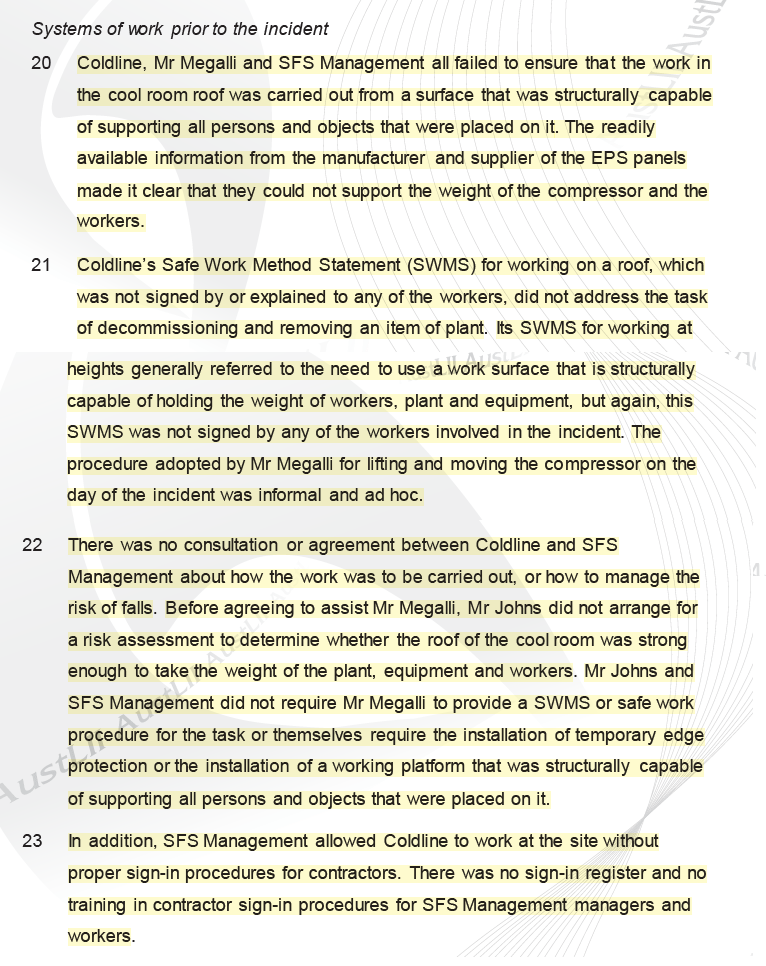
· One SWMS “for working on a roof, which was not signed by or explained to any of the workers, did not address the task of decommissioning and removing an item of plant”
· “The procedure adopted … for lifting and moving the compressor on the day of the incident was informal and ad hoc”
· “There was no consultation or agreement between [the PCBUs] about how the work was to be carried out, or how to manage the risk of falls”
· “The risk of the roof collapsing while multiple people were working on it was foreseeable, and a cursory reading of the manufacturer’s document that identified the load that the EPS panels could safely support would have established that the panels were not strong enough to withstand the weight of seven workers and the 200kg compressor”
· “However, SFS Management did not make that enquiry. Therefore, the likelihood of the risk occurring was “virtually certain”
· The client “had control over the persons who were allowed to access the roof space and the equipment used by the workers. Despite this, it did not require Coldline to provide a SWMS or safe work procedure for the task and instead adopted a “hands off” approach to the work”
· “It was complicit in the ad hoc and unsafe procedure adopted, including by allowing Mr Johns and Mr Fenech to assist with the task. In addition, there was no effective sign-in procedure in place for contractors to follow before the work commenced”
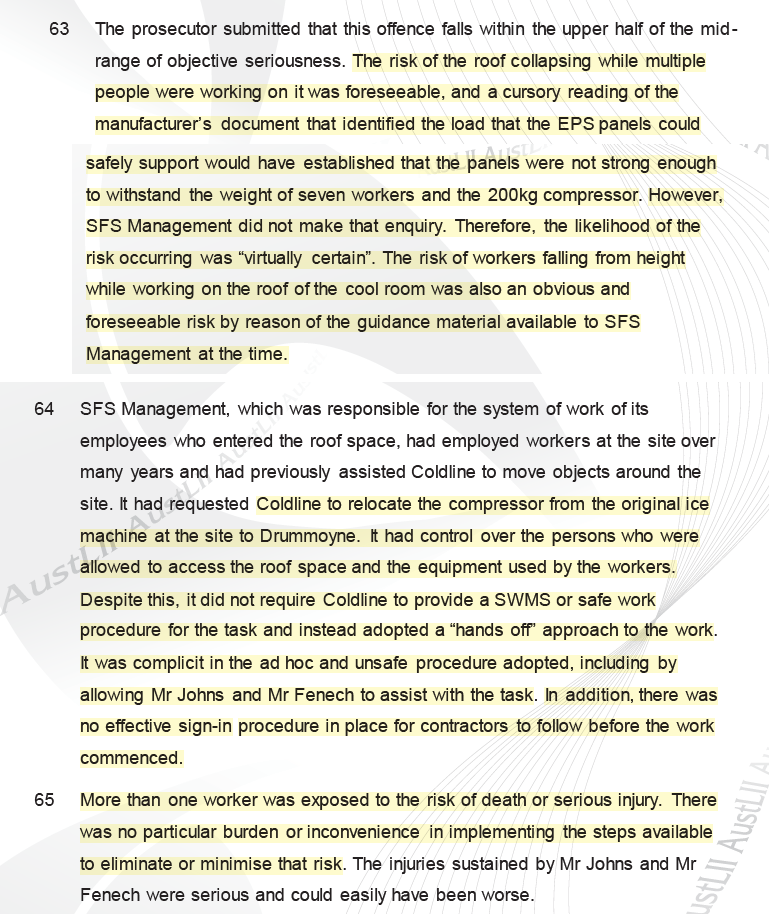
· “There was no particular burden or inconvenience in implementing the steps available to eliminate or minimise that risk”
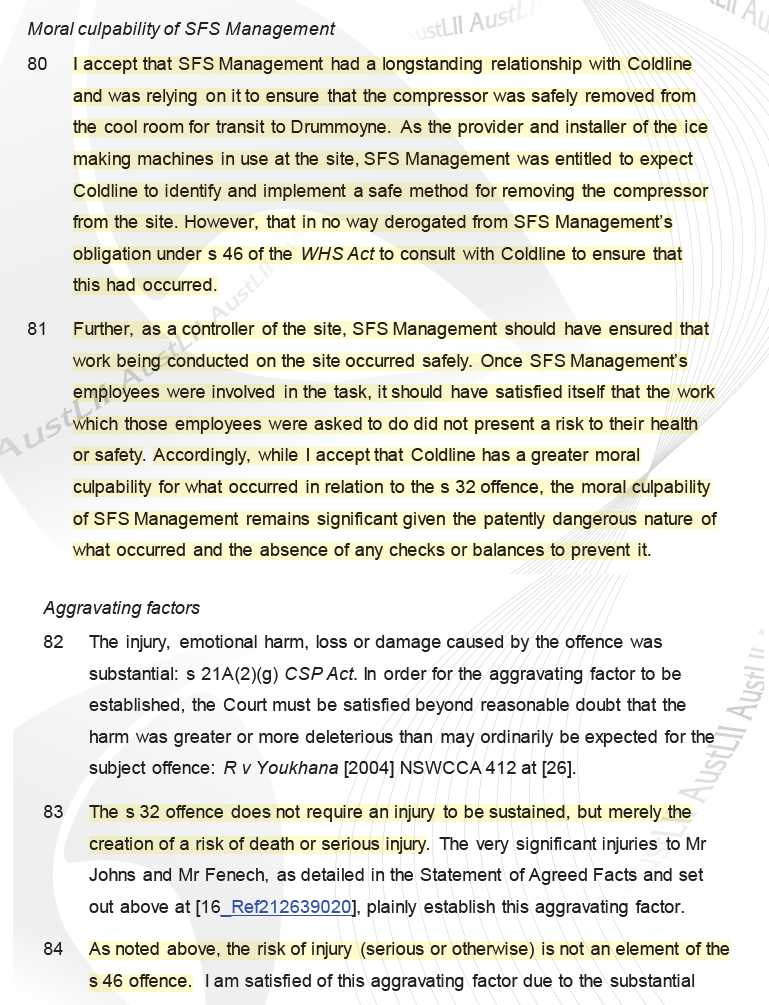
· Next they look at moral culpability, noting that SFS management and Coldline had a longstanding relationship, and SFS relied on Coldline for the safe removal of the ice compressor
· “As the provider and installer of the ice making machines in use at the site, SFS Management was entitled to expect Coldline to identify and implement a safe method for removing the compressor from the site”
· “However, that in no way derogated from SFS Management’s obligation under s 46 of the WHS Act to consult with Coldline to ensure that this had occurred”
· “Further, as a controller of the site, SFS Management should have ensured that
· work being conducted on the site occurred safely”
· “Once SFS Management’s employees were involved in the task, it should have satisfied itself that the work which those employees were asked to do did not present a risk to their health or safety”
· “The s 32 offence does not require an injury to be sustained, but merely the creation of a risk of death or serious injury”
· “I accept that proper consultation, co-operation and co-ordination in accordance with s 46 of the WHS Act could have prevented the incident”
Ref: SafeWork NSW v SFS Management (Aust) Pty Ltd [2025] NSWIC 18


 SafetyInsights.org
One thought on “SafeWork NSW prosecution: moral culpability, PCBU duties and control over works, and SWMS”