
What’s the link between shift work and safety incidents?
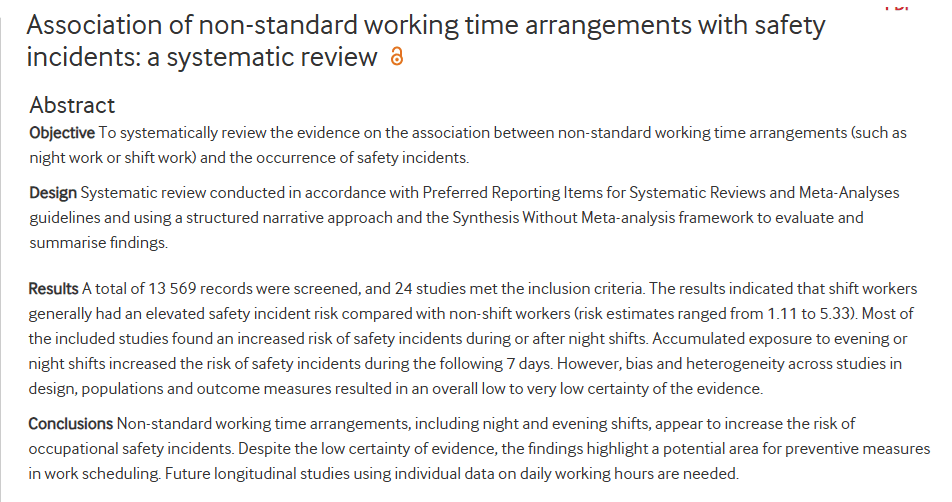
This systematic review of 24 studies explored the links.
Extracts:
· It’s estimated that 10-30% of the workforce in industrialised societies engage in non-standard work / shift work
· Overall, they found “an increased risk of safety incidents during or after night shifts”
· “Accumulated exposure to evening or night shifts increased the risk of safety incidents during the following 7 days”
· Importantly though, “bias and heterogeneity across studies in design, populations and outcome measures resulted in an overall low to very low certainty of the evidence”
· Research indicated an increased risk of incidents via odds ratios between 1.11 to 5.33
· “One study found that working night shifts, compared with regular shifts, was significantly associated with an increased risk of sleep-related car crashes at any time point (OR 5.55”
· “Being a shift worker was associated with an increased risk of safety incidents in 9 of 14 E/O combinations when compared with day workers”, but evidence was generally of high bias risk
· “Significantly higher incident risk during night shifts compared with day shifts was identified in five out of nine E/O combinations”
· One study found that “driving at night shift posed a higher risk of a safety incident compared with shifts without night shift,50 with risk estimates ranging from 1.23 to 3.42”
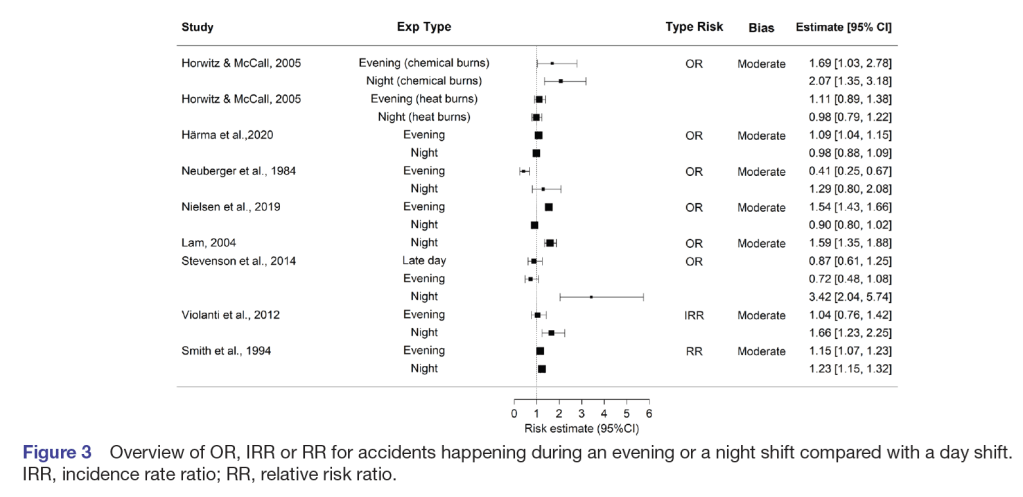
· For evening shifts, “four out of eight E/O combinations indicated a higher incidence risk compared with day shifts … with risk estimates ranging from 1.09 to 1.69”
· “Conversely, one study reported a lower risk during evening shifts compared with the day shift”
· “one study identified a significantly increased risk of incidents following an evening or night shift36 showing increased risk following night shift (OR 1.33 (95%CI 1.17 to 1.52)), but not evening shift (OR 1.01 (95%CI 0.95 to 1.07))”
· “A significantly increased incident risk was observed among individuals working 6–12 night shifts .. or working more than eight night shifts in the past 28days and 3–6 night shifts in the last 7days”
· “If individuals worked five or more night shifts in the 7days prior to the incident, both studies36 57 reported a significantly higher risk even after just one night”
· “However, as the number of night shifts increased, the risk appeared to gradually decline, showing elevated risk in only one of the studies”
· Further, that study “revealed a U-shaped pattern, showing a decline in risk from the first to the third night shift, followed by an increase in risk from the third to the fourth night shift and beyond (ie, after more than five night shifts)”
· “the results support the notion that exposure to three or more evening shifts in the previous 7days increases the risk of safety incidents in the following week”

Ref: Moen LV, S Lie J-A, Sterud T, et al. BMJ Open 2025;15:e100931

Shout me a coffee (one-off or monthly recurring)
Study link: https://doi.org/10.1136/bmjopen-2025-100931

 SafetyInsights.org