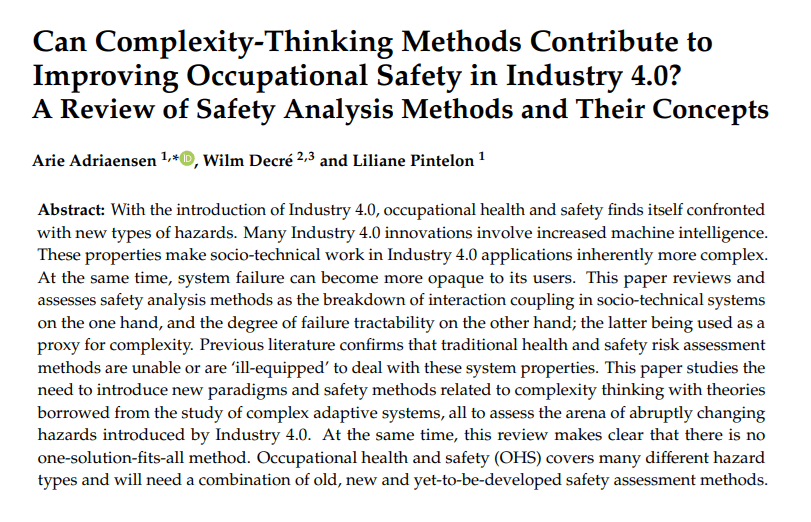
This discussion paper on complexity-thinking in Industry 4.0 may interest people.
Not a summary – another hashtag#LazyNYupload. You might want a strong coffee.
(** Note: Shared under an Open Access CC BY 4.0 licence, allowing it to be uploaded here.)
Some extracts:
· “This paper reviews and assesses safety analysis methods as the breakdown of interaction coupling in socio-technical systems on the one hand, and the degree of failure tractability on the other hand”
· “it has become clear that current safety analysis methods in OHS have some limitations and were mostly designed for risks established from another era”
· “Traditional OHS safety analysis methods lack the ability to analyze socio-technical issues collectively”
· “At the same time, complexity methods have been described as very time and resource intensive”
· “Understanding and managing risks will therefore increasingly become a skill of switching between micro, meso and macro understandings of systems”
· Importantly, though, when looking for literature critical to complexity thinking – they didn’t really find anything. Further “We have not found any literature that tried to disassemble these concepts and paradigms, but only found marginal remarks”
· Moreover, “Hovden et al. remind us that one should not forget that many hazards and risks in OHS remain the effect of loosely coupled and tractable failures, and that linear traditional methods also remain essential instruments for the analysis of particular hazards and risks”
· “A magic bullet method does not exist, which is inherently related to the ever-varying conditions of work systems. To quote Vincent et al. [139] (p. 5): “Safety is a constantly moving target.”
Ref: Adriaensen, A., Decré, W., & Pintelon, L. (2019). Safety, 5(4), 65.


 SafetyInsights.org