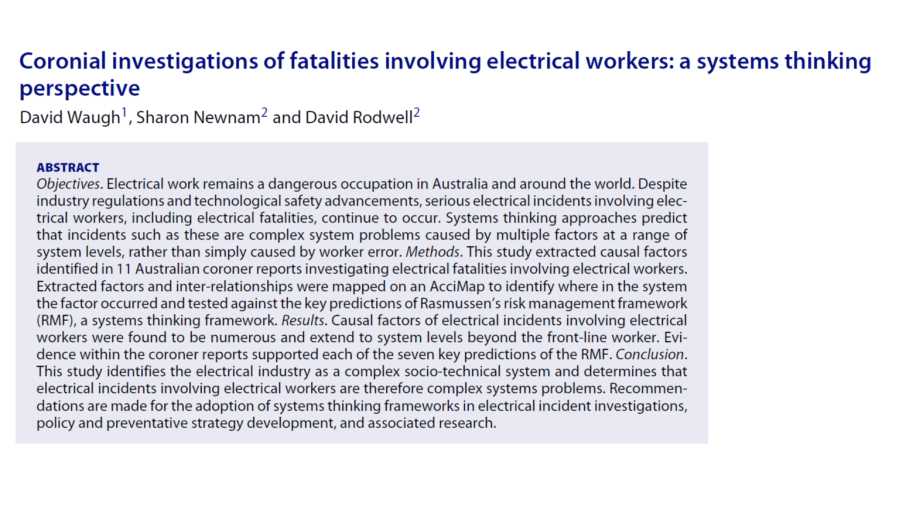
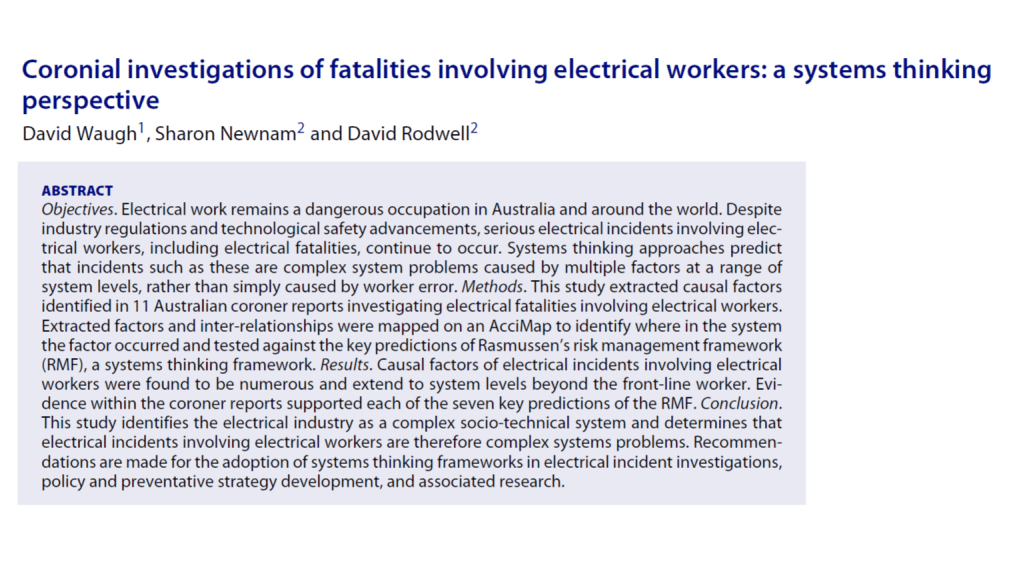
Are electrical safety incidents complex systems problems?
This evaluated 11 Australian coronial reports using Rasmussen’s Risk Management Framework
Extracts:
· A “key finding of this study is the identification of the electrical industry as a complex socio-technical system and the determination that electrical incidents involving electrical workers are therefore a complex systems problem”
· “evidence within the coroner reports was found that supported each of the seven key predictions of the RMF. Similarly, no evidence was found that discounted or contradicted the predictions”
· “In every included report, incident causation was multifactorial (P2), with no examples of a single decision or action causing the event in any of the included reports”
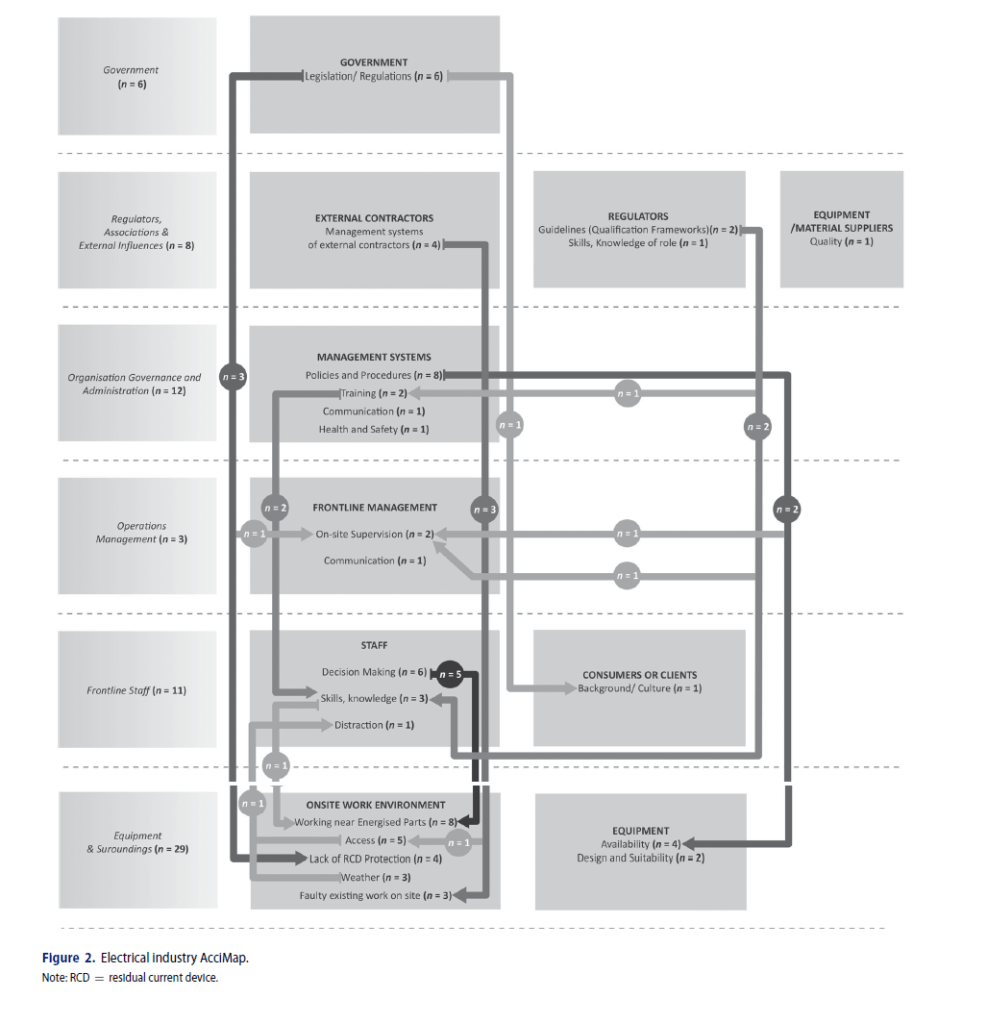
· “Vertical integration issues, best demonstrated by the relationship arrows on the AcciMap, were found to play a contributory role in the incidents”
· “These relationships often demonstrated a cascading effect between causal factors at lower levels. For example, in one incident, insufficient regulatory qualification frameworks for training requirements were related to insufficient training being provided at the organizational level”
· “This, in turn, led to deficiencies in the skills and knowledge of the front-line worker, which in turn led to work occurring near energized parts”
· “The issues with vertical integration were affected by a lack of feedback mechanisms from lower levels. In many of the incidents, the only apparent feedback mechanisms involved in the events were the formal investigations and inquests into the fatal incident”
· “the migration of worker behaviour towards, and over, the boundary of acceptable performance was found to be influenced by cost pressures and the tendency for workers to undertake tasks with the least amount of effort”
· “Cost pressures were evidenced by the identification of factors involving under-resourcing, including examples of failure to provide adequate levels of training, supervision and [PPE]”
· “the study findings indicate that the migration of behaviours towards unsafe work practices was not confined to the front-line worker”
· “migration of behaviour involved a gradual degradation of system defences over time (P7) … [e.g.] the worker/contractor had developed an industry reputation for being safety focused, but, at the time of the incident, had adopted unsafe work practices such as failing to isolate and prove the parts deenergized prior to undertaking works”
· Limitations present – e.g. not all electrical worker fatalities result in coronial inquiry and publicly available, and not all Aus regions were represented
Ref: Waugh, Newnam & Rodwell (2025): Coronial investigations of fatalities involving electrical workers: a systems thinking perspective, International Journal of Occupational Safety and Ergonomics

Shout me a coffee (one-off or monthly recurring)
Study link: https://doi.org/10.1080/10803548.2025.2600233
My site with more reviews: SafetyInsights.org
Shout a coffee: https://buymeacoffee.com/benhutchinson
Safe As LinkedIn group: https://www.linkedin.com/groups/14717868/

 SafetyInsights.org