How does Safety-II thinking enable different insights in aviation safety?
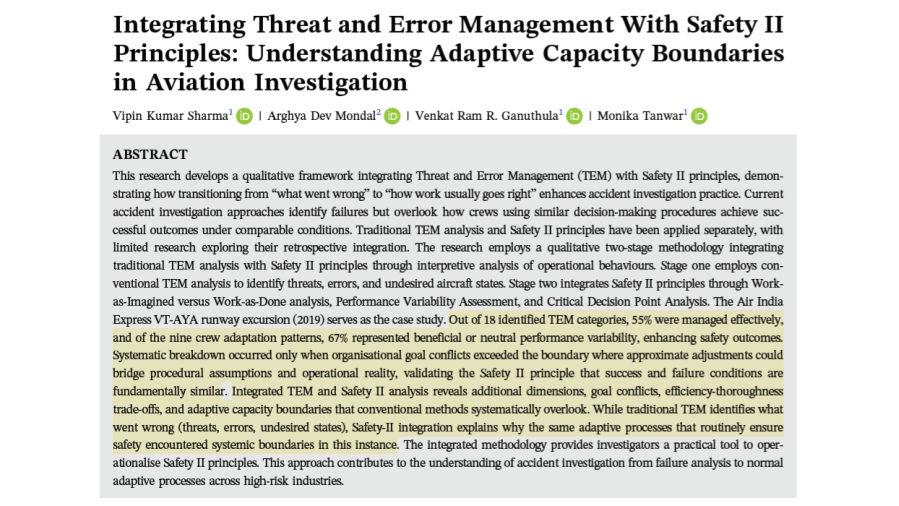
This study explored things like Threat & Error Management (TEM), performance variability, and a shift from ‘what went wrong’ to ‘how work usually goes right’, based on an analysis of the Air India Express VT-AYA runway excursion.
Skipped heaps.
Background:
- In S-II, “performance variability is not to be viewed in a negative sense but in the positive sense, and this variability represents the adjustments that are the basis for safety and productivity”
- “the conditions underlying successful and unsuccessful operations are fundamentally similar (Hollnagel 2014, p. 137), differing primarily in how performance variability manifests under specific circumstances”
- “safety emerges from dynamic interactions between multiple system elements rather than static properties of individual components”
- They provide some definitions: i) Performance Variability: Recognising that human and system performance naturally varies, and this variability is often the reason for both successes and failures; (ii) Adaptive Capacity: An essential capability that bridges the gap between designed systems and operational reality; (iii) Resilience and Adaptation: Focuses on how people and organisations adapt to changing conditions and disturbances to maintain safe operations
Findings:
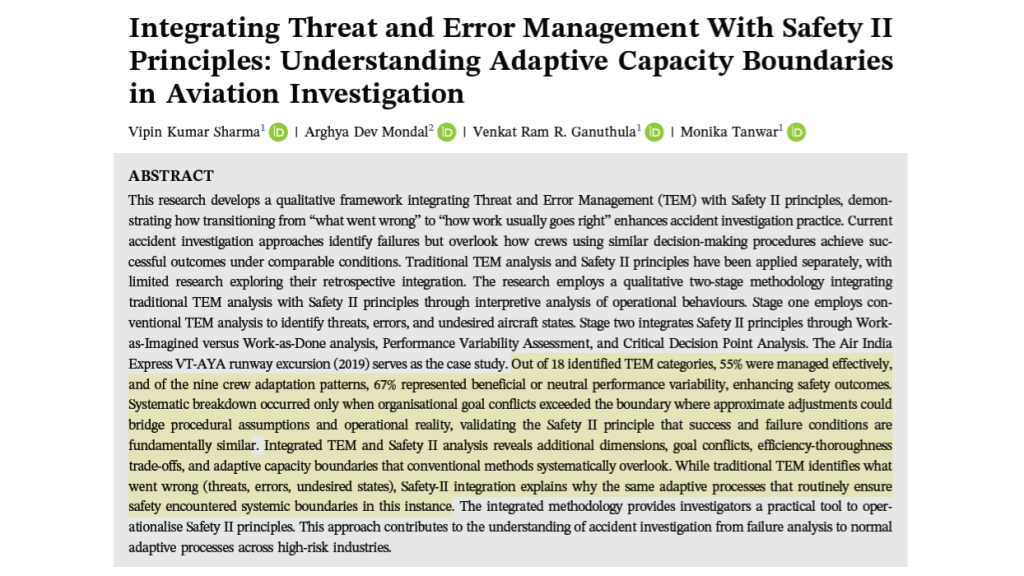
- “Out of 18 identified TEM categories, 55% were managed effectively, and of the nine crew adaptation patterns, 67% represented beneficial or neutral performance variability, enhancing safety outcomes”
- “Systematic breakdown occurred only when organisational goal conflicts exceeded the boundary where approximate adjustments could bridge procedural assumptions and operational reality, validating the Safety II principle that success and failure conditions are fundamentally similar”
- “Integrated TEM and Safety II analysis reveals additional dimensions, goal conflicts, efficiency‐thoroughness trade‐offs, and adaptive capacity boundaries that conventional methods systematically overlook”
- “While traditional TEM identifies what went wrong (threats, errors, undesired states), Safety‐II integration explains why the same adaptive processes that routinely ensure safety encountered systemic boundaries in this instance”
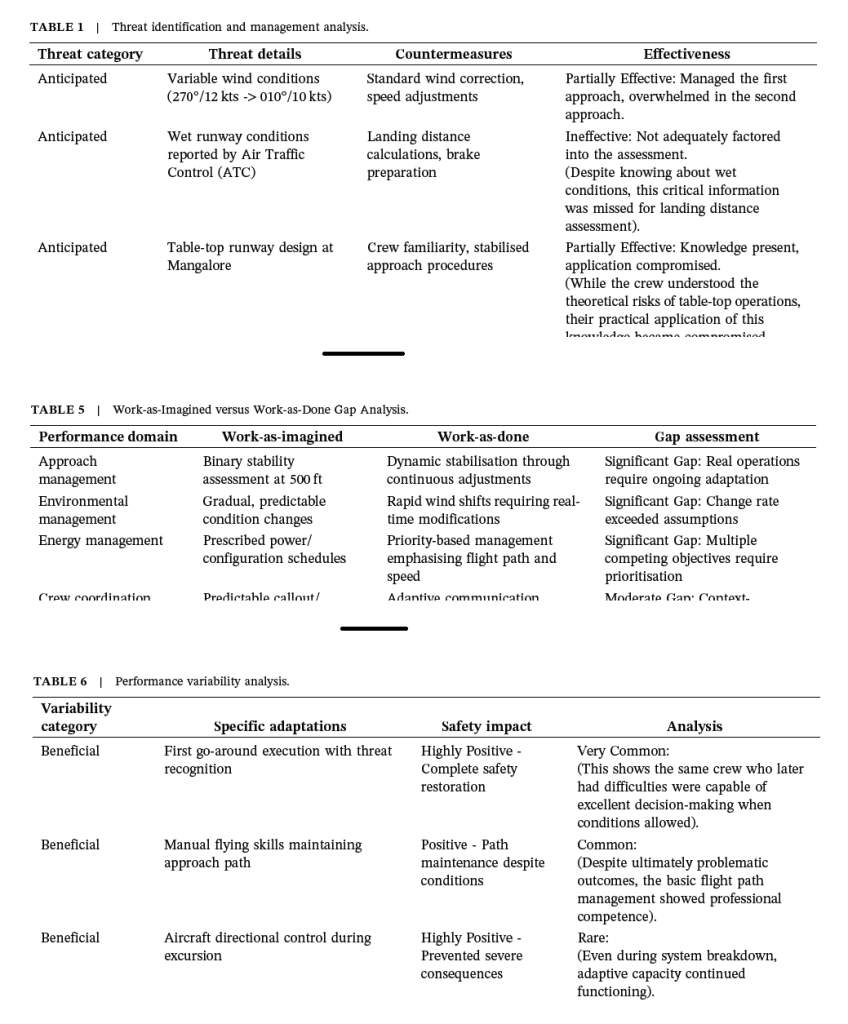
- “Safety‐II analysis reveals the paradox obscured by conventional methods: the same crew adaptations that TEM classifies as “errors” or “ineffective threat management” actually enhanced safety outcomes in 67% of identified instances during the same operational sequence”
- “Safety‐II analysis shows that six of nine crew adaptation patterns were beneficial or neutral, demonstrating that the crew possessed substantial adaptive capacity that functioned effectively until encountering specific boundary conditions”
- “This distinction, between capacity presence and capacity limits, is invisible to TEM’s binary success/failure taxonomy”
- “Traditional TEM identifies the PIC’s decision as a violation; Safety‐II reveals it as a rational adaptation to irreconcilable organisational demands”
- “The analysis reveals that the VT‐AYA accident resulted from an emergent combination of conditions that created irreconcilable goal conflicts”
- “The crew’s normally effective adaptive capacities could no longer bridge the gap between Work‐as‐Imagined and Work‐as‐Done”
- And “This was not due to lack of knowledge or skills but represents what Hollnagel identifies as the fundamental challenge of intractable systems: “We can only specify the work in detail for situations that we understand completely, but there are very few of those”
- “findings support the argument that safety emerges from the ability to succeed under varying conditions and how this ability can become overwhelmed when adaptation demands exceed available cognitive and operational resources”
Several limitations present, including retrospective design from documents, and limited generalisability.
Ref: Sharma, V. K., Mondal, A. D., Ganuthula, V. R. R., & Tanwar, M. (2025). Integrating Threat and Error Management With Safety II Principles: Understanding Adaptive Capacity Boundaries in Aviation Investigation. Journal of Contingencies and Crisis Management, 33(4), e70104.

Shout me a coffee (one-off or monthly recurring)
Study link: https://doi.org/10.1111/1468-5973.70104

 SafetyInsights.org