

What source do workers prefer for informing on risk?
106 UK frontline construction workers were surveyed, from a single building site.
More extracts in comments.
Extracts:
· In this study, “supervisors and safety managers were the most preferred sources of risk information overall”, but further analysis “suggested that workers’ risk information source preference is risk dependent and might be driven by source expertise”
· E.g. “for information about asbestos, workers expressed a preference for information from the UK HSE. Essentially, workers expressed a preference to receive information from those sources they regard as having the most expertise, or experience, with a particular risk”
· A prior study “found that laypeople preferred to receive different types of information about the risks of a chemical plant from different sources (e.g. the company was the preferred information source about what is produced and which products are manufactured, but environmental groups were the preferred source for information about health risks and potential accidents)”
· “Given that safety managers are one of the most trusted information sources (and that trust in an information source is risk independent … they may be able to increase their influence on workers’ risk-related behavioural intentions by consulting workers’ preferred risk-dependent sources of information (e.g. the HSE for asbestos) and citing that source when they communicate with workers about that risk”
· “The leading model of trust in organisations … suggests that a person’s perceived trustworthiness is based on perceptions of ability, benevolence, and integrity”
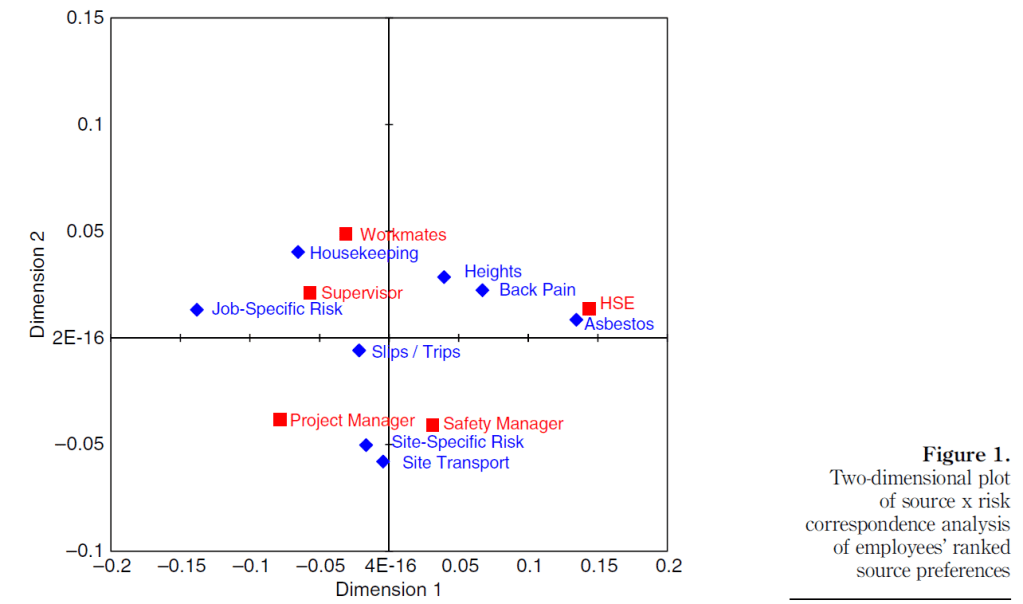
· E.g. “if workers talk about housekeeping (a risk for which they are the preferred source of information) more frequently during safety meetings or shift briefings, this may allow them opportunities to also demonstrate their care and concern for their fellow workers’ safety (i.e. benevolence) and their safetyrelated behavioural intentions (i.e. integrity)”
· And this “may lead to an increase in trust for those workers through more positive perceptions of their benevolence and integrity, which as per Mayer et al. (1995) are important factors of trustworthiness”
· However, “studies have shown that individuals do not engage with published material about risk or safety warnings if they consider themselves to be experienced … In these cases, individuals are more likely to draw on their own experiences and rely on internal search strategies for estimating risk”
· As a result, relying on their own experience may lead to “biased perceptions of risk through melioration bias (underestimating the likelihood of a negative event occurring to oneself), rare-event bias (underestimating the occurrence of a low-frequency event), and optimism bias (the tendency to perceive others as being at greater risk than oneself)”
Other extracts:
- Prior work suggests that “workers’ safety behaviours were more strongly affected by supervisors than by workmates, even though both sources were in the same local information field”
- Or “workers’ perceptions of risk were influenced more strongly by supervisors’ responses to risk, than workmates (but the organisational response was a stronger influence on risk perceptions than supervisors’ response”
- Cross-cultural factors can obstruct risk communication, e.g. one study found that “Danish construction workers experienced more accidents than Swedish workers despite both being on the same site. The differences between these groups were accounted for by differences in education, training, organisational commitment, economic interest, and safety attitudes”
- Another study found that “the HSE and safety managers were the most trusted sources of occupational risk information (compared to project managers, supervisors, and workmates) and the most influential in shaping workers’ risk-related behavioural intentions”
P.S. Check out my new YT channel: https://youtube.com/@safe_as_pod?si=u-c_JpQqPK_NHIxD

Shout me a coffee (one-off or monthly recurring)
Ref: Burns, C., & Conchie, S. (2013). Employee Relations, 36(1), 70-81.

 SafetyInsights.org