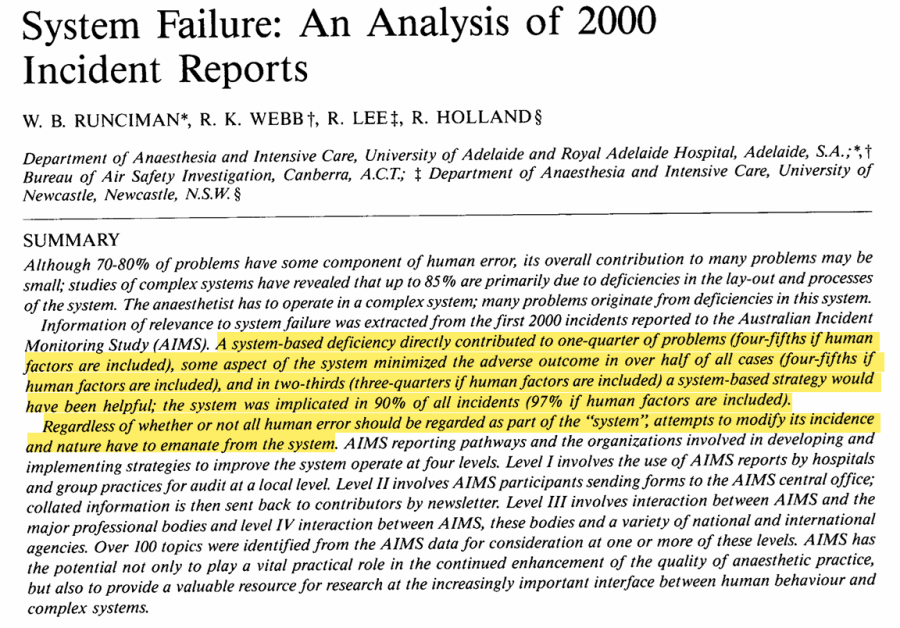
Systems-based issues implicated in almost all incidents, according to this 1993 study.
They assessed the source of the factors in 2000 reported medical incidents from the Australian Incident Monitoring Study (AIMS).
If you gloss-over the specific percentages, they said:
· “The notion that many problems result primarily from defects in the system rather than from deficiencies in the performance of individuals had its origins in the 1920s with the application of statistical methods to process control”
· “A system-based deficiency directly contributed to one-quarter of problems (four-fifths if human factors are included), some aspect of the system minimized the adverse outcome in over half of all cases (four-fifths if human factors are included)”
· and “in two-thirds (three-quarters if human factors are included) a system-based strategy would have been helpful; the system was implicated in 90% of all incidents (97% if human factors are included)”
· “Even by current perceptions, the AIMS data show that the system per se is important or potentially important in 90% of problems; if human behaviour is included, this rises to 97%”
· “Regardless of whether or not all human error should be regarded as part of the “system”, attempts to modify the incidence and nature of human error will have to emanate from the system”
Limitations present of course, and WYLFIWYF.
P.S. Check out my new YouTube channel and please subscribe, like and comment on the vids! (Link in comments)
Ref: Runciman, W. B., Webb, R. K., Lee, R., & Holland, R. (1993). System failure: an analysis of 2000 incident reports. Anaesthesia and intensive care, 21(5), 684-695.
PS. Check out my new YouTube channel: https://www.youtube.com/@Safe_As_Pod


 SafetyInsights.org