[NB. Minor update and reshare since I think this topic will interest people]
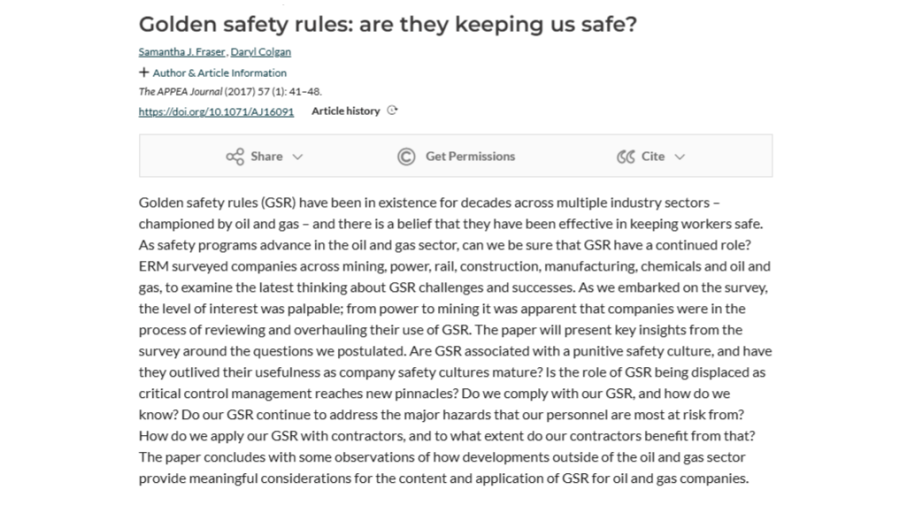
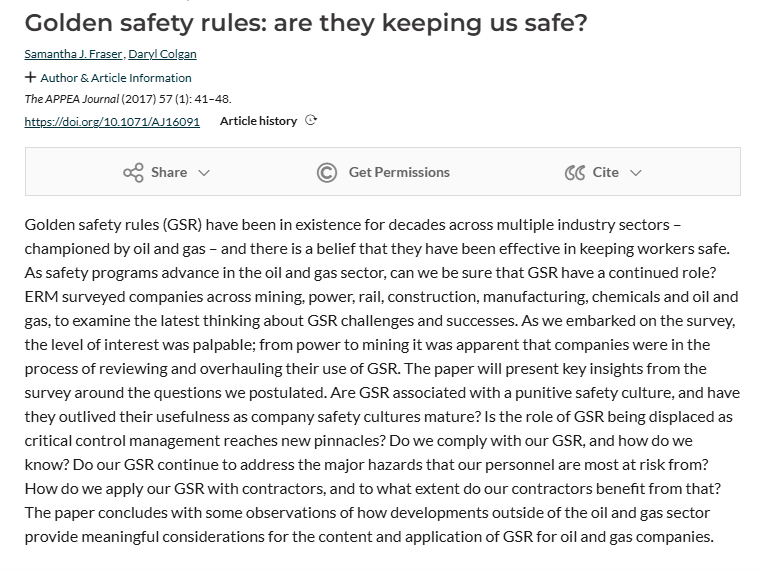
This was a small survey study of 18 practitioners across 15 various hazardous industry companies (chemical, oil & gas, construction, mining, mower + more).
The goal was to understand the perspectives of whether Golden Safety Rules (GSR) (also called Life Saving Rules, Cardinal Rules etc.):
- Are GSR associated with punitive safety environments?
- Have they outlived their usefulness as companies mature?
- Are GSRs being displaced by critical control management approaches?
- Do people comply with GSRs and how would we know?
- Do GSRs continue to address the most relevant major hazards?
- + more questions.
Before moving into the results, they quote another conference paper based in oil & gas (Bryden et al., 2016), which concluded that: “Since their introduction in Shell there has been a 75% reduction in fatalities and a 35% reduction in lost time injuries. The Life-saving Rules are arguably the single biggest contribution to achieving ‘No Harm’ in Shell”.
Note. It’s a limited sample survey study, so the results represent what people say/believe (whether for or against GSR).
Results
GSR considered to be successful
1/3 of participating companies considered GSR programs to have been critical in achieving their safety improvements (five in total). These companies were in oil & gas, manufacturing and chemical.
The success of GSR was seen to be reflected in lagging indicators, personal opinion and in some cases via opinion surveys used within their respective companies. GSR was also seen to have ongoing relevance.
Here, some respondents believed that GSR were effective for reducing fatalities and relevant for both mature and less mature parts of their business. 15 success factors were associated with the GSR’s impact; broadly:
- Intent of care: GSRs are seen to communicate the intent of care to stakeholders, which apparently leads to respect, trust, mutual care, transparency and compliance.
- Consequence management: For those who saw GSRs as successful, they believed there need to be a clear, consistent and fair process for managing consequences; all necessary for success of GSR.
All five companies in this group referred to a just culture-type model or methodology that is applied “during investigation to determine appropriate actions for the person(s) involved in breaking the rule” (p43). [FYI Diane Chadwick-Jones recently published a nice reconceptualization of the just culture methodology; link provided below.]
Groups moving away from GSR
Conversely, five companies had an attitude of “Moving away from GSR”. These companies were two from mining, two construction and one from oil & gas.
Two main reasons where cited by participants on why their organisation no longer sees value in investing in GSRs or perceive significant value from the approach.
1. Cultural reasons: Their organisations were seen to have “matured beyond a ‘culture of compliance’ and they do not anticipate that focusing on rule-based compliance will help them achieve improvements in safety” (p44).
2. Four of the five companies in this group had implemented a critical control management (CCM) program and “this is displacing the need or benefit from GSR implementation” (p44); these companies were in construction and mining.
For these groups, GSR were “seen to have an association with a punitive safety culture” (p44); although issues with blame were recognised by all groups (for and against GSR). In the “for” group, they tried to counter punitive blame by “carefully designed and delivered communications on their Rules” (p46).
For the “against” groups, the perception of blame was seen to be “too difficult to overcome” (p46). This negative perception of GSR was seen to have come from employees’ own historical experience of these programs or carried from previous workplaces/rumours.
Regarding their perception of having matured beyond a culture of compliance, one participant remarked that “We have enough rules, standards and sticks. We need to work on pro-active and leadership approaches” (p46).
They gave an example of encouraging decisions based on internal locus of control rather than an external locus of control. Further, they were pushing a focus on the work crews creating their own rules to live by; creating greater ownership and self-regulation and peer-to-peer reinforcement.
Is the role of GSR being displaced as critical control management reaches new pinnacles?
There was a perception that CCM programs are lessening the relevance/importance of GSR. CCM were seen to address a broader suite of critical control elements compared to GSRs, which were seen to have a “focus on behavioural” that are “seen by these companies as too narrow” (p46). There was also diminishing benefit for “communicating their behavioural rules separately from their expectations for implementing critical controls” (p46).
An observation from the authors about CCM is that the concept is well established for major hazards/catastrophic events in oil & gas and process industries but rather less rigorous when applied to single/multiple fatality risks involving things like working at height, confined space, lifting, ground disturbance etc, which are common in construction and mining; hazards seen to be better “represented” by GSR.
Proponents of CCM spent more time discussing the verification of critical controls in their responses (construction & mining) compared to proponents of GSR (more common in oil & gas) who “in general were not defining and verifying critical controls for the fatal risks addressed by Rules as consistently and explicitly as they do for catastrophic and process safety risks” (p47).
The authors then provide some reflections on what both CCM and GSR can learn from each approach (which I’ve skipped).
[NB. I think it was Andy White who relayed a fantastic insight at a workshop – why do golden rules always focus on what workers must/must not do but never highlight what senior leaders & organisations will do to ensure those hazardous conditions never exist? Something I think about.]
Authors: Samantha J. Fraser, and Daryl Colgan, 2017, The APPEA Journal, 57, 41–48.
Study link: http://dx.doi.org/10.1071/AJ16091
Link to the LinkedIn article: https://www.linkedin.com/pulse/golden-safety-rules-keeping-us-safe-ben-hutchinson
Diane’s Chadwick-Jones just culture study: https://doi.org/10.1016/j.jlp.2018.06.015

 SafetyInsights.org