Another bow tie article that may interest you – this one from rail.
PS. Check out my new YouTube channel: https://www.youtube.com/@Safe_As_Pod
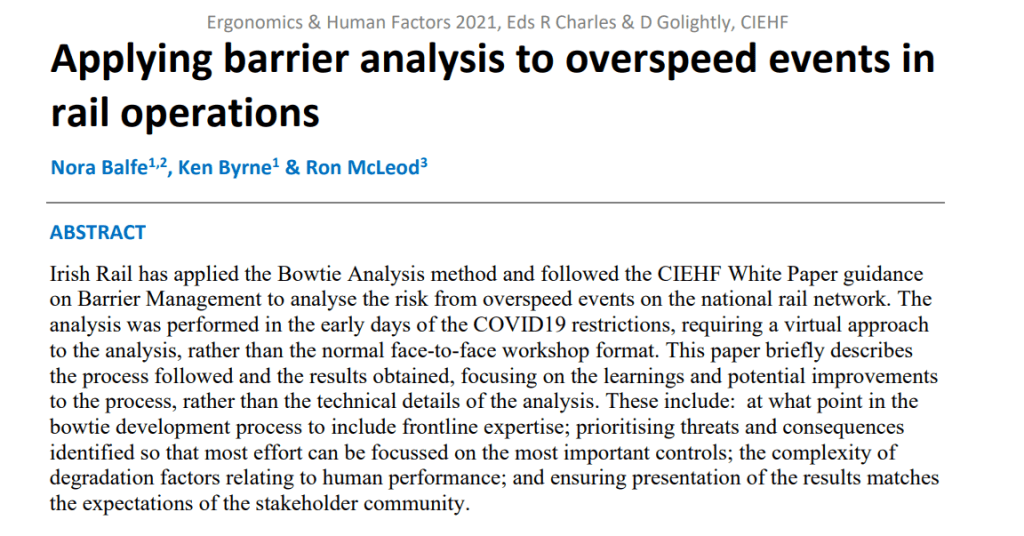
Extracts:
· “Bowtie diagrams provide a visual representation of the risk space, and how it is controlled, in a way that is easier to understand than a textual or tabular representation”
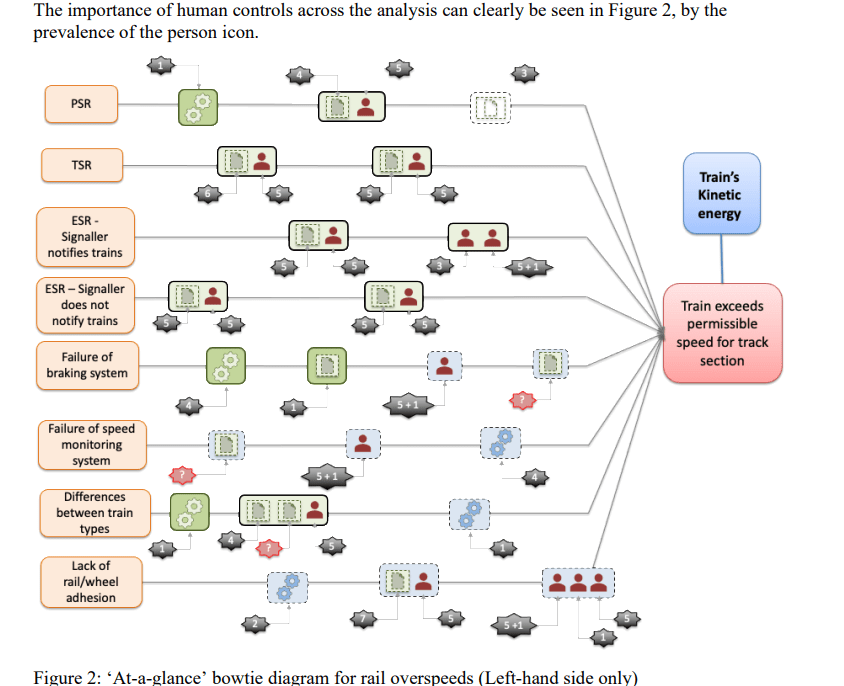
· Based on one example (failure of train’s braking system) threat line, they observe four controls are relied on, an overview of the quality of the controls, namely “Two are full barriers while two are key safeguards” (where full barriers are indicated by a solid border, while safeguards use dashed)
· Visual indicator of the types of controls, where one is technical (using a cog), one organisational (using a document icon), and one operational (person icon)
· At a quick glance, they indicate that the “The importance of human controls across the analysis can clearly be seen in Figure 2, by the prevalence of the person icon”
· E.g. in this top event, many of the controls rely on human action, which typically don’t meet the quality criteria of a full barrier
· An example of the degradation factors are shown, like “use of the Working Timetable can be degraded by; 1. The physical size which deters drivers from placing it on the driving console of the train; 2. Poor information design which impacts readability and usability” and more
· Whereas the working group was “initially keen to capture human error as a threat (reflecting the tendency of investigation reports to identify the immediate cause of an overspeed event as human error), this was “overcome with the help of the facilitator and the group became convinced of the contradiction of designating the human elements .. as both a threat and a control”
· They note that while including operational stakeholders was extremely important, their contributions were made later in the analysis, and particularly for degradation factors
· Hence, sometimes, “it may have been beneficial for a smaller group to set the initial framework of the bowtie, (i.e. the top event, threats and consequences), and then invite the detailed expertise of the frontline staff to contribute to the development of the controls and degradation factors”
· Relying on a good mixture of frontline and technical staff meant a reasonable confidence that work-as-done was the core focus over work-as-imagined; but it had the trade-off of being resource intensive
· Finally, they used a spreadsheet rather than customised bowtie software
· “These limitations were significant: in most cases, it would not be realistically practical to conduct a bowtie analysis of the same complexity without using commercial software”
· However, one benefit “lay in the ability to focus attention and think much more clearly, deeply and creatively about the nature of the risks and the characteristics of the controls than would have been achieved [via custom software]”
Study link: https://publications.ergonomics.org.uk/uploads/05_29.-edited.pdf

 SafetyInsights.org