
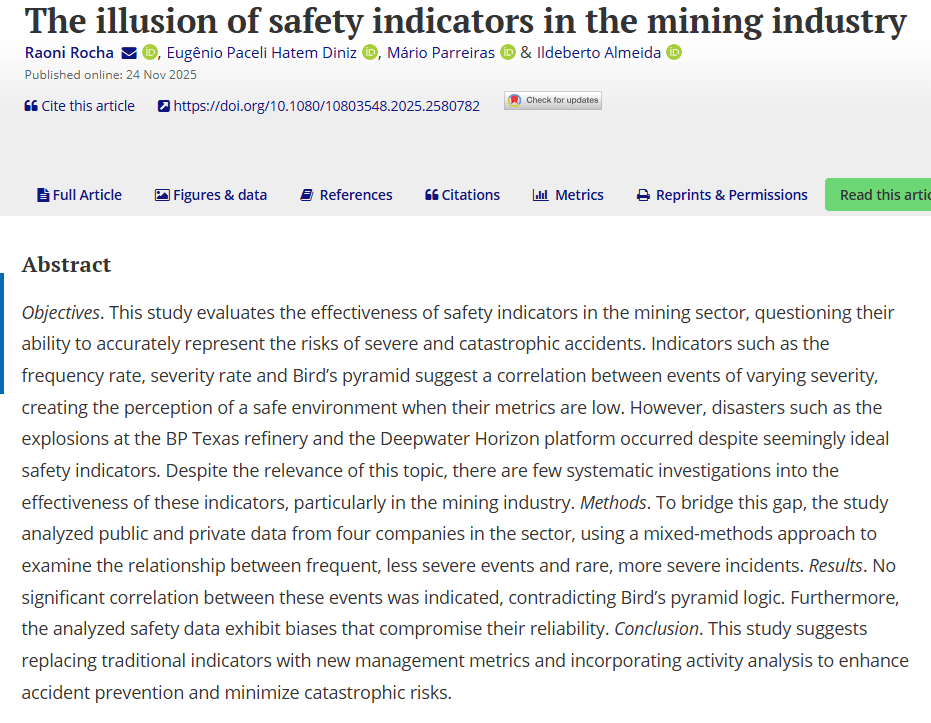
Are minor and severe/fatal incidents related?
Another study tested the links based on private and public mining data.
** Check out my YouTube channel: https://www.youtube.com/@Safe_As_Pod
Extracts:
· “the number of days without accidents does not reflect the true safety of the environment”
· “The data generate markedly distinct trend lines between the accident frequency rates and the absolute numbers of severe injuries or fatalities”
· “While the total accident rates follow a pattern of reduction over the years, the number of severe injuries or fatalities exhibits patterns that alternate between decreasing and increasing”
· “This indicates that overall accident frequency does not predict severe injuries or fatalities at Vale”
· [** Noting we’d likely need to look within the same scenarios / hazard types to find a link, e.g. see Bellamy’s work]
· “In practical terms, the reduction of accident rates over time did not correspond to a reduction in severe occurrences, suggesting that other factors may drive catastrophic events”
· “significant positive correlations identified between incidents and minor accidents … indicate that preventive measures targeting everyday events can contribute to reducing less severe injuries”
· “Vale celebrated annual reductions in its FR, which dropped from 0.6 in 2013 to 0.45 in 2016, 3 years before the tragedy in Brumadinho … This logic is repeated in all the reports analyzed”
· “Despite the significant human and environmental tragedies caused by the company, its reactive indicators continue to convey the perception of a safe environment”
· “The data used to feed safety indicators frequently exhibit sampling bias. Operators may refrain from reporting issues due to fear of punishment or a lack of confidence in management’s response”
· “Some studies, such as that by Bellamy [18], suggest that in industries with specific risks, there could be a non-linear relationship between low-severity and high-severity accidents”
· “However, in most cases, minor accidents are not precursors to severe or fatal accidents”
· “Hopkins [36] proposes the creation of three distinct groups of indicators: process and occupational; operational and managerial; and proactive and reactive”
· “the indicators TF, TG and PB are reactive – reflecting only past negative events – and operational, as they relate exclusively to the behavior of frontline workers”
· “The preventive measures of a system cannot be limited to indicators, as numbers do not reflect the quality of the data”
· “it is essential to abandon reactive, operational and work-based indicators and move toward the creation of indicators based on other logics, e.g., proactive, management and process indicators”
Ref: Rocha, R., Paceli Hatem Diniz, E., Parreiras, M., & Almeida, I. (2025). International Journal of Occupational Safety and Ergonomics, 1-13.
Study: https://doi.org/10.1080/10803548.2025.2580782


 SafetyInsights.org