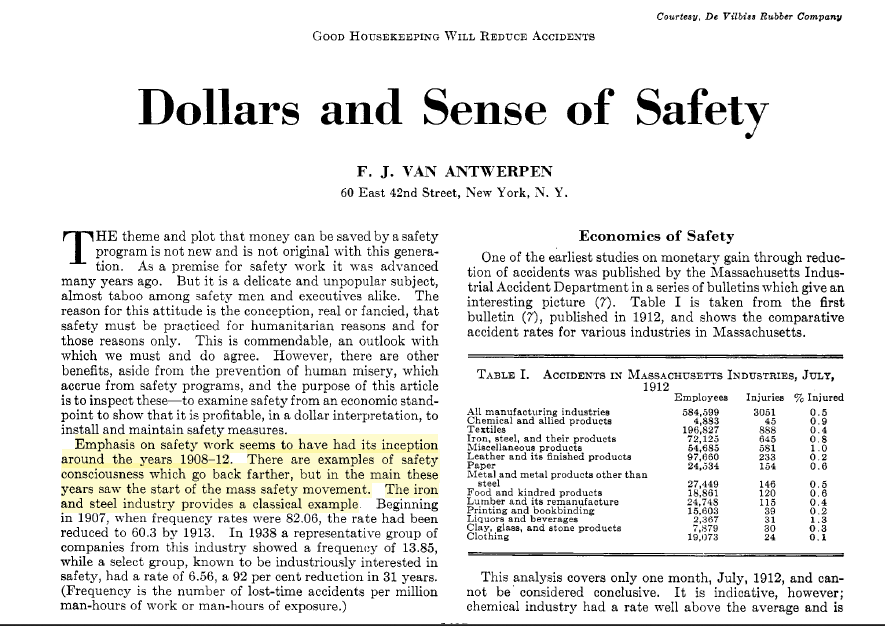
Is good safety good business?
A 1940 article discussing the evidence – and showing how it dated back decades even then.
Have some more classic bangers coming up soon.
** PS. Check out my YouTube: https://youtube.com/@safe_as_pod?si=nrKljK0AeUZXTOgd
Extracts:
· “The theme … that money can be saved by a safety program is not new and is not original with this generation”
· And while it is commendable that “safety must be practiced for humanitarian reasons”, other benefits like profit also result
· “Emphasis on safety work seems to have had its inception around the years 1908-12. There are examples of safety consciousness which go back farther, but in the main these years saw the start of the mass safety movement”
· “In October, 1915, the board described (9) how “a study shows a saving of 41 per cent in compensation payments as a result of the acceptance of the invitation by certain employers”.
· And as highlighted in some upcoming vintage articles, the insurance sector was a key driver of improved health and safety, rather than ethics or social movements
· “The insurance company carrying the risk then declared the company uninsurable because total claim far exceeded insurance premiums. A thoroughly alarmed management, faced with the possibility of paying large compensation claims … [responded with] A safety engineer was installed along with a full-time doctor and nurse”
· “Within one year the number of accidents dropped to one third and within two years to one fifteenth of the 1929 rate”
· Elsewhere the “safety program reduced the number of accidents, per 1000 shifts worked, from 0.90 to an average, for the past five years, of 0.18. The number of shifts lost because of accidents has been reduced from 12 to 5 per 1000 shifts worked”, resulting in savings up to 40k per year
· “For many years it has been known that compensation and insurance are only a fraction of the total cost borne by the employer and that there are other less obvious losses to management”
· “These indirect costs have been studied .. and many case costs analyzed; results indicate that a ratio of 4 to 1 represents the hidden charges. This means that for every dollar spent in direct compensation, medical, and insurance payments, four have been lost through other causes”
· “Whether this is the fault of engineering design of plants and equipment, employee ignorance, or the hazard of the industry cannot be judged until an analysis of the types of injuries is made known. The indications point, however, to faulty design and engineering application … is actively safety-minded, and management has done an excellent job in reducing the total number of accidents”
· “The severity of the accident can only be lessened by eliminating potential hazard”
· “Sense in engineering design may mean dollars in the profit statement and, lest we forget, a man’s life saved”
Ref: Antwerpen, F. V. (1940). Dollars and Sense of Safety. Industrial & Engineering Chemistry, 32(11), 1437-1444.

 SafetyInsights.org