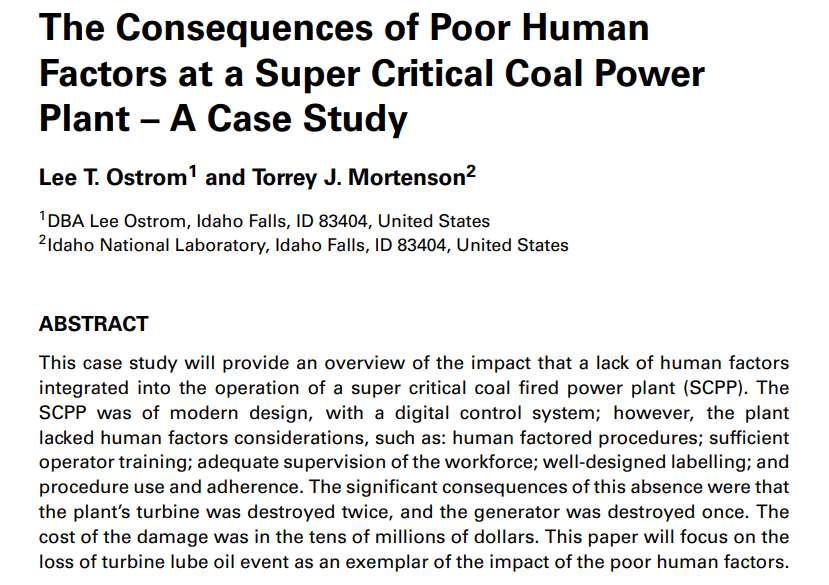
This brief paper explored some human factors matters relating to an incident in a super critical coal power plant.
Note – I’ve skipped most of the actual event’s background and details. So if you need to know, check out the paper.
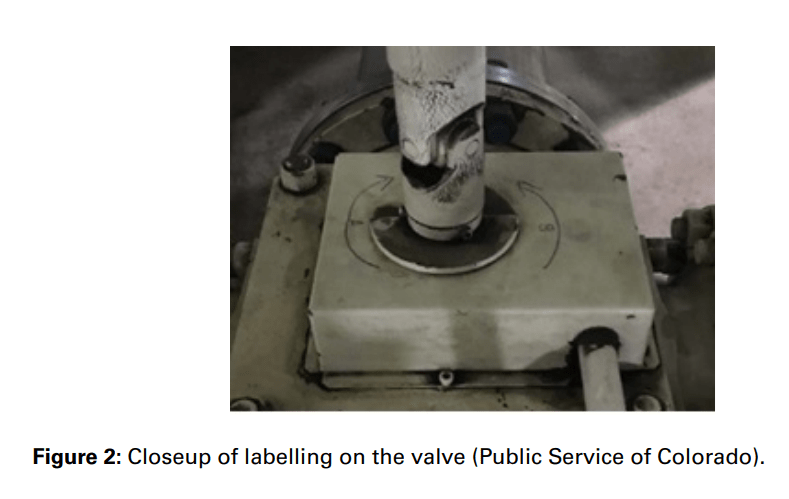
Briefly, the relevant plant was in a start-up phase. There was a six-way TLO valve, operated by turning the wheel in either direction. In the below image you can see the labelling of the valve.
The paper reports that “The 6-way valve was manipulated inappropriately by the operator and TLO was shutoff to the turbine and generator hydrogen seal”.
At the time:
· necessary communications didn’t occur between the control room personnel and the operator prior to changing valve positions
· the plan of action for the task wasn’t validated with the other operators prior to the task
· The “Mental model of the worker did not align with the potential consequences of operating a valve for oil flow to the turbine running at 3600 RPM” (emphasis added)
· Consequences of the event were impacted by a failed mechanical stop, which allowed the valve to isolate turbine lube oil
· And “human factoring was not conducive to ensure proper valve lineup (no markings, no immediate feedback that desired end-state was achieved)” (emphasis added)
· No procedures existed at the time for operating the valve, and training on the valve was “lacking”
· Relevantly, “the valve had only been operating a few times in the life of the SCPP”, but nevertheless the original OEM said that the valve should be regularly operated to ensure that it works as intended
Labelling Issues
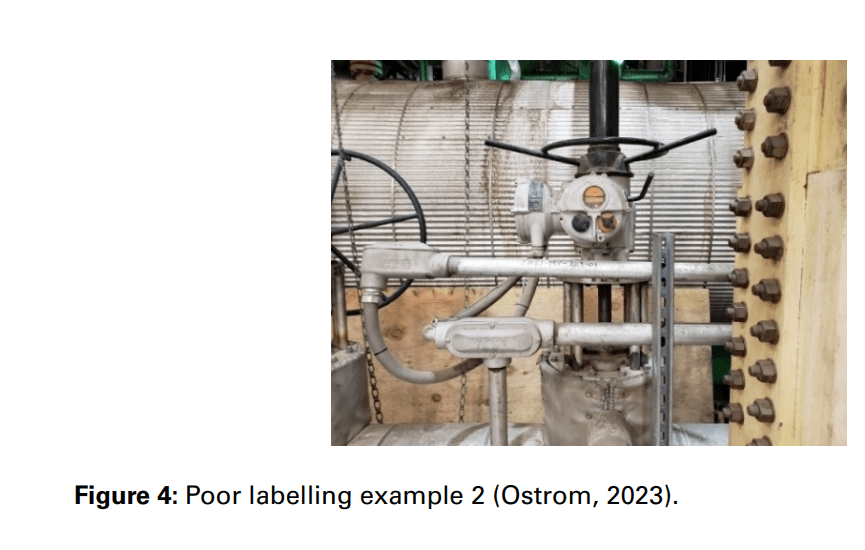
They zoom into the matter of valve labelling. It’s argued that the labelling wasn’t consistent, and appears to have been written with permanent markers. Ultimately it’s said to be confusing.
They note that “On the right side of the valve there is a curved arrow indicating how to engage the B-train. On the left side of the valve there is a curved arrow indicting how to engage the A-train. There is no indication about how to close the valve or where both lube oil trains are engaged” (emphasis added).
Communication Issues
Next the paper unpacks communication. They observed:
· Other operators who performed work on the TLO system didn’t explicitly communicate to the operator involved what they had done (Not sure if they were instructed to? Did they know they should have done that?)
· The environment was loud, and the operator didn’t clearly hear radio comms about the TLO system. The operator also hadn’t been provided with a radio that would also compensate for his hearing loss
· The operators had a meeting, but the main operator involved apparently made “an operating decision”, but didn’t communicate that with a supervisor or the control room (Again, do operators know they are supposed to? What are the triggers for reporting? Are there structural mechanisms to report that info, and clearly indicated to whom, and verifications that this info has been communicated to other stakeholders?)
Oil Incident
They note “Procedures at the SCPP were not human factored and the procedure writers guide that the plant was using did not provide adequate guidance on how to effectively write procedures that meet human factors guidance”.
The procedure didn’t provide guidance for changing the TLO six-way valve location, nor provide warnings about what could go wrong if the valve was positioned incorrectly [Nor, presumably, how to respond if it was changed incorrectly?]
They speculate “It is doubtful that operators followed the procedures developed before June 2020 because of the way they were written”, i.e. the procedures were likely never fully usable to begin with.
Hence, “in many cases an operator could not follow a procedure if they had wanted to. Instead, operators likely relied on tribal knowledge to operate the plant” (emphasis added).
They also highlight other issues of the procedures:
· The procedural steps contained multiple actions, whereas procedure steps should contain only one action
· The steps had embedded warnings/cautions, whereas these should be presented in a procedure in a distinctive manner
· Actions in a procedure must contain a verb and have actions to be completed
· “A document without actions is for information and is not a procedure”
· Ambiguous language regarding operator actions and hold points
· Plant procedures didn’t always match actual plant conditions – for instance “the plant’s startup procedure had several parameters that were unverifiable due to the absence of sensors that the procedure called out”
· Operators complained about communicating with the control room and avoided doing so [apparently because it “bothered” them…not sure what that means exactly]
· The procedure lacked necessary steps to safely change the TLO valve configuration
And some other issues like inadequate and confusing valve labelling, lack of operator training on valve operation, and the operator’s reliance “on his assumptions about how the Comanche 3 TLO system operates, rather than how it operates” [** which I’d argue isn’t actually an issue per se, but just reality of how people create mental models and schemas of the world – Don Norman’s work nicely captures these mismatches].
Ref: Ostrom, L., & Mortenson, T. (2024). The Consequences of Poor Human Factors at a Super Critical Coal Power Plant, A Case Study. AHFE International, 159, 159.
Study link: http://doi.org/10.54941/ahfe1005791
Linkedin post: https://www.linkedin.com/pulse/consequences-poor-human-factors-super-critical-coal-hutchinson-phd–yayxc


 SafetyInsights.org