Do safety regulator visits improve injuries and non-compliances? Yes, according to this.
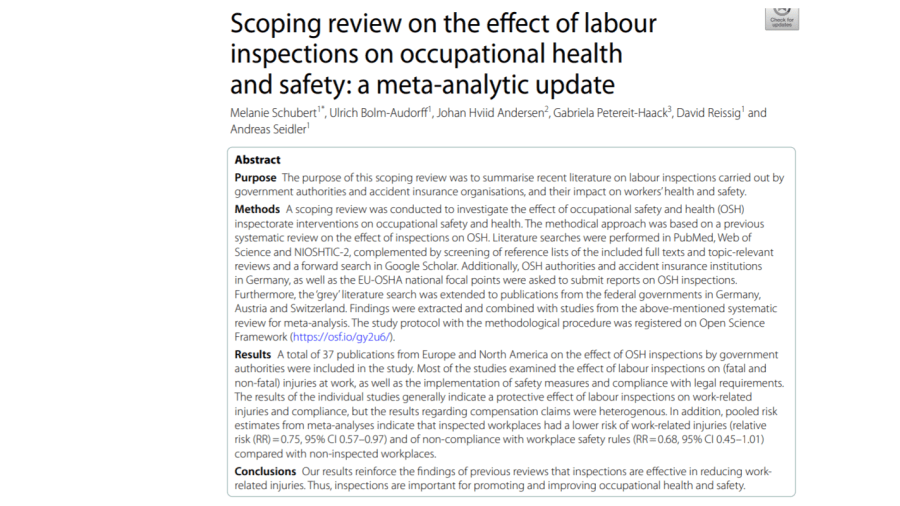
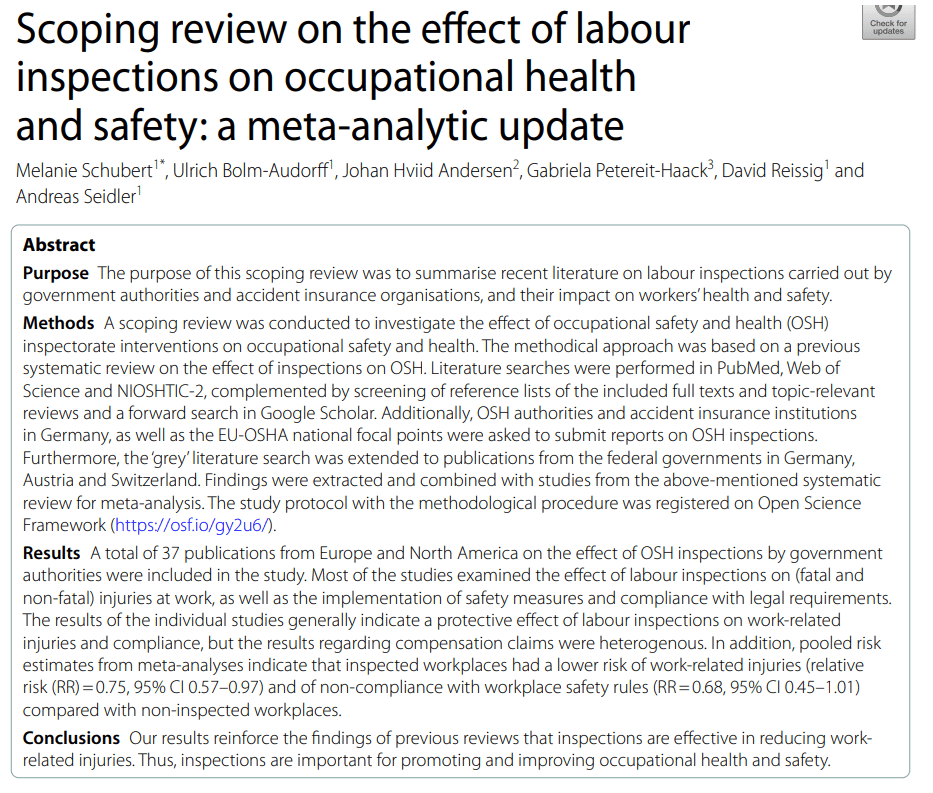
This scoping review evaluated 6 systematic reviews, one RCT, and 30 observational studies from 2017 – 24.
Check out my new YT channel: https://youtube.com/@safe_as_pod?si=u-c_JpQqPK_NHIxD
Extracts:
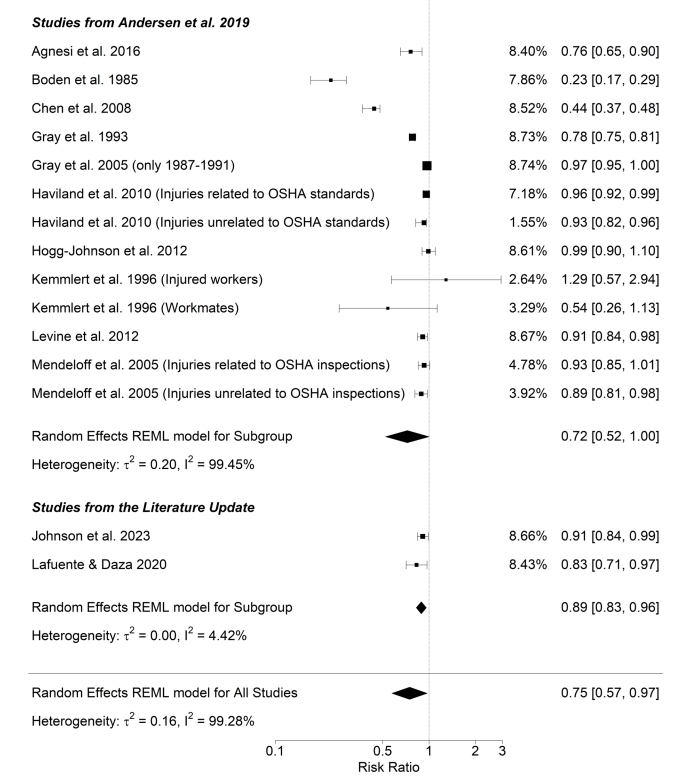
· “labour inspections were associated with a reduced risk of work-related injuries and non-compliance in inspected workplaces compared with non-inspected workplaces, indicating a protective effect of inspections”
· “Repeated violations of occupational safety regulations have been shown to become more frequent after inspections in smaller companies with up to 20 employees, but less frequent in large companies with 250 or more employees”
· “Small businesses with fewer than 10 employees and medium-sized businesses with 11 to 100 employees are more likely to have occupational safety deficiencies than larger businesses, which tend to employ occupational safety specialists and company doctors”
· “At the enforcement level … the effectiveness of enforcing safety regulations increases with high penalties, but not low ones [39, 44, 61]. Furthermore, labour inspections involving orders have been found to be more effective in implementing risk management measures and reducing workrelated injuries than inspections without orders”
· “a combination of inspections and consultation visits might lead to a larger reduction in fatalities than inspections alone [40]. Here, it was inspections (and consultations) rather than higher average penalties that were associated with lower fatality rates”
· “workplace inspections followed by an additional consultation session for managers were more effective at prompting the implementation of safety measures [21, 35]. Therefore, labour inspections involving consultations, together with the prospect of severe penalties, could improve occupational safety and health”
· “One study showed that the effectiveness of occupational safety and health could be increased by personal factors and the ability of supervisors or inspectors to explain the changes necessary to comply with regulations”
· Interestingly, “companies that had committed violations in one US state subsequently committed fewer violations in that state, but more in others”
· This was described as an ‘information friction’, where “inspections at one company location do not necessarily lead to improvements in occupational safety at another company location [50]. Therefore, labour inspections conducted at a regional level could result in a company with multiple locations shifting its OSH priorities”
Schubert, M., Bolm-Audorff, U., Andersen, J. H., Petereit-Haack, G., Reissig, D., & Seidler, A. (2026). Journal of Occupational Medicine and Toxicology, 21(1), 5.

Shout me a coffee (one-off or monthly recurring)
Study link: https://doi.org/10.1186/s12995-026-00497-6

 SafetyInsights.org