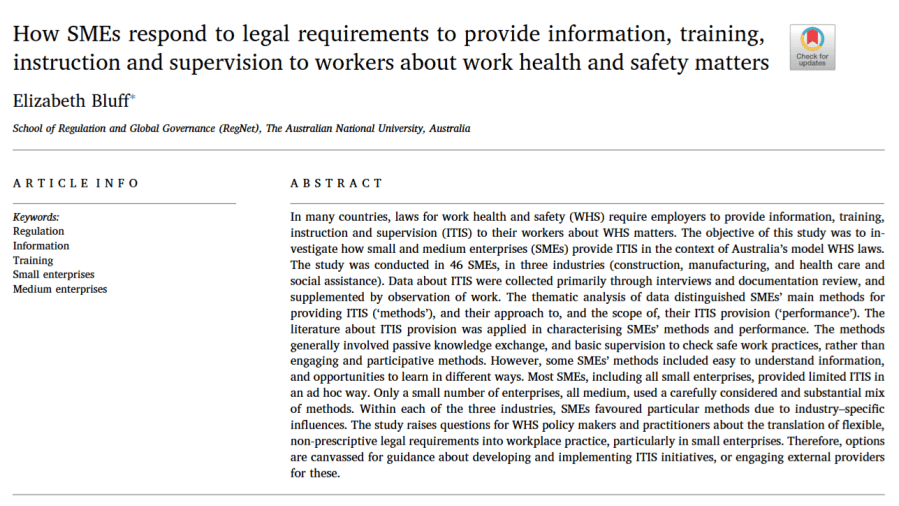
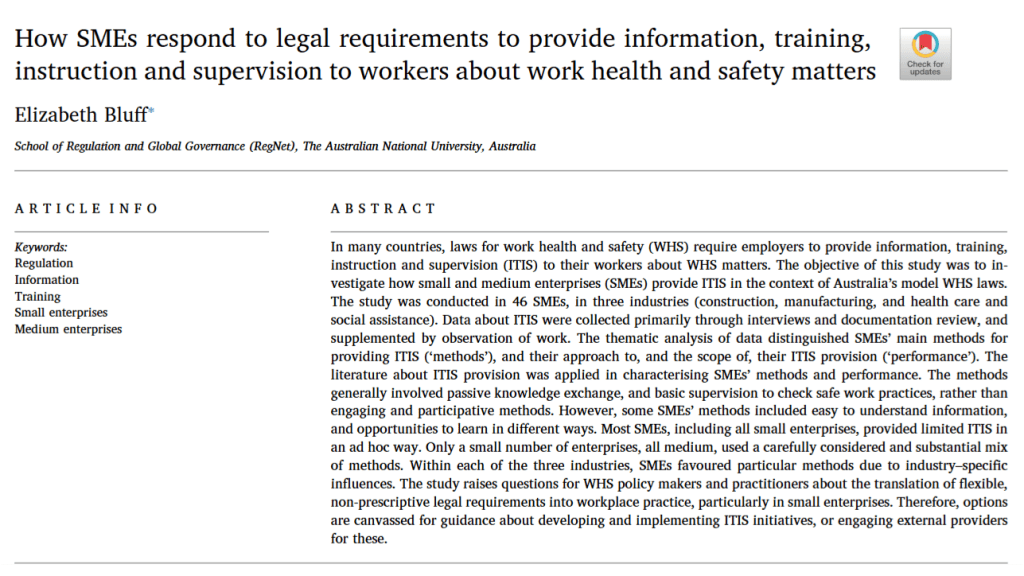
This article explores how small to medium enterprises (SMEs) provide information, training, instruction and supervision (ITIS) to their workers regarding WHS matters.
Note that I’ve skipped HEAPS in this paper, so consider it a superficial overview.
46 SMEs were included.
Background:
· They highlight the general requirements for employers to provide ITIS to their workers, and the general benefits that provision of ITIS can have
· They cite the WHS Act, which states ”the person conducting a business or undertaking (the PCBU) must provide ITIS (WHS Act s 19(3)f)), which is to be ‘suitable and adequate’, and provided in ways that are ‘readily understandable’ (WHS Reg 39(1)–(2))”
· Also, “The requirements to provide ITIS are flexible rather than prescriptive in contrast, for example, to OSHA standards in the United States”
Results
Some key findings were that:
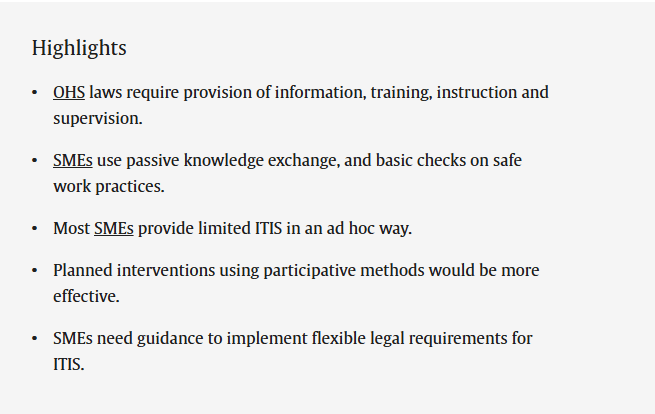
· “SMEs use passive knowledge exchange, and basic checks [e.g. supervision] on safe work practices” rather than “engaging and participative methods”
· “Most SMEs provide limited ITIS in an ad hoc way”
· “Planned interventions using participative methods would be more effective”
· “SMEs need guidance to implement flexible legal requirements for IT IS”
· “some SMEs’ methods included easy to understand information, and opportunities to learn in different ways”
· “Only a small number of enterprises, all medium, used a carefully considered and substantial mix of methods”
Induction
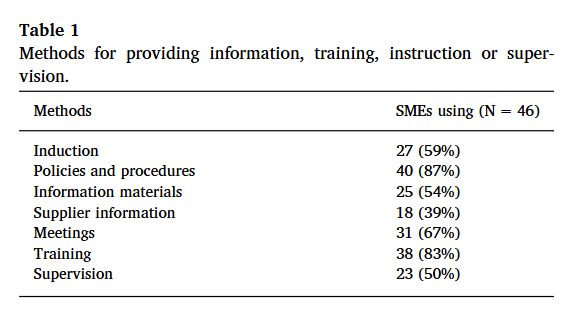
59% of SMEs used some form of induction to onboard new starters, typically including first aid and emergency evacuation, hazard and incident reporting and other policies etc.
Some provided this verbally, while others also included workplace walkarounds, and others used handbooks or manuals.
It’s said that the induction material was typically what the employer determined what workers needed to know, and “the approach was one of knowledge exchange, using passive, low engagement methods”.
The authors suggest that, at best, “it could be said that induction might provide some opportunity to learn in different ways through listening, looking at the work environment, reading information materials, and perhaps asking questions”.
Documented Procedures etc
Documented procedures were used to provide info to workers, used by 87% of SMEs. They were often called safe work practices/procedures/statements, or operating procedures.
It’s observed that these documents often used headings and sub-headings and were “often quite long, and not written or formatted to be easy to read and understand”.
Moreover, the “The primary focus seemed to be the content of policies and procedures, although some thought went into how to provide access to them, with variation in practice”.
Here the authors discussed how policies and procedures might improve learning about WHS, providing that they were “living documents’ in the sense that workers and their managers or supervisors discussed them and applied them in practice”.
But this was based on an assumption of engagement with the procedures, and wouldn’t occur if people had little “opportunity, capacity or motivation to absorb the information contained in them”.
Workers were also expected sometimes to sign the documents before fully reading them.
There were other barriers, like literacy skills, non-English backgrounds, or had a preference for verbal info over written, and more.
Hence, “In these circumstances, requiring workers to sign such documents was mindless paperwork or, ‘just an arse covering exercise’”. These documents were said to lack value “even within a conventional model of knowledge exchange”.
54% of SMEs also used written or visual materials in a variety of formats. Some took more efforts towards using different visual formats to display info, but “the various methods involved passive knowledge exchange”.
Meetings were also used in 67% of SMEs for providing WHS instruction or info. Some people were positive about the value of meetings, meetings were still saw as a passive method. That is, relying on somebody listening to info or instructions, with some limited opportunity to comment or ask questions.
Based on the participant views, often “meetings did not provide opportunities for genuine participation and engagement, because WHS matters had to compete with operational issues for time on the agenda and tended to be passed over quickly, and information might be unreliable when it was relayed from participants in one meeting to others who were not present”.
Training
As expected, dedicated training was used by most (83%) of SMEs. External training providers were often used. Here they observe that “Training was a mixed bag”. Some training was well-developed with opportunities for participant interaction, whereas in other cases it was basic, with considerable passiveness. They make another observation that some of these passive and basic training interventions also used “cynical attempts to convey competency by giving participants the answers”.
Supervision
50% of SMEs used different supervision methods for transferring info on WHS. In some places this was via a supervisory role checking practices onsite.
Planning
Some SMEs (15%) had a thorough needs analysis for ITIS, whereas others (52%) were less planned and systematic, but still had some direct ITIS interventions in place.
Some of the weaker performers (20%), “provided ‘little’ IT IS”. They employed maybe just a couple of ITIS methods, and didn’t otherwise do or have much to provide WHS info etc. These providers “also relied on worker experience rather than actively developing capacities”.
13% were weak performers, having negligible ITIS in place. Some of these SMEs did little to address WHS matters more broadly since they “prioritised their core business over WHS, as well as self-employed individuals and micro-enterprises”.
Size of business
Not too unexpectedly, the medium-sized enterprises were more likely to employ multiple methods compared to smaller enterprises, and they tended to perform at a higher level. In contrast, “Among small enterprises performance was skewed to the poorer levels with more than half providing ‘little’ (38%) or ‘negligible’ (19%) ITIS, and the remainder providing ‘some’ ITIS (43%)”.
Other findings
They found little examples of SMEs tailoring their approaches for learning in different ways, nor evaluations of worker language proficiency.
They suggest that overall “SMEs struggle to provide effective ITIS as there were few examples of enterprises taking a planned and systematic approach to providing IT IS”.
They suggest that a systematic and planned approach would include the ID of learning needs for people in different roles, and determining the most effective methods to improve WHS skills and other objectives.
Just a smaller number of the better performing enterprises adopted a planned approach.
Of little surprise is that “small enterprises tended to use fewer methods, in an ad hoc way, and relied more on workers learning about WHS informally through their past or current work, but without knowledge and skills, and documented policies and procedures for service practices”.
They point to some of the challenges within the construction industry. One is the focus on the “paper trail” and site meetings, which emphasises pre-starts ,toolboxes, procedures and more. It also encourages the SWMS to be “often long, not easy to read and understand, and include content added to satisfy the expectations of clients or principal contractors higher in supply chains, but not required by the regulations”.
Ref: Bluff, E. (2019). How SMEs respond to legal requirements to provide information, training, instruction and supervision to workers about work health and safety matters. Safety science, 116, 45-57.
Study link: https://doi.org/10.1016/j.ssci.2019.02.036
My YouTube: https://www.youtube.com/@safe_as_pod
Shout me a coffee: https://buymeacoffee.com/benhutchinson
Safe As LinkedIn group: https://www.linkedin.com/groups/14717868
LinkedIn article: https://www.linkedin.com/pulse/how-smes-respond-legal-requirements-provide-training-ben-wxbyc

 SafetyInsights.org