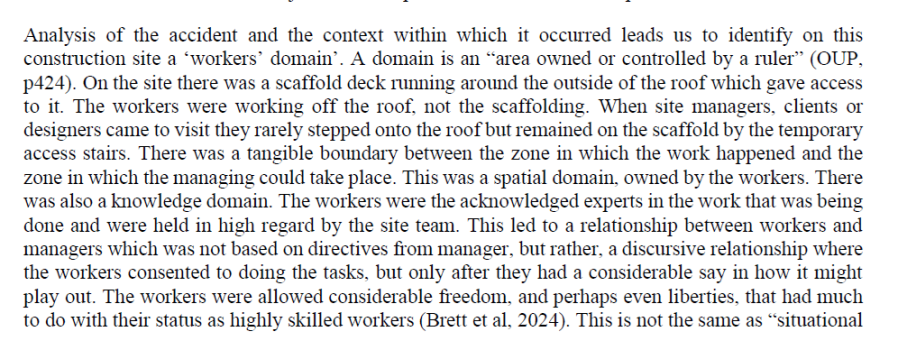
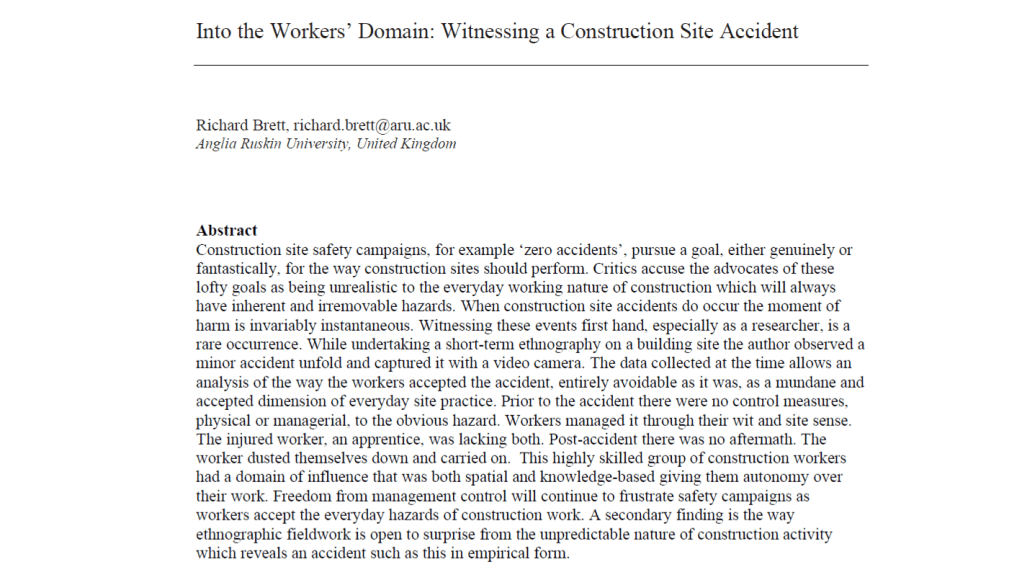
This was interesting – describes an ethnographic study where the researcher was onsite recording/observing work on job craft/craftsmanship, when they observed a minor site incident.
It’s framed about the researcher’s contention that this hazard was normalised by the workers – but an entirely “mundane and accepted dimension of everyday site practice”.
First they unpack some of the criticisms about zero harm and safety campaigns, noting that there is always potential for worker harm despite such well-intended initiatives.
For one, such campaigns are “management led”, whereas there is “an element of everyday work practice that exists outside the reach of management control”.
The “appeal of zero harm threatens to squeeze out any room for nuance in the debate around construction site accidents”, because it requires somebody brave to suggest that we should accept any injuries.
However, there needs to be recognition of the “structural realities of construction whereby the over-bearing emphasis on production within a limited and compromised set of resources means worker safety is not the dominant concern of construction operations (Jeschke, 2022) but a sub-set of the operational concerns”.
The Domain of Work
It’s said that construction workers, within this historical domain, have independence, control over their work processes, autonomy and loose supervision. This is even more prevalent with the sub-contracted labour – being labour intensive and low tech.
Because of this, it affords greater decision-making power to the workers how they do their, often specialised and labour intensive work.
This autonomy that construction workers have “acts as a limitation on the ability of managers, i.e. those that pursue zero harm as an achievable target, to exert complete control over the way construction work is carried out at the very point of delivery”.
The researcher then discusses the observed incident. I’ve skipped most of the rich description, but in short they were observing workers, who were comfortable in their environment. They were roofers, moving lead sheets into position. As an apprentice stood backwards, they fell into a person-sized penetration in the roof deck; the worker “half disappeared”.
The apprentice climbed out, and besides a sore butt, only had his pride injured. Some jokes were made, the apprentice placed some wood over the penetration, and everybody went about their work.
The researcher observed that the workers “were not being forced to work in poor conditions. The contractor in this example was an experienced company in this field with a long lineage”. Moreover, the researcher says that there wasn’t any equipment failure, poor weather, or unusual circumstances. It might be considered an ‘unsafe working condition’ per some accident causation model, but for the researcher, the acceptance to the penetration was “provocative”.
The penetration was covered afterwards, but not before, as people worked around it. For the researcher, the “striking thing about the event is the acceptance, by all those involved, of this obvious and preventable hazard. It was also a very mundane event”.
Further, after the “briefest of checks to see if [the apprentice was] ok”, everybody carried on – the researcher is unsure if it was reported. But in their view, it has an under-current of “macho culture”.
Further, while the apprentice may have picked up a bruise, things could have been a lot worse – but for this crew, in their work domain, “It is better not to dwell on what might have been”.
For the researcher, there was an “everydayness about the way in which the accident was accepted by the workers”. But for the researcher, it “was not an everyday occurrence [and they observed something] which could have had major consequences, had an air of inevitability about it, and which zero safety campaigns would have us believe is eradicable”.
Again, from their perspective, observing this event revealed a “persistent acceptance of low-level risk in day-to-day work”, where the control measures for the task “is the wit and experience of the operative”.
As such, risk is accepted by the workers because “it is within the gift of the operative to control it by their physical coordination and site knowledge. They are accustomed to difficult working environments and a hole in the floor is just another one to be avoided. Skilled workers value the autonomy their abilities give them”.
The Workers Domain
Next the article unpacks the ‘workers domain’, their special part of the world that is largely “beyond the reach of management controls”.
The researcher argues that explanatory models of construction accidents are largely derived from retrospective analysis of events that have already happened, which are “ over-burdened with the wisdom of hindsight”.
In this instance, at least for the researcher, the hazard (open penetration on the roof deck) was “easily identifiable” to all those on site, yet no mitigation was taken until after the incident.
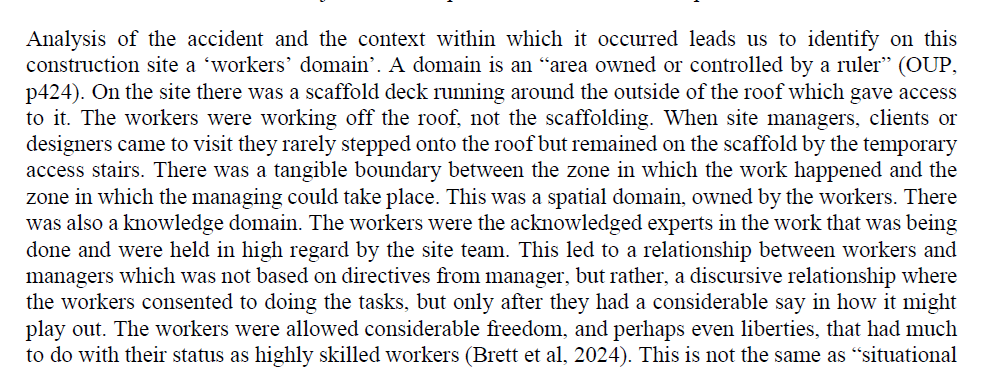
The worker’s domain is their specialised area in the field, where they apply their expertise and domain knowledge, which “isolates the workers from the managers which we called the workers’ domain. Within this space, the workers exercise their autonomy in the way they feel appropriate, and it is immune from management interventions to some degree”.
Here, it’s said that workers operate within this domain, working around and accepting that their workplace has hazards, and they’re “happy to work in this situation”. Within this domain, they exercise a degree of freedom to go about their work as they see fit (e.g. working around an open penetration, and presumably not reporting it?).
While recognising the worker’s domain may be “uncomfortable message for some”, the researcher contends that “workers knowingly and contentedly working in hazardous conditions”.
Moreover, “Zero safety campaigns are disingenuous if they refuse to recognise safety controls are limited, and that hazards are acceptable to site workers”.
Ref: Brett, R. (2025). Into the workers’ domain: witnessing a construction site accident. In CIB Conferences (Vol. 1, No. 1, p. 92).
Study link: https://docs.lib.purdue.edu/cgi/viewcontent.cgi?article=2019&context=cib-conferences
LinkedIn post: https://www.linkedin.com/pulse/workers-domain-witnessing-construction-site-accident-ben-u5rvc
My YouTube: https://www.youtube.com/@safe_as_pod
My site with more reviews: SafetyInsights.org
Shout me a coffee: https://buymeacoffee.com/benhutchinson
Safe As LinkedIn group: https://www.linkedin.com/groups/14717868

 SafetyInsights.org