
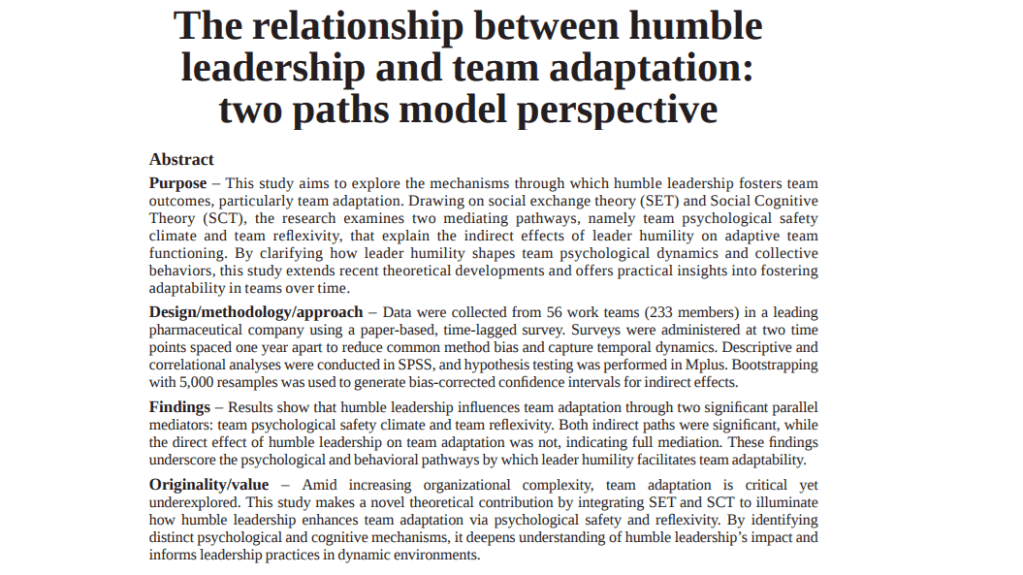
This study investigated how humble leadership fosters team outcomes, like team adaptation.
Psychological safety climate and reflexivity were explored as mediating pathways. Surveys at two time points across 56 work teams (233 members) were collected.
Background:
· The word humility derives from the Latin humilitas, meaning from the earth/grounded
· Humility has a long history and is “deeply rooted in many religious and philosophical ideologies”
· Humility has been seen as a “virtue with inherent value” with positive attributes like accurate self-appraisal and willingness to admit mistakes
· “Humble leadership is defined as “the leadership that involves viewing oneself accurately, providing an appreciation of others’ strengths and contributions, and modeling teachability”
· Humble leadership has been positively correlated with “affective commitment, trust, creativity, engagement, job satisfaction and organizational identification and outperforms other leadership styles in various outcomes”
** They use the term ‘psychological safety climate’. This is better known as ‘psychological safety’, and isn’t ‘safety climate’. Frustratingly, these terms can be mixed up, where psychological ‘safety climate’ is the individual-level measure of safety climate.
Results:
· “humble leadership influences team adaptation through two significant parallel mediators: team psychological safety climate and team reflexivity”
· “These findings underscore the psychological and behavioral pathways by which leader humility facilitates team adaptability”
· “when examining its mediating role, the indirect effect estimate of psychological safety climate (0.24) is greater than that of team reflexivity (0.12). This result highlights the pivotal role psychological safety plays in promoting team adaptation”
· A “significant positive association between task dependence and humble leadership (r = 0.35, p < 0.01)” was found, aligning “with previous research indicating that leaders in teams characterized by high task dependence tend to be perceived as humbler by their members”
· These findings support prior work “research indicating that effective team adaptation relies on leaders’ receptivity to new ideas and feedback … as well as their readiness to acknowledge mistakes”
Ref: Lin, T. T., Huang, C. Y., & Chien, C. J. (2025). The relationship between humble leadership and team adaptation: two paths model perspective. The Learning Organization: An International Journal.

Study link: https://doi.org/10.1108/TLO-07-2024-0201
Safe AS LinkedIn group: https://www.linkedin.com/groups/14717868/

 SafetyInsights.org