
Is safety climate stable day-to-day or more dynamic and variable?
A really interesting study which explored the stability of safety climate over a 28 day offshore work period (hitch).
Background:
· “Safety climate is a domain-specific form of organizational climate (Schneider, 1975). It is defined as ‘shared perceptions with regard to the priority of safety policies, procedures and practices and the extent to which safety compliant or enhancing behaviour is supported and rewarded at the workplace”
· “In fact, Zohar (2014) identified the misalignment between what is formally espoused versus actually enacted as an important indicator of management commitment to safety, the core dimension of safety climate”
· Whereas culture is often argued to be stable, and climate more variable, there is a paucity of research supporting climate’s variability
Findings:
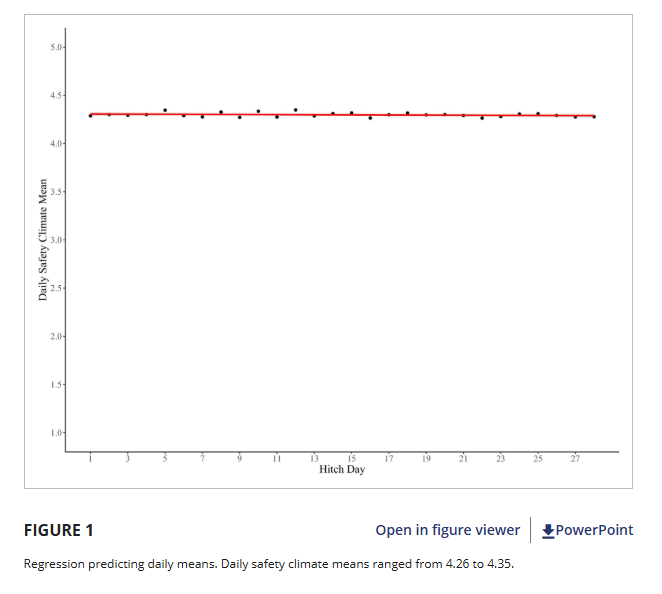
· “Overall, the daily means, standard deviations and 1-day lagged correlations of safety climate remained very stable over the course of the hitch”
· “the relationship between any two measurements of safety climate significantly diminished as the amount of time between measurements increased”
· “Dynamic structural equation modelling revealed that some individuals perceived a much more stable safety climate than others, but none of the 15 person-level variables explained this between-person variability in stability”
· Hence, they “found minimal changes in these daily scores over a 28-day work period. When aggregated to the workgroup level, safety climate scores appeared to be even more stable”
· “Whereas daily means and SDs did not vary significantly, there was a significant negative association between the time-lagged correlation of daily safety climate scores and the time-lag between measurements, indicating that individual ratings of climate on a given day became less predictable as the amount of time from the previous measure increased”
· And “safety climate from a previous day was strongly associated with subsequent days’ safety climate for up to 22 days later”
· They note that “Whereas most organizations measure [safety climate] annually … there are likely several months out of the year in between measurements where the observed safety climate is likely not an accurate reflection of the current climate”
· “If a safety climate measure only maintains a strong relationship with a measure taken up to 3weeks later, then measures taken over longer intervals are likely weakly related at best, or unrelated at worst”
· “We recommend organizations in high-reliability industries measure safety climate at least monthly, in order to maximize its potential as a leading indicator”
Ref: Payne, S. C., Dumlao, S. V., Zhang, B., Kang, J., Mehta, R. K., & Sasangohar, F. (2025). Journal of Occupational and Organizational Psychology, 98(3), e70051.

Shout me a coffee (one-off or monthly recurring)
Study link: https://bpspsychub.onlinelibrary.wiley.com/doi/pdf/10.1111/joop.70051
Safe As LinkedIn group: https://www.linkedin.com/groups/14717868/

 SafetyInsights.org