NASA’s language of risk was “technical, impersonal, and bureaucratic”.
Some extracts from both the Columbia accident report (CAIB 2003 image 1) and Ocasio’s chapter ‘The Opacity of Risk’, in Organization at the Limit (images 2 & 3; awesome book – I think essential reading).
I’m writing up both for upcoming summaries, but for now just a few extracts:
CAIB:
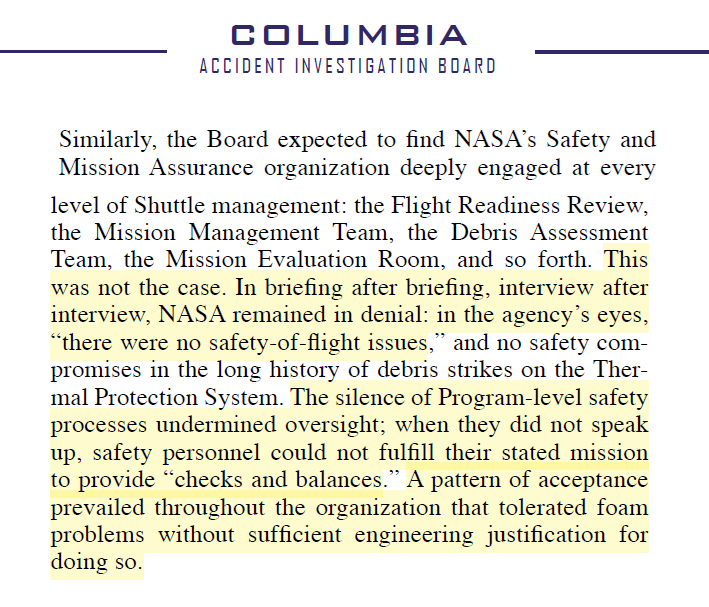
· The CAIB expected to find “NASAʼs Safety and Mission Assurance organization deeply engaged at every level of Shuttle management”. However, “This was not the case”
· And “In briefing after briefing, interview after interview, NASA remained in denial: in the agencyʼs eyes, “there were no safety-of-flight issues,” and no safety compromises”
· “The silence of Program-level safety processes undermined oversight; when they did not speak up, safety personnel could not fulfill their stated mission to provide “checks and balances.”
· “A pattern of acceptance prevailed throughout the organization that tolerated foam problems without sufficient engineering justification for doing so“
Ocasio:
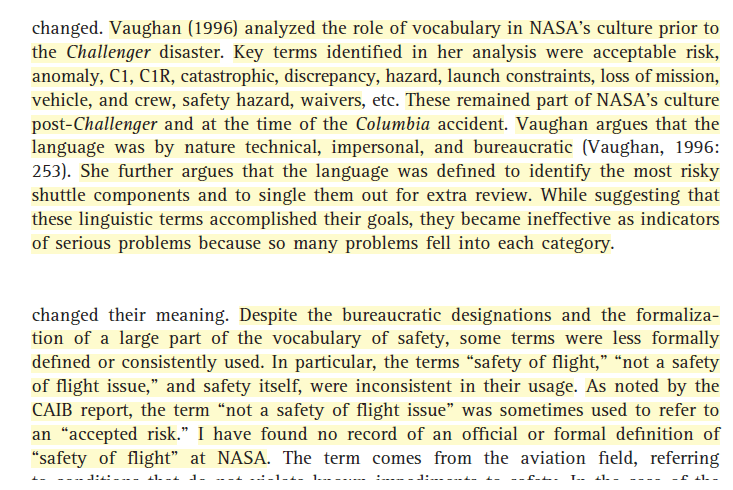
· “Vaughan (1996) analyzed the role of vocabulary in NASA’s culture prior to the Challenger disaster. Key terms identified in her analysis were acceptable risk, anomaly, C1, C1R, catastrophic, discrepancy, hazard, launch constraints” and more
· “Vaughan argues that the language was by nature technical, impersonal, and bureaucratic”
· “She further argues that the language was defined to identify the most risky shuttle components and to single them out for extra review. While suggesting that these linguistic terms accomplished their goals, they became ineffective as indicators of serious problems because so many problems fell into each category”
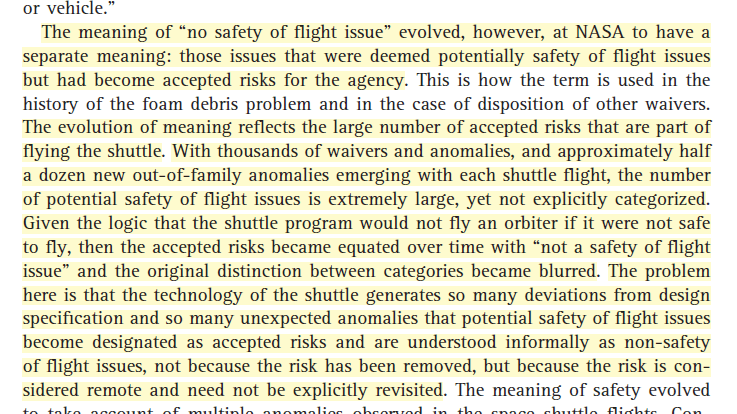
· “The meaning of “no safety of flight issue” evolved, however, at NASA to have a separate meaning: those issues that were deemed potentially safety of flight issues but had become accepted risks for the agency”
· “Given the logic that the shuttle program would not fly an orbiter if it were not safe to fly, then the accepted risks became equated over time with “not a safety of flight issue” and the original distinction between categories became blurred”
· “The problem here is that the technology of the shuttle generates so many deviations from design specification and so many unexpected anomalies that potential safety of flight issues become designated as accepted risks and are understood informally as non-safety of flight issues, not because the risk has been removed, but because the risk is considered remote and need not be explicitly revisited”

Shout me a coffee (one-off or monthly recurring)
Refs:
1. CAIB 2003
2. Ocasio, W. (2005). The opacity of risk: Language and the culture of safety in NASA’s space shuttle program. Organization at the limit: Lessons from the Columbia disaster, 101-121.

 SafetyInsights.org