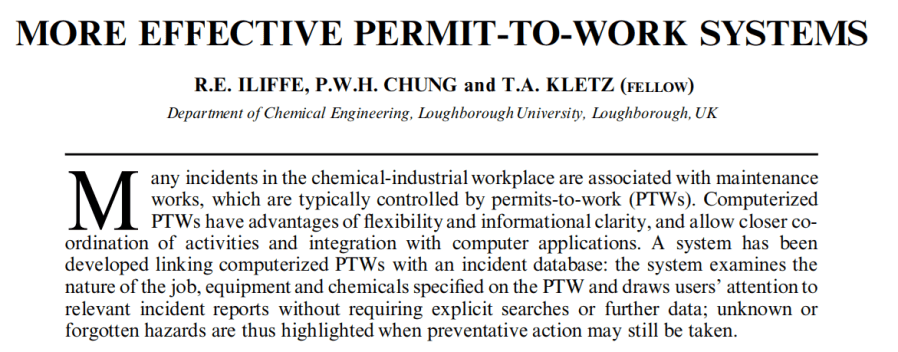
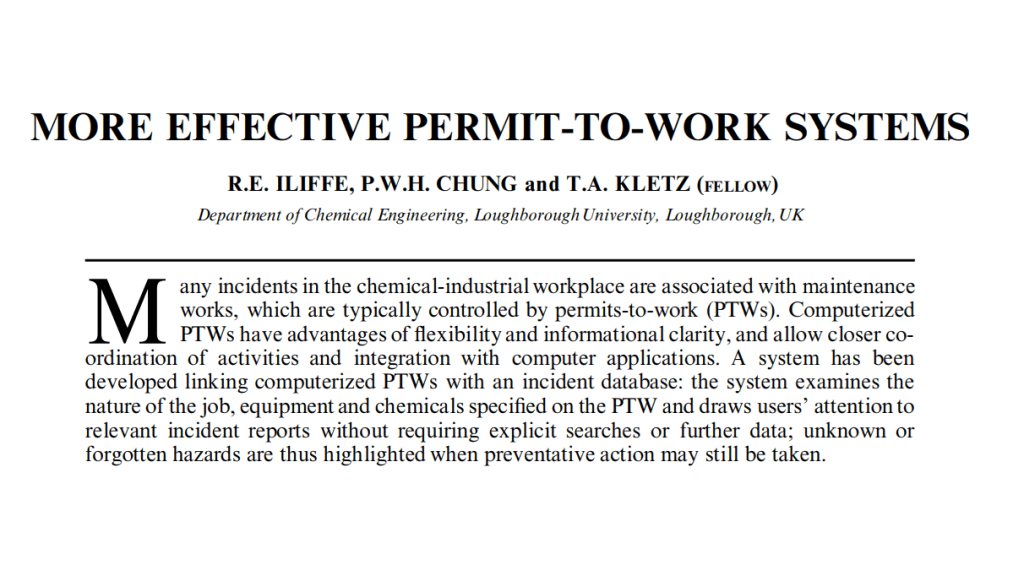
Kletz and colleagues in 1998 discussing follies of permit to work (PTW) systems, and some improvements.
Was meant to be a mini-post, but couldn’t be bothered cutting it back.
Extracts:
· “A quick check of the Institution of Chemical Engineers’ Accident Database reveals that over 700 accidents of the 5000 listed were maintenance-related”
· Some related to the ways that maintenance was carried out but “most were due to errors in the way the equipment was prepared for maintenance or handed over”
· It’s interesting to see the rose coloured glasses Kletz had in the early days towards digital permit systems – many justified, and other ‘benefits’ that I don’t think necessarily came true (due to several reasons)
· PTW systems “incorporates both a written document and a series of rules describing and circumscribing safe methods of working”, but their specific goals “are more diverse and more complex”
PTWs are argued to perform three functions:
1) Identify potential hazards “together with the concomitant precautions which must be taken”
2) Aid in the co-ordination of the risk precautions, carrying out the task and the removal of the precautions/reinstatement
3) “Third, they provide a written record of what was done, by whom, when and how”
· But, “It would be a mistake to perceive PTW systems as being set in stone; to obtain the best use of them they should be capable of easy modification to meet changing circumstances and individual user needs”
· A 1995 survey in medium-sized chemical plants found the type and format of PTWs varied across the plants – and many plants had at least 3 different forms to cover various jobs, and some plants had 10 different forms
· “…many companies copy the permits of other companies without paying sufficient regard to their appropriateness to their own needs” and at the other end of the scale “too great specificity of permit forms may lead to a confusion of paperwork with a consequent loss of efficiency”
· Moreover it’s “frequently difficult to locate authorized issuers when a permit is actually needed, with the result that permits are commonly issued at a specific time in the morning with actual commencement of the work being left till some time later in the day”
· “confusion frequently exists over which authorizations, additional to that of the issuer, a permit requires– whether it must be signed off by a fire-marshal, by management or by some specialist”
· One issue is “ensuring that all those people who need to be informed of maintenance work are, in fact, informed”
· This is amplified when “maintenance carries-over between shifts– the Cullen Report6 cites the failure to inform a new shift that safety-critical equipment had been disconnected as one of the proximate causes of the Piper Alpha disaster”
· In some plants, pipework may pass through many different areas other than where the work’s carried out, “It is clearly important that the people in charge of those areas be informed of the isolation; sometimes this is not done”
PTW’s also carry other general weaknesses:
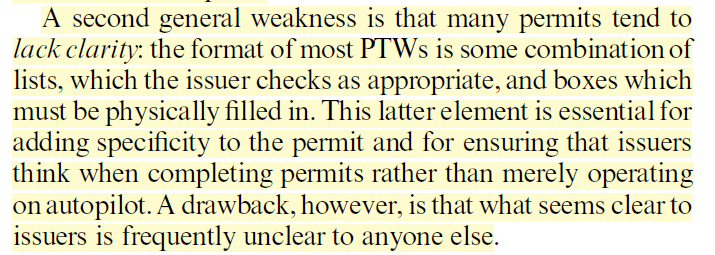
· “First, they are uninformative. All current systems assume that issuers are competent to identify hazards and that they merely need to be prompted to remind them of particular dangers”
· But this isn’t always accurate, as the workplace is “highly and increasingly complex; while it is reasonable to expect issuers to be aware of the more common hazards, such is this complexity that their failure to guard against every possible hazard is not culpable”
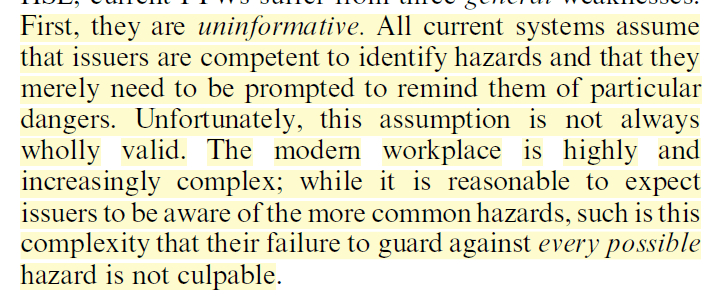
· Two, “many permits tend to lack clarity: the format of most PTWs is some combination of lists, which the issuer checks as appropriate, and boxes which must be physically filled-in”
· Hence, people tick boxes on autopilot
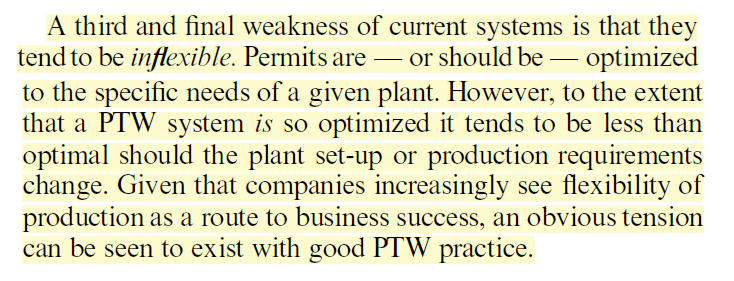
· Three, current PTW systems “they tend to be inflexible. Permits are – or should be – optimised to the specific needs of a given plant”
Computer vs the paperclip
· Computer systems trump paperwork for legibility – e.g. poor handwriting, soiled permits etc.
· Computer systems though trump paperwork when it comes to co-ordination
· A limitation of prior approaches was to break down the system into sub-systems and address each separately
· It’s argued that these multi-paper-permits “is not beyond criticism: greater apparent control in such a case is achieved only at an increased cost in bureaucratic complexity; workers may be reluctant to perform ‘unnecessary’ administration and may not complete the PTWs properly, or may link completed permits improperly; fitters may, as a result of information overload, suffer confusion over what actions the permits actually require them to perform”
· Hence, “redundancy may result in decreased safety”
· While “computer control of permits cannot eliminate these hazards it does allow much closer control of what goes on”
· They propose an active database system that links the permits to incidents, providing better insights into what can, or has, gone wrong in the past
· This system is more practicable than ever with the widespread adoption of AI models – I’ve done something similar with auditing and investigations (e.g. being trained on reports and company bow-ties)
Ref: Iliffe, R. E., Chung, P. W. H., & Kletz, T. A. (1999). More effective permit-to-work systems. Process safety and environmental protection, 77(2), 69-76.

Shout me a coffee (one-off or monthly recurring)
Study link: https://doi.org/10.1205/095758299529839
Safe As LinkedIn group: https://www.linkedin.com/groups/14717868/
LinkedIn post: https://www.linkedin.com/pulse/more-effective-permit-to-work-systems-ben-hutchinson-ezpcc


