How does AI use in training improve, or impact, skill acquisition?
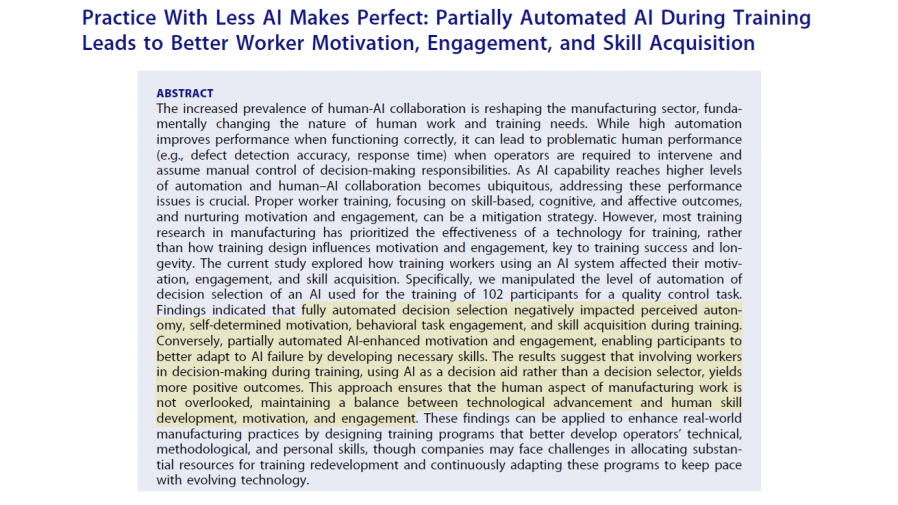
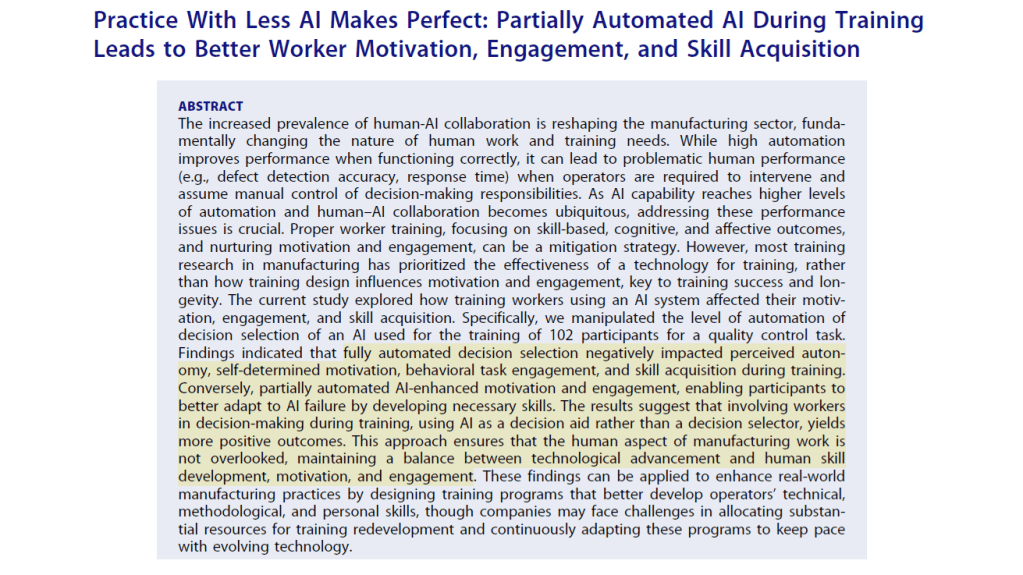
This study manipulated training protocols with varying levels of AI decision-making automation, among 102 participants during a quality control task.
Extracts:
· “Partial automation led to the most positive outcomes”
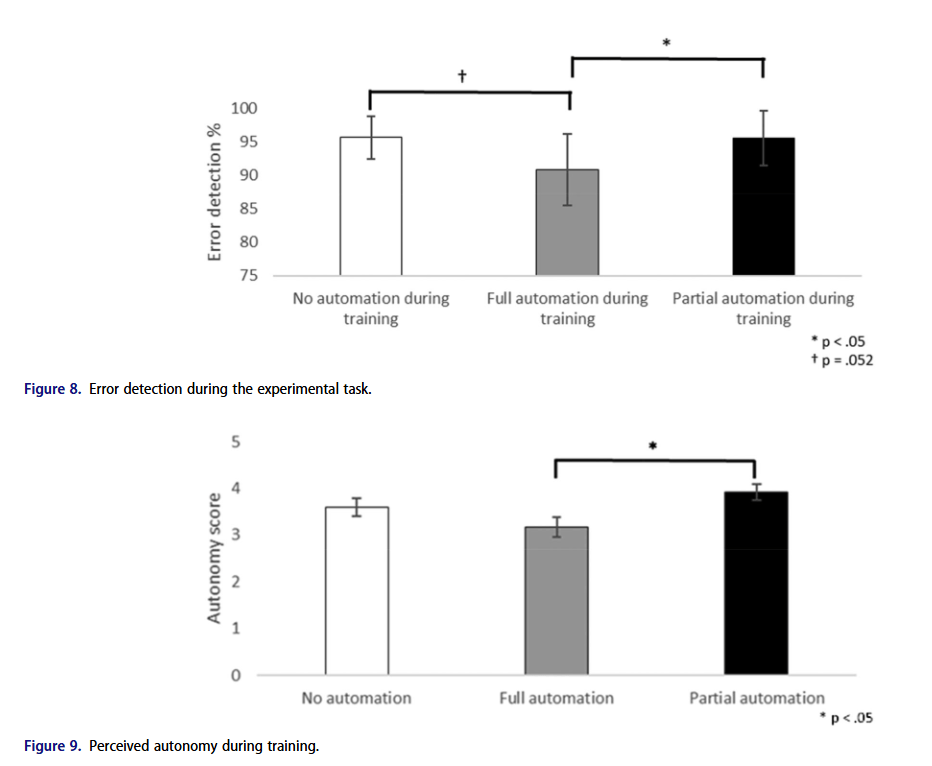
· “Participants who were trained with the fully automated version of the AIEDS had a significantly worse error-detection performance… compared to participants who were trained with partial or no automation”
· “Full automation of decision selection keeps trainees out of the decisional loop… creating a passive learning approach, rather than an active one”
· “Participants felt the strongest sense of autonomy when being trained with the partially automated AIEDS”
· “Partial automation… characterized as more meaningful and gratifying, which positively affected their perception of autonomy”
· “Identified regulation was higher when participants used partially automated AI compared to fully automated AI”
· “Identified motivation has been shown to be the strongest predictor of performance and organizational citizenship behaviors”
· “Partial automation led to the highest engagement, while full automation led to the lowest”
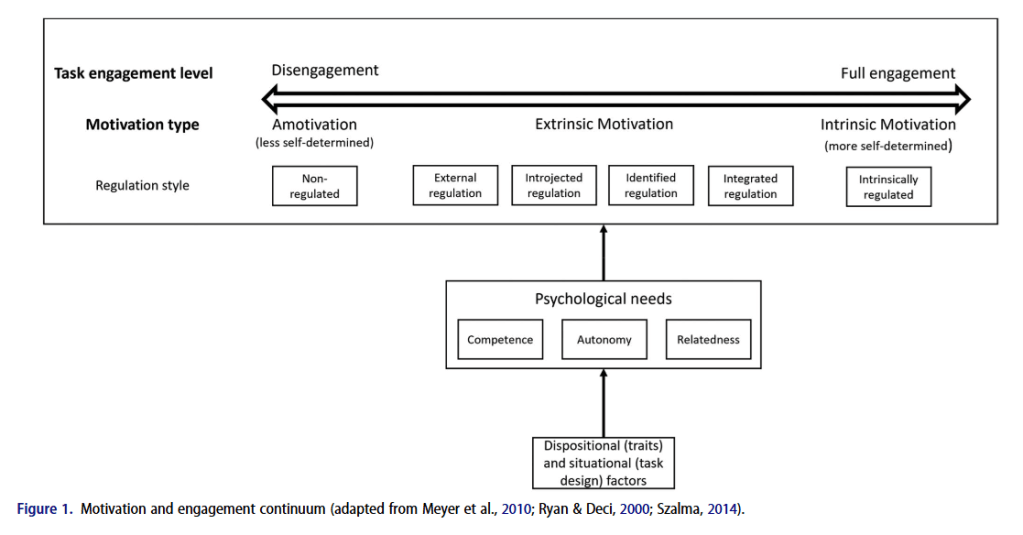
· “Participants were the most physically engaged in the training when decision selection was only partially automated”
· “Practitioners creating training should avoid automation past the critical boundary… focus on creating training curricula that employ an active learning approach”
· “maximizing the level of automation may not be the ideal solution for successful skill acquisition”
· “Indeed, workers retaining decision-selection authority during training led them to feel a stronger sense of decisional latitude (autonomy), self-determined motivation, and behavioral engagement during training. In turn, this better allowed workers to develop their technical, methodological, and personal skills, which led to them being able to better adapt to AI failure”
· “AI may have more value as a decision aid rather than a decision selector during training”
· “By promoting training programs that balance AI capabilities with human skill and decision-making, policies can foster a workforce that is adaptable and competent in an increasingly automated world”
Ref: Passalacqua, M., Pellerin, R., Yahia, E., Magnani, F., Rosin, F., Joblot, L., & Léger, P. M. (2025). International Journal of Human–Computer Interaction, 41(4), 2268-2288.

Shout me a coffee (one-off or monthly recurring)
Study link: https://doi.org/10.1080/10447318.2024.2319914


