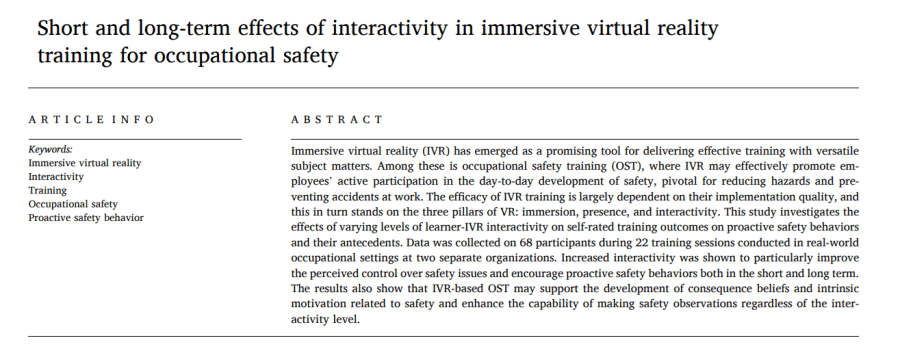
This tested Immersive Virtual Reality (IVR) on “proactive safety behaviours and their antecedents”.
They argue that the efficacy of IVR depends on the implementation quality, which depends on immersion, presence and interactivity.
22 training sessions were held with 68 participants.
Extracts:
· “Increased interactivity was shown to particularly improve the perceived control over safety issues and encourage proactive safety behaviors both in the short and long term”
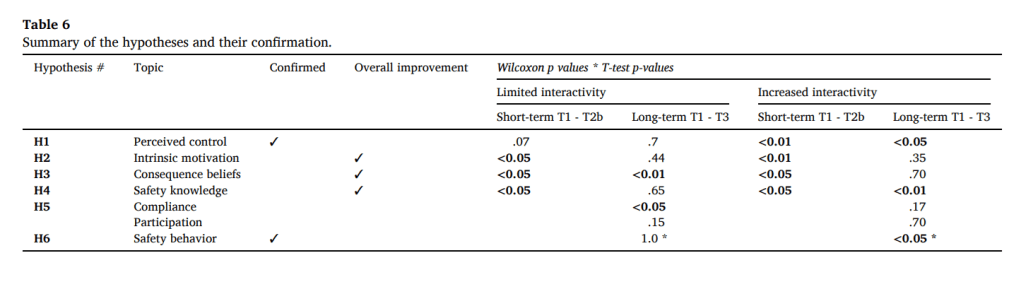
· The training intervention successfully achieved some goals, as “intrinsic motivation (Hypothesis H2), consequence beliefs (H3), and procedural knowledge of making safety observations (H4) strengthened significantly as a result of the training for both interactivity conditions” in the short-term
· Short-term results showed that “perceived control over safety issues (H1) was significantly stronger only for the increased interactivity participants”
· At 10 weeks follow-up, “training in the increased level of interactivity IVR environment induced more proactive safety behaviors… A similar change in pre-post measures was not observed for the limited interactivity group”
· The positive effect on “perceived control over safety issues (H1)” maintained a “statistically significant change” within “the increased interactivity condition” at 10 week follow-up
· For procedural safety knowledge, “statistically significant changes within the increased interactivity condition” also persisted at the ten-week follow-up
· Self-rated consequence beliefs had significant increases for both conditions in the short-term, but “the effect persisted only for the limited interactivity group at T3” in the long-term
· “Rather unexpectedly, we found that those in the training condition with less interactivity in the IVR learning environment rated their own safety compliance more negatively at the ten-week follow-up”
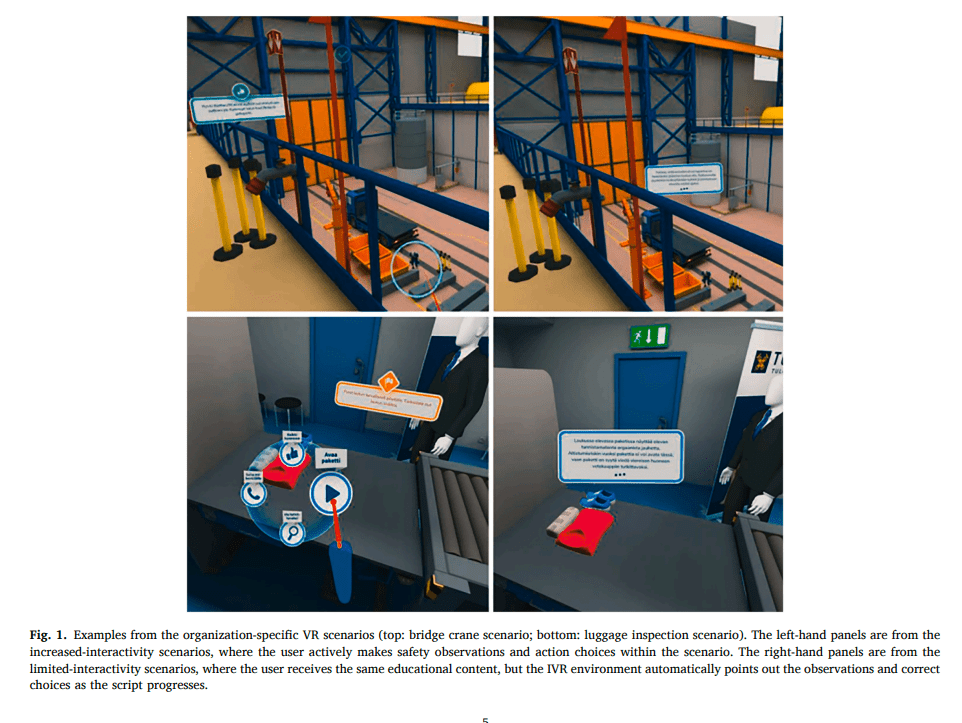
· They conclude that “scenario designs that encompass direct object interaction in learning tasks and appropriate feedback on the learners’ corresponding actions may unlock the best instructional strategies for IVR OST”
· Results indicate that the “level of interactivity in an IVR training environment is likely an active ingredient in IVR OST design that enhances employees’ safety-related control beliefs and supporting proactivity in improving safety, with effects persisting over time”
Ref: Lukander, K., Lehikko, A., Nykänen, M., Lantto, E., Uusitalo, J., & Ruokamo, H. (2025). Computers in human behavior reports, 20, 100809.

Shout me a coffee (one-off or monthly recurring)
Study link: https://doi.org/10.1016/j.chbr.2025.100809


