Further extracts from Energy-Based Safety:
· “We only Identify about 45% of the Hazards during our Work Planning”
· “The crews from these industry-leading companies were identifying fewer than half of the hazards”
· “Hazard Recognition Skills are the Same Regardless of Age, Experience Or other Personal Factors”
· “We assumed seasoned workers would identify more hazards than their junior counterparts, but we were wrong. There was no statistical relationship between experience and performance”
· “Although experienced workers were better at explaining or respond to hazards, they were just as likely to miss them in the first place”
· “Not Every Hazard Is Reasonably Identifiable in a Pre-Job Safety Briefing”
· “When shadowing crews, it became apparent that hazards are missed for one of two reasons: (1) the hazard was detectable before work began, but the team did not identify it; or (2) the hazard wasn’t reasonably detectable with the information available at the time”
· “For example, crews often miss hazards such as pressure vessels and cable tension that are integral components of the planned work”
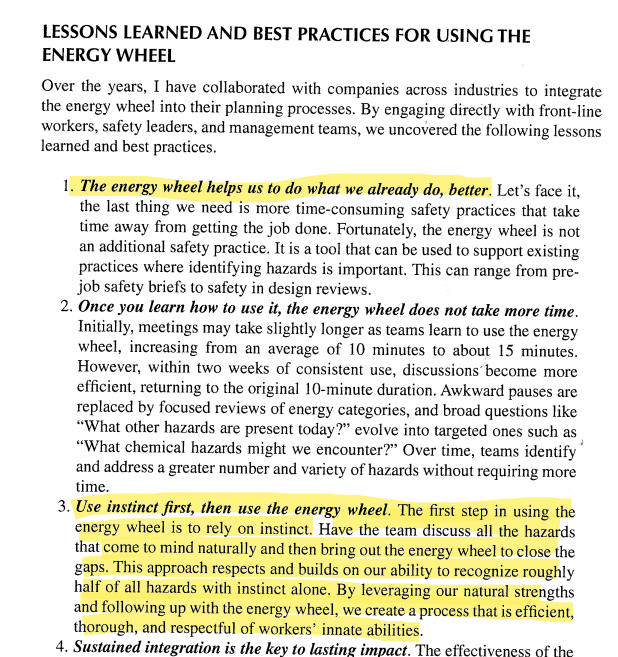
· “…other hazards are missed because they emerge from unforeseen change (e.g. a subcontractor unexpectedly staging materials above a workspace”
· “We Tend to See Gravity and Motion Hazards but Overlook Others such as Pressure, Temperature, Radiation, Chemical, and Biological”
· “The patterns in hazard recognition were puzzling. Understanding that the ceiling for pre-job hazard recognition is about 70%, crews were nearly perfect at identifying gravity and motion hazards”
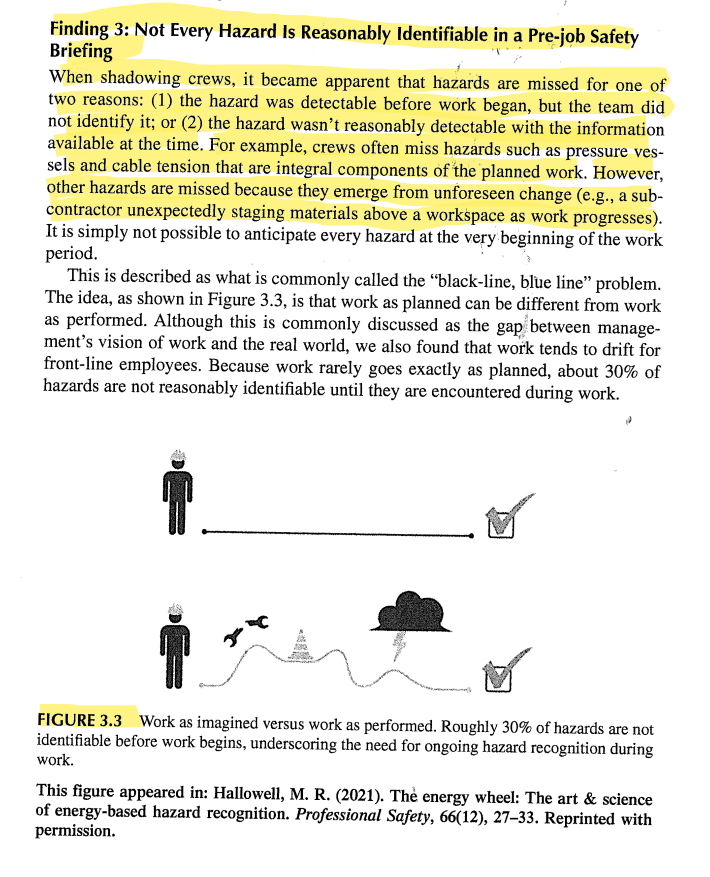
· “The energy wheel helps us to do what we already do, better …”
· “Use instinct first, then use the energy wheel”
· “The first step in using the energy wheel is to rely on instinct. Have the team discuss all the hazards that come to mind naturally and then bring out the energy wheel to close the gaps”
· “By leveraging our natural strengths and following up with the energy wheel, we create a process that is efficient, thorough, and respectful of workers’ innate abilities”
· [** Though I suspect some of my peers familiar with STAMP/STPA and enforcing constraints from unsafe control actions, or HAZOPs and the like familiar with guide words, may find this approach a bit weak]
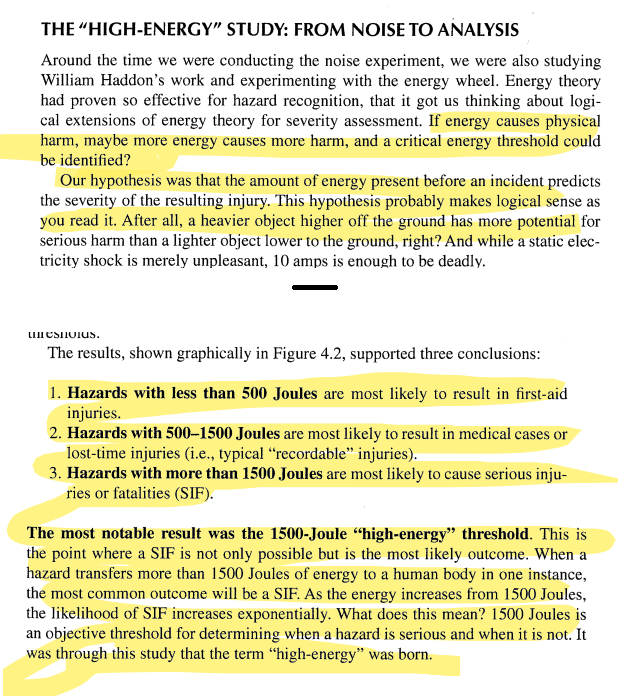
· The final image covers some findings on the links between energy magnitude and severity of injury – where more energy present before an incident predicts the severity
· Hazards with <500 J are more likely to result in first-aid, 500-1500 J more likely to result in medical cases or LTI, and >1500 J are more likely to cause SIFs
· From their research the “most notable result was the 1500-Joule “high energy” threshold”
· “This is the point where a SIF is not only possible but is the most likely outcome”