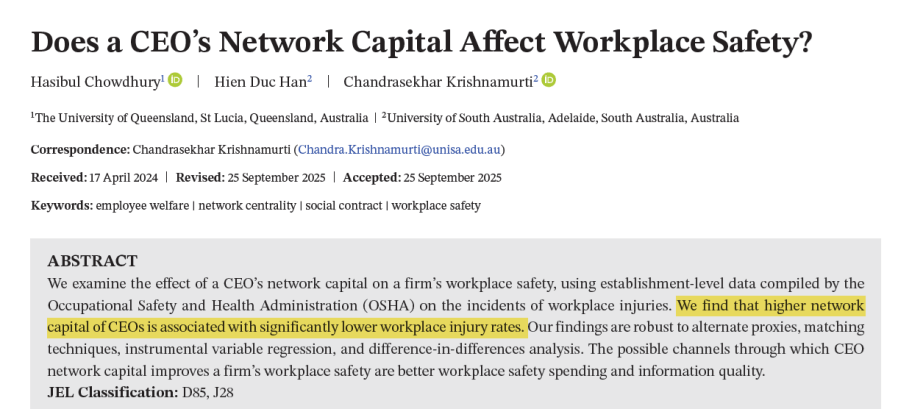
This study explored whether CEOs with strong professional networks influences the reported OSHA injuries.
They anaylsed a CEO’s network capital (how connected they are across companies and boards), OSHA recordables at the establishment level, and controlled for heaps of stuff including company size, finances, CEO traits, risks.
993 public firms from 2002 to 2011 were included. (** and yes, they’re using OSHA recordables. I get it. Caveat emptor as always.)
Extracts:
· “We find that higher network capital of CEOs is associated with significantly lower workplace injury rates”
· “The possible channels through which CEO network capital improves a firm’s workplace safety are better workplace safety spending and information quality”
· “CEO network social capital enhances their reputation by embedding trust, which minimizes the negative outcomes of incomplete contracts (Grossman and Hart 1986), thereby reducing the need for costly external monitoring”
· “Social network capital also embeds a disciplinary mechanism by penalizing members who breach social contracts, which can include neglecting employee well-being”
· “Well-connected CEOs gain access to high-quality information through their networks, enabling better decision-making”
· “We propose that well-connected CEOs, who have strong access to external information, can leverage this advantage to enhance the quality of internal information within their organizations”
· “Taken together, well-connected CEOs protected by labor market insurance and shielded from monitoring have incentives to take more risk”
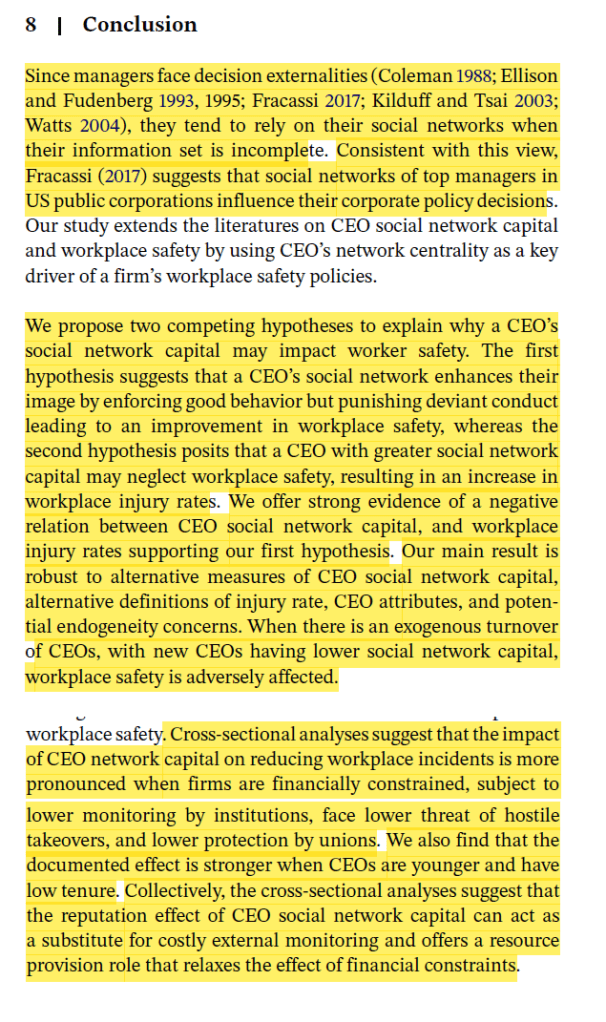
· “Our baseline results… suggest a robust negative relation between CEO centrality and work-related injury rates, supporting the hypothesis that well-networked CEOs improve the safety of the firms they lead”
· “We find that highly-networked CEOs increase their safety expenditure, resulting in lower levels of adverse safety-related incidents”
· “A CEO’s network capital improves workplace safety due to the well-connected CEO’s effort to maintain better information flows within the organization”
· “We find that when a new CEO has lower network capital there is an adverse effect on workplace safety, suggesting a causal relationship between CEO centrality and workplace safety”
· “Overall, these results suggest that well-connected CEOs play a ‘substitutive’ governance role, mitigating adverse workplace incidents and this effect is stronger when firms are otherwise weakly-monitored”
· “CEO network capital plays a bigger role when CEOs have high career concern (e.g., CEO tenure and CEO age are low)”
· “CEO network capital also plays a significant role in firms with high safety risk characterized by low safety expenditure and elevated level of tangible assets”

Shout me a coffee (one-off or monthly recurring)
Ref: Chowdhury, H., Han, H. D., & Krishnamurti, C. (2025). Financial Review.


