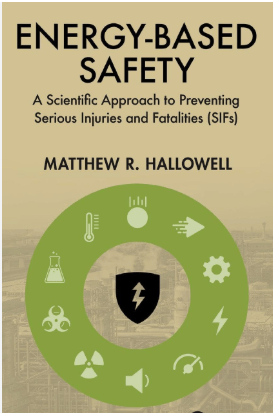
More extracts from Energy Based Safety – now focusing on Direct Controls & Alternative Controls (AC/DC):
· “Not everything casually labeled a “control” effectively manages the boundary between high-energy and people”
· “To reduce confusion, we define “energy controls” as physical measures that actively reduce or remove hazardous energy”
· “Many safety measures, such as policies, plans, and procedures are critical for supporting energy control, but they do not mitigate hazardous energy directly”
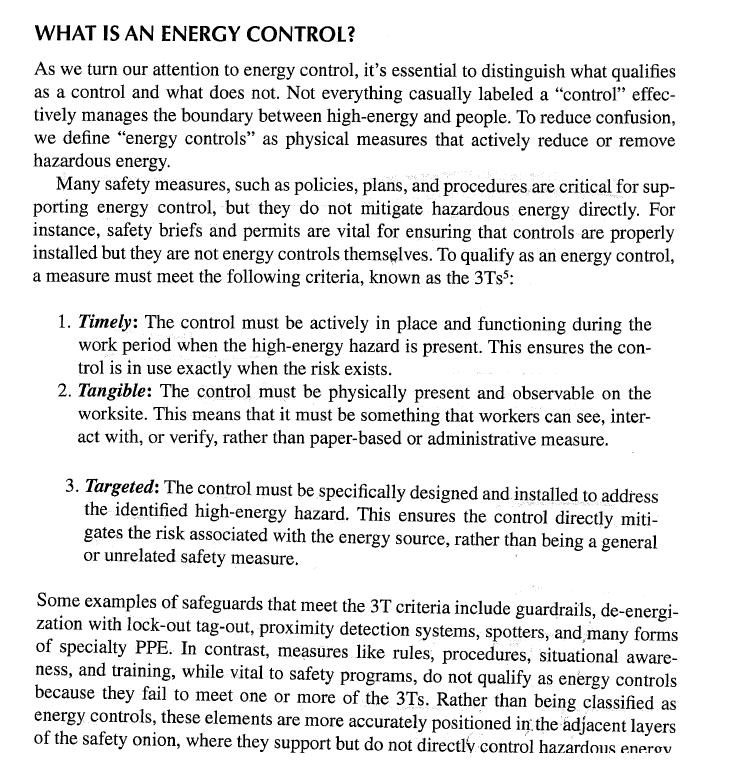
· They propose three criteria to qualify as an energy control – known as the 3Ts:
· “Timely: The control must be actively in place and functioning during the work period when the high-energy hazard is present”
· “Tangible: The control must be physically present and observable on the worksite. This means that it must be something that workers can see, interact with, or verify, rather than paper-based or administrative measure”
· “Targeted: The control must be specifically designed and installed to address the identified high-energy hazard”
· This includes things like guardrails, interlocks and more – but rules, situational awareness and training don’t meet the definition, despite being important
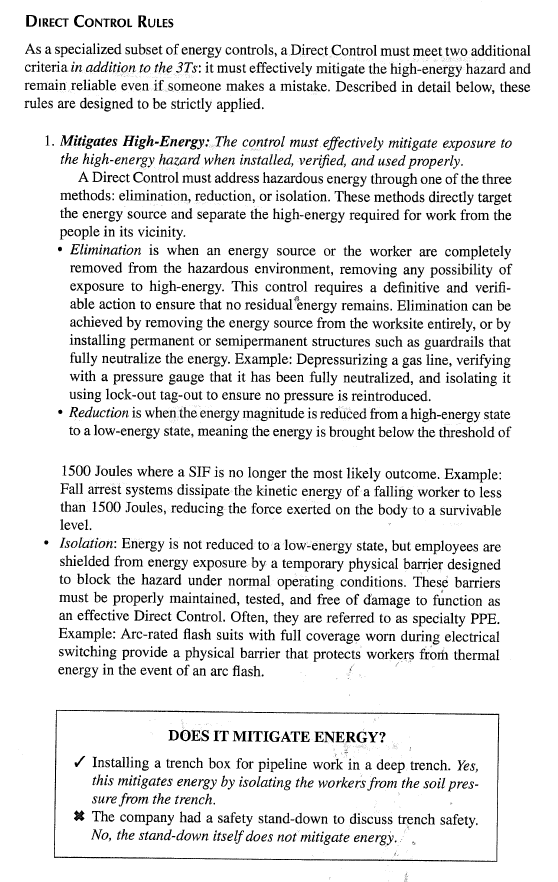
· Such activities don’t directly control hazardous energy but support the control systems
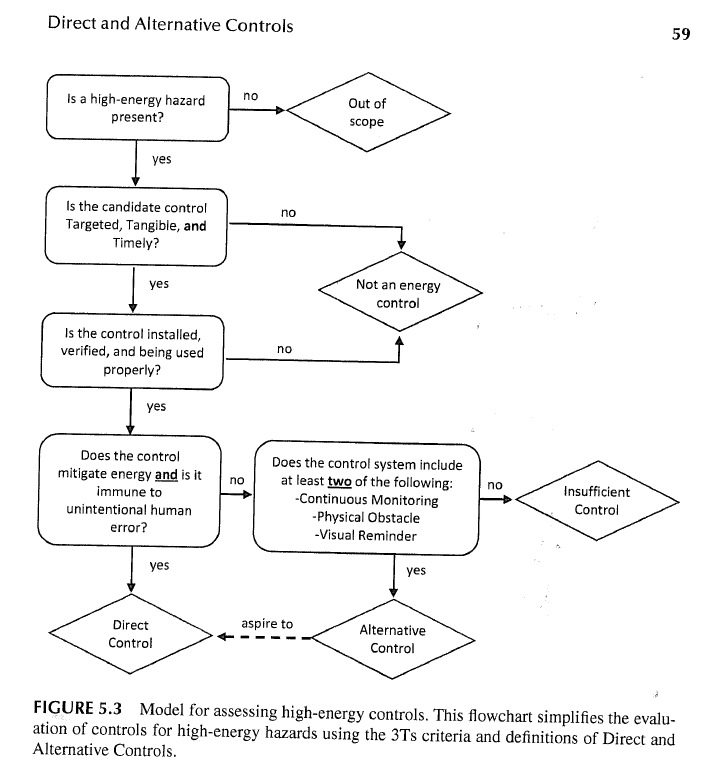
· Direct Controls (DC) must also meet two additional criteria to the 3T: “it must effectively mitigate the high-energy hazard and remain reliable even if someone makes a mistake”
· DCs must address hazardous energy through elimination, reduction or isolation
· Alternative Controls (AC) are used when a DC “is deemed unfeasible and this determination is confirmed by a competent person”
· “Because Alternative Controls focus on minimizing human error, they are never stand-alone solutions”
· Hence, for a control to qualify as AC the “system must include at least two complementary and independent methods of error reduction, and each of these measures must meet the 3T criteria
· ACs must come from more than one of the following categories:
· Physical Obstacle, e.g. barriers
· Dedicated Monitoring, e.g. a dedicated spotter or proximity detection system
· Visual Reminder, e.g. visible warnings of high-energy hazards


 SafetyInsights.org