An interesting Master’s thesis, which explored a novel concept: ‘synthetic psychological safety’.
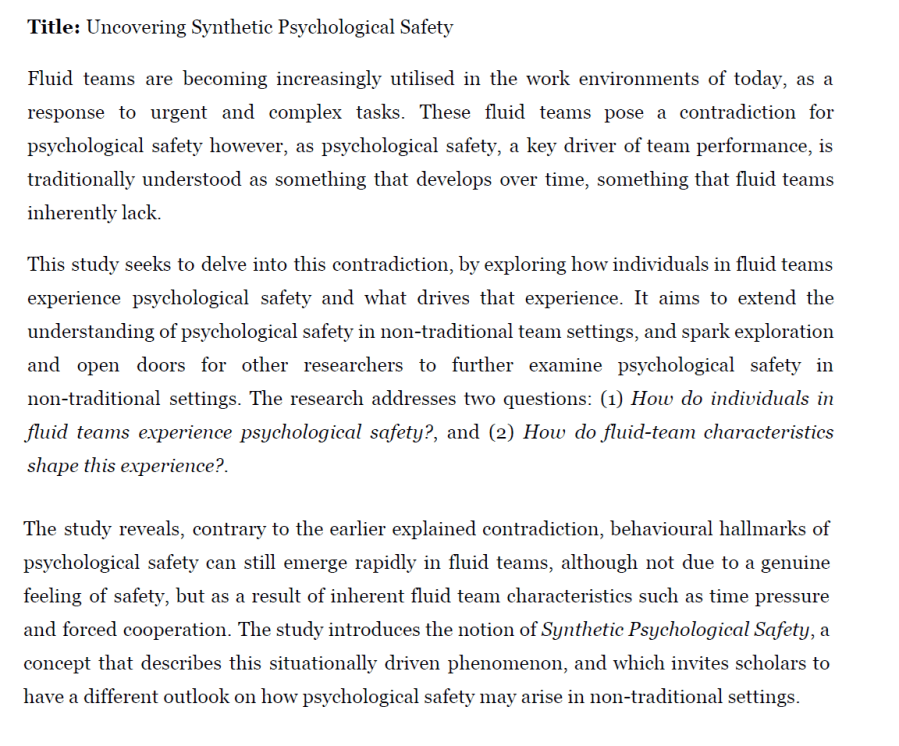
This is a “a state in which the outcomes of psychological safety … are present, but arise from the characteristics that constitute a fluid team rather than interpersonal depth … ‘assembled rather than grown”.
Extracts:
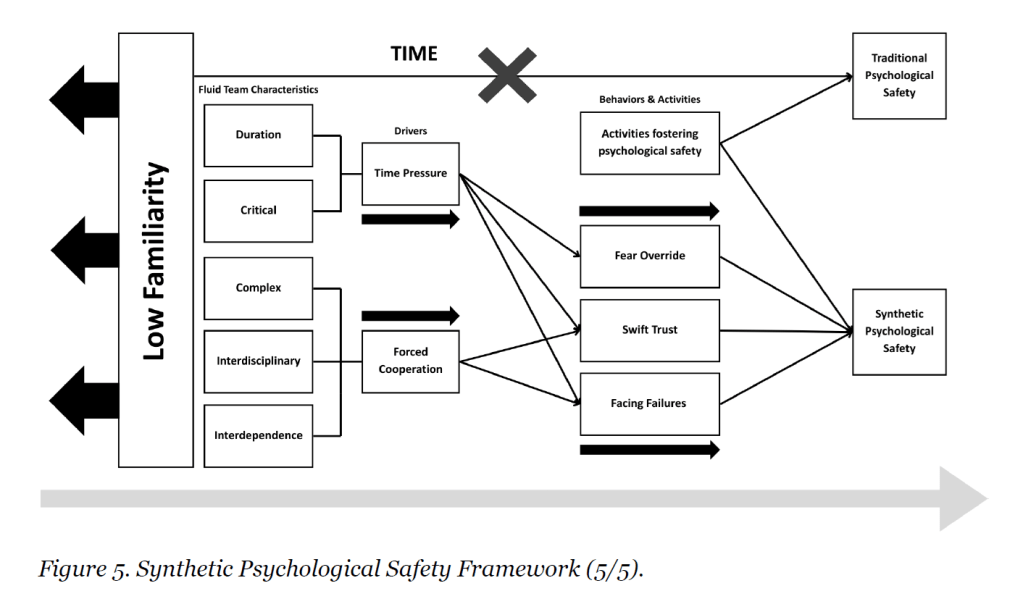
· “These [synthetic PS] behaviours do not stem from a feeling of safety, but instead are driven by time pressure and forced cooperation, inherent to the fluid team”
· “two drivers of psychological safety, time pressure and forced cooperation, … emerge from the fluid team characteristics, giving rise to behaviours safe for interpersonal risk‑taking”
· “Time pressure functions as an override that compels individuals to be open despite an unresolved sense of fear”
· “This swift trust … acts as a temporary or contextual replacement to traditional relationship‑based trust”
· The PS “is forced and chosen rather than organically grown; while the output is similar, what shapes this experience is vastly different”
· “The findings show that time pressure and forced cooperation can create a synthetic form of psychological safety; situational and pragmatic which unlocks similar collaborative behaviours that more traditional teams build through interpersonal relationships”
In other words, whereas in ‘traditional’ PS, teams build interpersonal trust through cohesive and genuine PS over time. In fluid teams with little time or other drivers, the high pressure context drives the need to cooperate – the practical necessity of interpersonal risk taking etc., rather than grown organically.
Ref: Lindqvist, M., Frammin Tillema, H., & Norr, A. (2025). Uncovering Synthetic Psychological Safety: An exploratory study on psychological safety in fluid teams.

Shout me a coffee (one-off or monthly recurring)
Thesis link: https://www.diva-portal.org/smash/get/diva2:1974802/FULLTEXT01.pdf

 SafetyInsights.org